Vitamin K2 After 40: What the Bone Evidence Says
Being over 40 or entering menopause doesn’t, by itself, establish a reason to take vitamin K2.
Age over 40 alone isn’t a proven reason to start vitamin K2, also called menaquinone. A three-year trial in healthy postmenopausal women found less decline in some bone measures with MK-7, but results varied by bone site. A broader review found a lumbar-spine signal, while a review focused on postmenopausal women concluded that the evidence wasn’t enough to recommend vitamin K supplements to prevent bone loss or fractures. 2 3 4
Age isn’t a supplement indication
Vitamin K helps the body make proteins involved in bone and tissue health. That role gives researchers a reason to study vitamin K2, but it doesn’t show that everyone over 40 needs a K2 supplement or that taking one prevents osteoporosis. 1 3
Menopause is relevant to bone health, but it isn’t the same as a demonstrated need for K2. The research in postmenopausal women offers some promising findings, yet it hasn’t established an age cutoff for supplementation or shown that K2 reliably prevents fractures. A bone-health diagnosis or a specific recommendation from your clinician is a more meaningful starting point than a birthday. 2 4
What postmenopausal research found
In a randomized trial, 244 healthy postmenopausal women received a placebo or MK-7 for three years. The MK-7 group had less decline in bone mineral measures at the lumbar spine and femoral neck, but not at the total hip. Some measures of bone strength also favored MK-7. That’s a result from one particular study and form of K2, not proof that every woman after menopause will benefit. 2
A 2024 systematic review and meta-analysis of vitamin K supplementation in middle-aged and older adults found a pooled increase in lumbar-spine bone mineral density. Its female subgroup showed a similar signal. The review also described inconsistent results across skeletal sites; it did not show that a change in bone density or a bone-related marker necessarily means fewer fractures. 3
That difference between a bone measure and a fracture outcome matters. A review focused on postmenopausal women concluded that the evidence was insufficient to recommend vitamin K supplements to prevent bone loss or fractures. So a claim that K2 is a proven way to prevent osteoporosis after 40 goes beyond what these findings establish. 4
Consider the reason, not just the age
If you’re looking at K2 because a product claims it’s essential after 40, the available findings don’t support that as a general rule. If you have a bone-health diagnosis or a clinician has raised a concern, ask how K2 relates to your specific situation and what outcome it’s meant to address. The research described above doesn’t establish K2 as a replacement for an individualized bone-health assessment or treatment for osteoporosis. 2 4
Food sources and supplement decisions are separate questions. Vitamin K is found in green vegetables, while K2 occurs in some animal and fermented foods. Those sources don’t, by themselves, establish that you need a K2 supplement; this research doesn’t identify a particular dietary pattern after 40 that calls for one. 1 3
One medication point deserves attention: if you take a blood thinner, be careful about changes in vitamin K intake. Check with the person managing that medication before changing your intake or starting a vitamin K product. 1
The practical takeaway: menopause can make bone health worth discussing, but age alone doesn’t settle whether K2 is worthwhile. The reason for considering it, and the outcome you hope to affect, matter more than the number of candles on your cake.
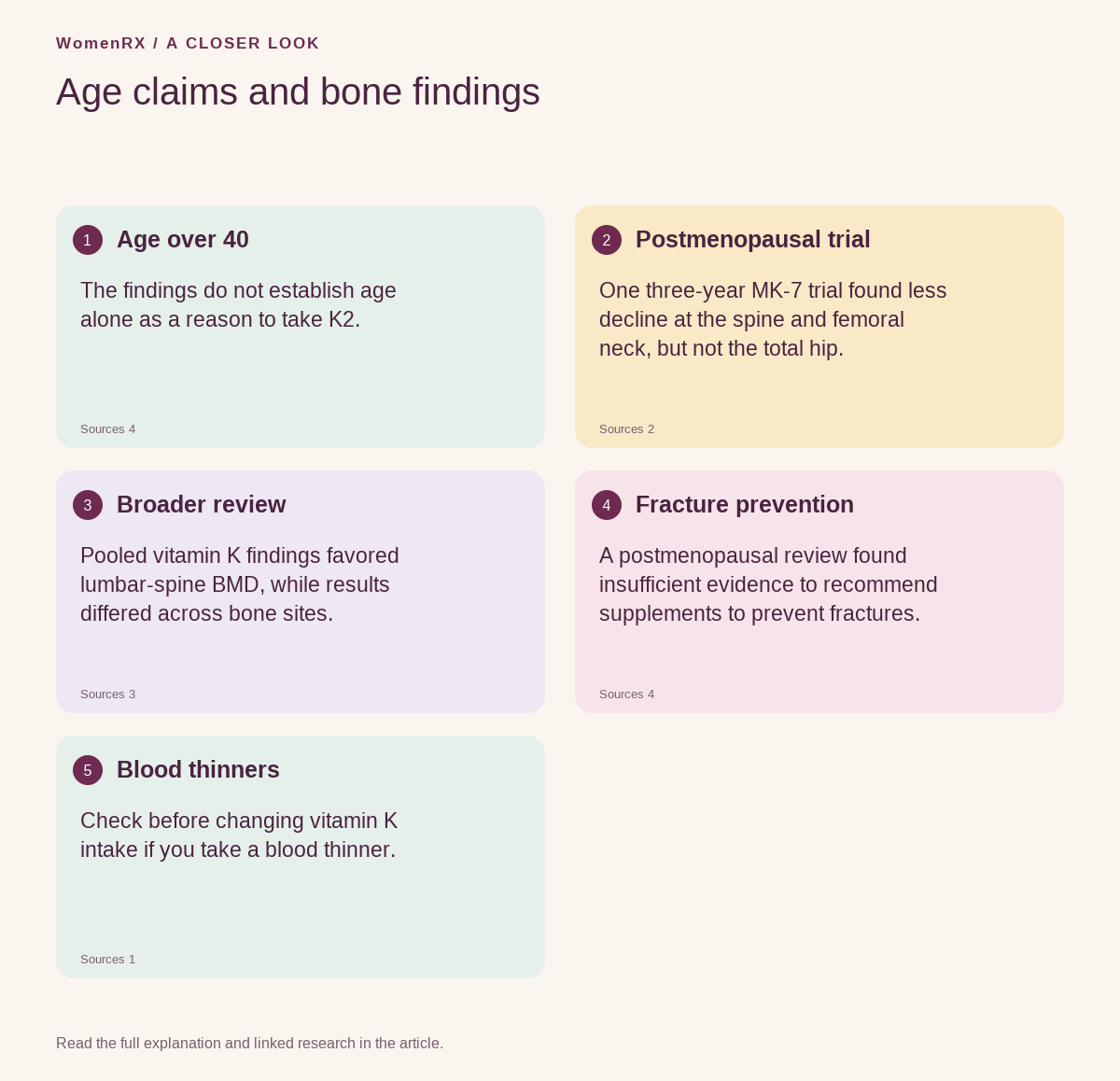
Age claims and bone findings
Age over 40: The findings do not establish age alone as a reason to take K2.4
Postmenopausal trial: One three-year MK-7 trial found less decline at the spine and femoral neck, but not the total hip.2
Broader review: Pooled vitamin K findings favored lumbar-spine BMD, while results differed across bone sites.3
Fracture prevention: A postmenopausal review found insufficient evidence to recommend supplements to prevent fractures.4
Blood thinners: Check before changing vitamin K intake if you take a blood thinner.1
Read the figure as text
Compare the age-based claim with what postmenopausal and broader adult research actually measured.- Age over 40: The findings do not establish age alone as a reason to take K2.4
- Postmenopausal trial: One three-year MK-7 trial found less decline at the spine and femoral neck, but not the total hip.2
- Broader review: Pooled vitamin K findings favored lumbar-spine BMD, while results differed across bone sites.3
- Fracture prevention: A postmenopausal review found insufficient evidence to recommend supplements to prevent fractures.4
- Blood thinners: Check before changing vitamin K intake if you take a blood thinner.1
More questions, answered
Is MK-7 the same as vitamin K2?
MK-7 is one form of vitamin K2, or menaquinone. The postmenopausal trial discussed above tested MK-7 specifically, so its findings shouldn’t automatically be treated as proof about every type of K2. 2 3
Can vitamin K2 replace osteoporosis treatment?
The findings don’t establish K2 as an osteoporosis treatment or a substitute for care based on an individual bone-health assessment. A review focused on postmenopausal women found insufficient evidence to recommend vitamin K supplements to prevent bone loss or fractures. 4
Sources you can check
- Vitamin K: MedlinePlusAccessed 2026-09-25Return to first citation
- Three-year low-dose menaquinone-7 supplementation helps decrease bone loss in healthy postmenopausal women.Knapen MH, Drummen NE, Smit E, Vermeer C, Theuwissen E. · Osteoporosis international : a journal established as result of cooperation between the European Foundation for Osteoporosis and the National Osteoporosis Foundation of the USA · 2013Return to first citation
- Effects of vitamin K supplementation on bone mineral density at different sites and bone metabolism in the middle-aged and elderly population.Xie C, Gong J, Zheng C, Zhang J, Gao J, Tian C, Guo X, Dai S, Gao T. · Bone & joint research · 2024Return to first citation
- Vitamin K and musculoskeletal health in postmenopausal women.Hamidi MS, Cheung AM. · Molecular nutrition & food research · 2014Return to first citation