Vitamin K2: What Outcomes Have Supplements Been Shown to Change?
K2 can change a bone marker without changing bone density, and evidence for fewer fractures comes from a narrower set of studies.
Vitamin K2 has changed undercarboxylated osteocalcin, a blood marker related to vitamin K activity, in postmenopausal trials. Changes in bone density are inconsistent. A pooled analysis of older MK-4 trials reported fewer fractures, but the evidence came largely from Japanese postmenopausal studies and doesn’t establish that every K2 form or supplement prevents fractures. Studies discussed below do not demonstrate heart-health benefits from K2 supplements. 1 2 3
What “working” can mean
Vitamin K helps activate osteocalcin, a protein involved in bone. That gives researchers a measurable blood marker: undercarboxylated osteocalcin (ucOC). A lower ucOC level can show that vitamin K is affecting this pathway. It isn’t the same as having denser bones or being less likely to break one. 1
That distinction matters if you’re considering K2 for bone or heart health. A supplement can change a marker without changing a patient-important outcome. In the studies summarized here, results also depend on which form of K2 was studied and what researchers measured.
Bone markers: a change was seen
In a randomized trial of 334 healthy Norwegian women who were 1 to 5 years past menopause, MK-7 was compared with placebo for 12 months. The MK-7 group had lower ucOC and higher carboxylated osteocalcin, but the groups did not differ in bone loss at the hip or other measured sites. So, in this study, a marker changed while bone mineral density (BMD) did not. 2
A smaller randomized study followed 48 postmenopausal women taking alendronate, with or without MK-4, for a year. Among the 44 women who completed treatment, adding MK-4 led to a larger decrease in ucOC and a greater increase in femoral-neck BMD. This was a small study of K2 added to a prescription osteoporosis medicine, not evidence that K2 alone prevents fractures. The reported outcomes were a blood marker and BMD. 3
Bone density and strength: mixed findings
BMD is closer to a bone-health outcome than a blood marker, but it still isn’t a fracture. In the 12-month MK-7 trial, BMD didn’t differ between groups. An NIH Office of Dietary Supplements summary also describes a 12-month trial in 381 postmenopausal women in which neither MK-4 nor vitamin K1 improved measured BMD compared with placebo, although both lowered ucOC. 1 2
The same NIH summary reports a separate three-year study in postmenopausal women in which MK-7 improved bone strength and reduced loss of vertebral height in the lower thoracic spine. Those findings are not the same as showing fewer fractures. Together, the studies don’t support a simple promise that K2 reliably increases BMD. 1
Fractures: a signal from older MK-4 trials
Fracture outcomes are the most directly meaningful bone result, but the evidence is concentrated in MK-4 studies. A systematic review summarized by the NIH included 13 trials, most conducted in Japan and involving postmenopausal women; the trials lasted 6 to 36 months. Seven reported fracture data, and all used MK-4. A pooled analysis found significantly lower rates of hip, vertebral, and all nonvertebral fractures. 1
That result deserves attention, but it doesn’t settle whether K2 supplements prevent fractures in women generally. It comes from a particular set of older trials using MK-4, not from the MK-7 trial described above. The available findings don’t show that all K2 forms are interchangeable or that results apply to younger women or other populations. BMD results from later studies have also been mixed. 1 2
Heart health: don’t confuse association with treatment
Vitamin K-dependent proteins are involved in processes related to blood vessels, but that mechanism doesn’t prove a supplement prevents heart disease. The NIH summary describes observational studies linking dietary menaquinone intake with less vascular calcification or lower coronary heart disease mortality. Observational associations can’t establish that taking K2 caused those outcomes. 1
The supplement trial in that summary measured coronary artery calcification over three years, but it used vitamin K1, not K2. It found no significant difference between treatment and control groups overall. That result doesn’t demonstrate a heart benefit from K2. 1
A practical way to read the claims
When you see a K2 claim, check the form (MK-4 or MK-7), the comparison group, and the outcome. A change in ucOC is evidence of a biological effect. A BMD or bone-strength result is a different kind of finding. A fracture result is more directly relevant to whether people broke fewer bones. For heart claims, ask whether a study tested a K2 supplement and measured a clinical outcome, rather than dietary intake or a vessel marker.
If you take warfarin, don’t start, stop, or substantially change vitamin K supplements without discussing it with the clinician managing your medication. Changes in vitamin K intake can affect warfarin’s anticoagulant effect. 1
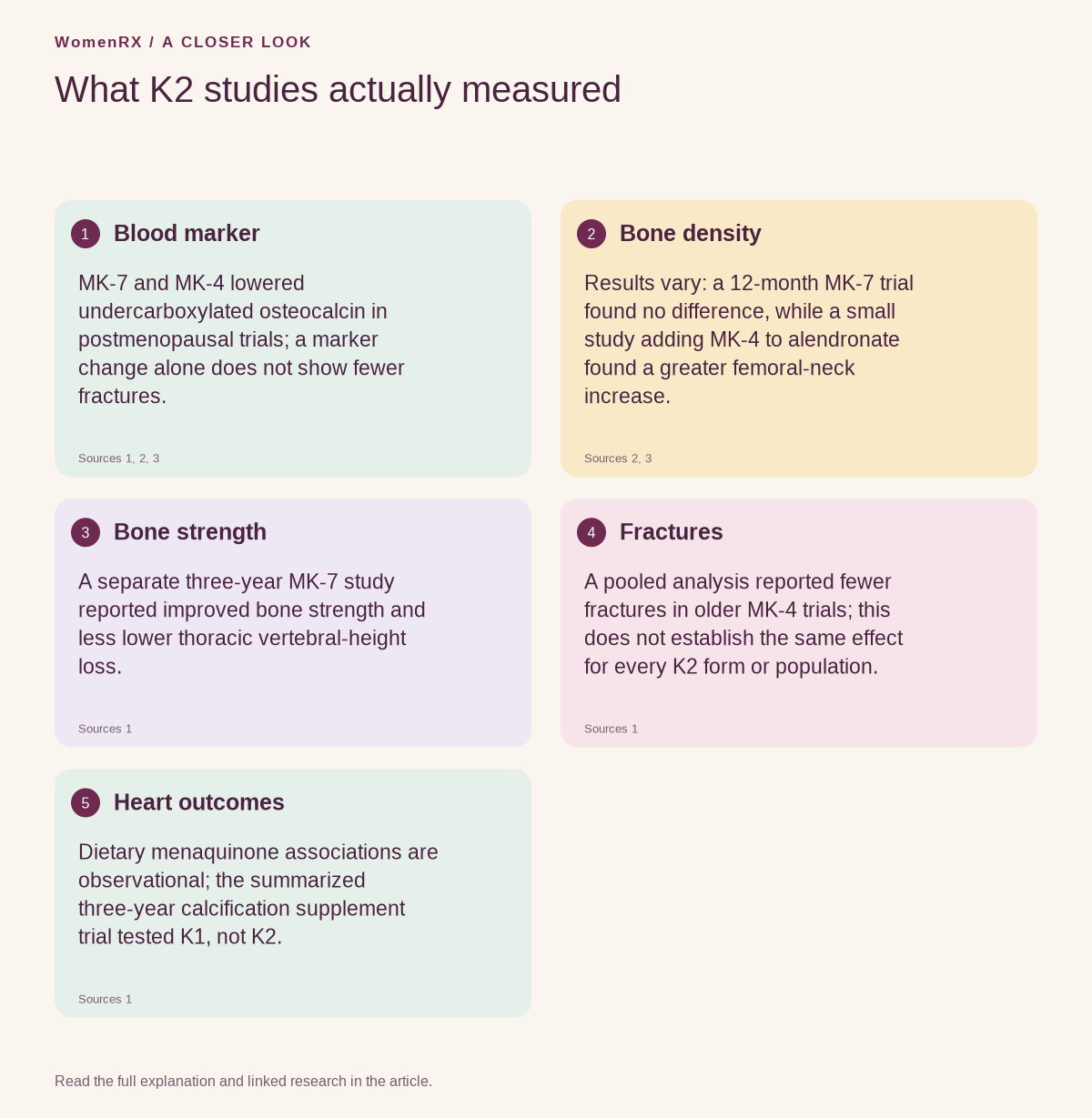
What K2 studies actually measured
Blood marker: MK-7 and MK-4 lowered undercarboxylated osteocalcin in postmenopausal trials; a marker change alone does not show fewer fractures.123
Bone density: Results vary: a 12-month MK-7 trial found no difference, while a small study adding MK-4 to alendronate found a greater femoral-neck increase.23
Bone strength: A separate three-year MK-7 study reported improved bone strength and less lower thoracic vertebral-height loss.1
Fractures: A pooled analysis reported fewer fractures in older MK-4 trials; this does not establish the same effect for every K2 form or population.1
Heart outcomes: Dietary menaquinone associations are observational; the summarized three-year calcification supplement trial tested K1, not K2.1
Read the figure as text
These outcome types answer different questions. A biological marker is not interchangeable with bone density, fractures, or heart events.- Blood marker: MK-7 and MK-4 lowered undercarboxylated osteocalcin in postmenopausal trials; a marker change alone does not show fewer fractures.123
- Bone density: Results vary: a 12-month MK-7 trial found no difference, while a small study adding MK-4 to alendronate found a greater femoral-neck increase.23
- Bone strength: A separate three-year MK-7 study reported improved bone strength and less lower thoracic vertebral-height loss.1
- Fractures: A pooled analysis reported fewer fractures in older MK-4 trials; this does not establish the same effect for every K2 form or population.1
- Heart outcomes: Dietary menaquinone associations are observational; the summarized three-year calcification supplement trial tested K1, not K2.1
More questions, answered
How long does vitamin K2 take to work?
There isn’t one established timeline. In a postmenopausal MK-7 trial, osteocalcin markers changed over 12 months, but bone loss rates did not differ from placebo. A separate study summarized by NIH reported bone-strength and vertebral-height findings after three years. These study endpoints don’t tell you when you’ll feel a change. 1 2
Does a lower osteocalcin marker mean my bones are stronger?
Not by itself. In the 12-month trial of early postmenopausal women, MK-7 changed osteocalcin markers without changing BMD. A marker shows an effect on a biological process; it doesn’t establish stronger bones or fewer fractures. 2
Sources you can check
- Vitamin K - Health Professional Fact SheetAccessed 2026-09-25Return to first citation
- Vitamin K2 supplementation does not influence bone loss in early menopausal women: a randomised double-blind placebo-controlled trial.Emaus N, Gjesdal CG, Almås B, Christensen M, Grimsgaard AS, Berntsen GK, Salomonsen L, Fønnebø V. · Osteoporosis international : a journal established as result of cooperation between the European Foundation for Osteoporosis and the National Osteoporosis Foundation of the USA · 2010Return to first citation
- Response of serum carboxylated and undercarboxylated osteocalcin to alendronate monotherapy and combined therapy with vitamin K2 in postmenopausal women.Hirao M, Hashimoto J, Ando W, Ono T, Yoshikawa H. · Journal of bone and mineral metabolism · 2008Return to first citation