How to Start Strength Training and Build From There
Two manageable full-body sessions can give you a starting point, with room to adjust as your strength and circumstances change.
Start with two full-body sessions a week, using movements you can control with body weight or simple equipment. The American College of Sports Medicine recommends training two to three days a week for beginners and uses an 8-to-12-repetition range as a starting guide. Keep a brief record, then make one small change when the work becomes manageable. Pregnancy and postpartum recovery call for a more individual starting point.48
You don't need a complicated split routine to begin strength training. A repeatable full-body session gives you a way to learn the movements and notice what changes. The training recommendations below come from guidance for healthy adults, not a women-only beginner trial; your starting point can be lighter or simpler than someone else's.4
Build one session you can repeat
The American College of Sports Medicine (ACSM) recommends resistance training two to three days a week for people new to it. Its beginner loading guidance uses an 8-to-12-repetition maximum, meaning a resistance that limits how many repetitions you could complete. You don't need to test a maximum on your first day. Use the range as a guide while you learn which version of each movement you can do with control.4
Here's an illustrative full-body session, not a required set of exercises. Choose one option from each line:
- Sit and stand: Rise from a sturdy chair, or try a squat if that feels manageable.
- Push: Push against a wall, or use a counter for a more demanding incline push-up.
- Pull: Row a resistance band or a manageable dumbbell.
- Hip movement: Practice a hip hinge with no weight, or hold a weight as you hinge.
- Optional carry: Carry a manageable object at your side if you have space to walk comfortably.
For a first try, you might do one round of the movements you chose, aiming for roughly 8 to 12 controlled repetitions of each. For a carry, use a comfortable short walk instead of counting repetitions. One round is an example that keeps the session simple, not a claim that it's the ideal training volume. ACSM's guidance supports using both multi-joint and single-joint exercises; it doesn't require this particular menu.4
A possible week is a session on Monday and another on Thursday. The days are just an example: the useful part is having a schedule you can repeat and time between sessions to notice how you feel. If you only have a chair and a wall, you can still begin with the sit-to-stand and wall push-up, then add a pulling option when you have a band or weight. You don't have to make every movement harder at once.
Progress when the work earns it
Write down the exercise version, resistance if any, and repetitions you completed. For example, “chair sit-to-stand, 10 controlled reps” tells you more next time than “leg workout.” If a movement feels hard to control, choose an easier version or less resistance rather than chasing the number.
ACSM suggests increasing resistance when you can complete one or two repetitions beyond your target at the current workload; its suggested increase is 2% to 10%. That's a progression guideline, not a demand to add weight every session.4 With limited equipment, your next small change might be a few more controlled repetitions within your target range before you switch from a wall push-up to a counter push-up. Change one thing, then see how that version goes before changing another.
Recovery belongs in that decision. If you're not ready to repeat a movement at your usual level, an easier version, a lighter session, or more time before trying it again may make more sense than forcing a progression. ACSM says training recommendations should account for a person's goals, physical capacity, and training status.4 A record is useful partly because it shows when today's capacity differs from last week's.
Know the difference between adjusting and stopping
An exercise can feel demanding without being a reason to push through pain. Pain is a signal that something may be wrong, so stop a movement that causes new or sharp pain rather than treating it as a repetition target. If pain persists or returns, get help assessing its cause before repeating the movement.3
Stop the session if you feel dizzy; sit or lie down until it passes, and don't keep handling weights while dizzy. Dizziness that persists, keeps returning, or comes with fainting or weakness needs medical assessment.2 Severe difficulty breathing or a heavy, tight chest calls for emergency help, not a lighter exercise variation.1
Adjust the starting point to your life stage
During pregnancy: Don't assume that a general beginner loading rule is a prenatal plan. Pregnancy activity guidance supports gradually building activity when there are no contraindications, while recognizing that fatigue or discomfort may call for doing less and returning when you're able. Previously active women may also need to modify activity as pregnancy progresses.8 For the sample session, that could mean choosing the wall push-up over a harder version or shortening the session on a difficult day. A review of prenatal resistance-training studies found that sets, repetitions, intensity, and external load were inconsistently reported, so research doesn't establish one precise strength progression for every pregnant beginner.5 These pregnancy recommendations apply in the absence of contraindications, so the example session is not a plan for someone with activity restrictions.8
Postpartum: Treat returning after birth as a new starting-point decision, not an automatic return to your pregnancy routine or an instruction to resume your old weights. A survey of competitive athletes found that their training during pregnancy did not predict their pre- or postpartum training efforts, but it cannot tell an individual when she's ready to lift.7 If a movement brings on pelvic, abdominal, or other pain, stop that movement and seek an assessment rather than trying to progress through it.3 This evidence doesn't support a universal postpartum lifting timetable.
In perimenopause or after menopause: You can use the same manageable-session framework rather than assuming you need a separate set of exercises. Strength and resistance activity are among the approaches recommended for supporting bone health during and after menopause.6 Start with the version you can do now, and let your record guide the next change, especially if sleep or other symptoms make one session feel different from another.
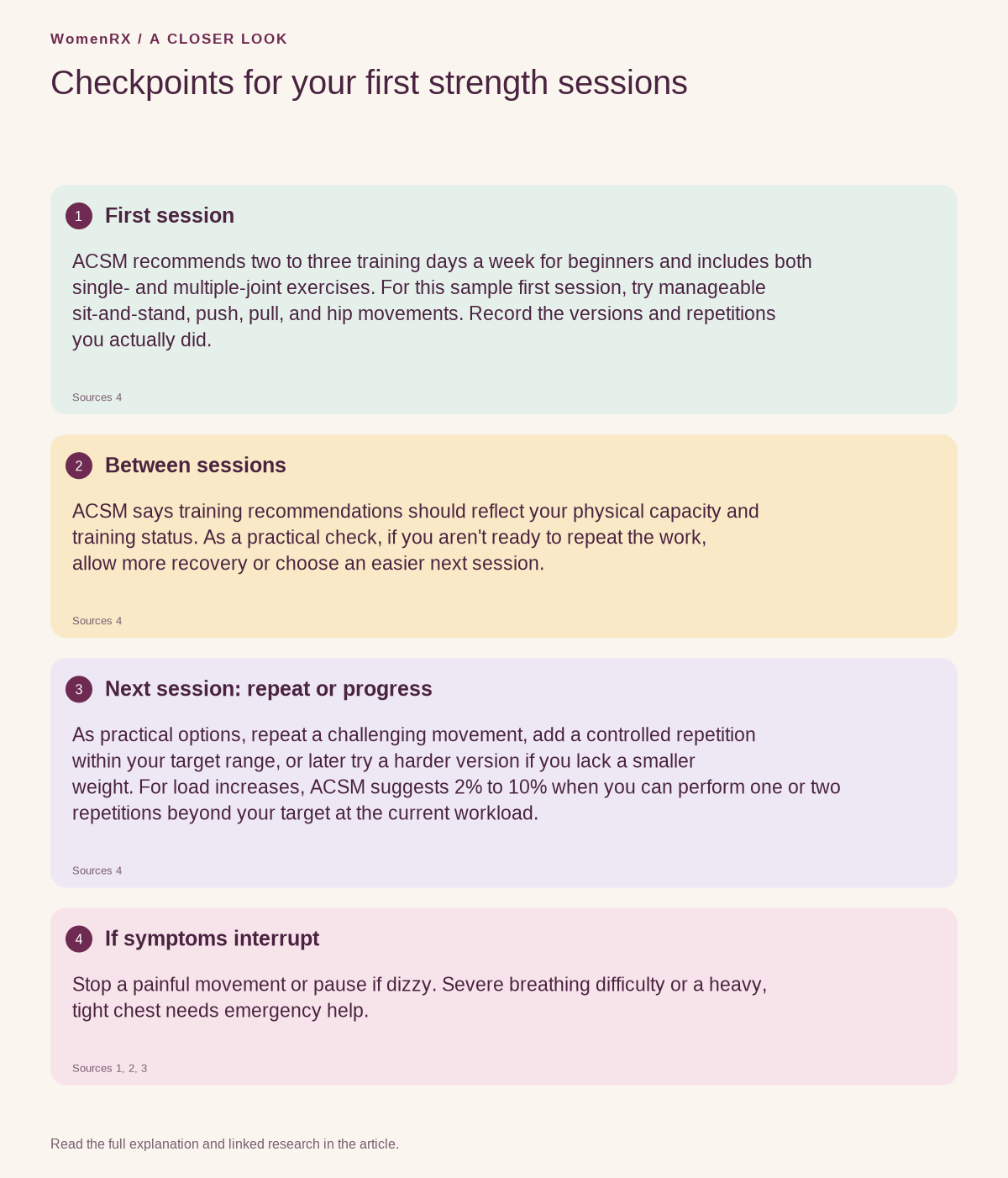
Checkpoints for your first strength sessions
First session: ACSM recommends two to three training days a week for beginners and includes both single- and multiple-joint exercises. For this sample first session, try manageable sit-and-stand, push, pull, and hip movements. Record the versions and repetitions you actually did.4
Between sessions: ACSM says training recommendations should reflect your physical capacity and training status. As a practical check, if you aren't ready to repeat the work, allow more recovery or choose an easier next session.4
Next session: repeat or progress: As practical options, repeat a challenging movement, add a controlled repetition within your target range, or later try a harder version if you lack a smaller weight. For load increases, ACSM suggests 2% to 10% when you can perform one or two repetitions beyond your target at the current workload.4
If symptoms interrupt: Stop a painful movement or pause if dizzy. Severe breathing difficulty or a heavy, tight chest needs emergency help.123
Read the figure as text
Use these checkpoints in sequence without treating them as a fixed-week progression schedule.- First session: ACSM recommends two to three training days a week for beginners and includes both single- and multiple-joint exercises. For this sample first session, try manageable sit-and-stand, push, pull, and hip movements. Record the versions and repetitions you actually did.4
- Between sessions: ACSM says training recommendations should reflect your physical capacity and training status. As a practical check, if you aren't ready to repeat the work, allow more recovery or choose an easier next session.4
- Next session: repeat or progress: As practical options, repeat a challenging movement, add a controlled repetition within your target range, or later try a harder version if you lack a smaller weight. For load increases, ACSM suggests 2% to 10% when you can perform one or two repetitions beyond your target at the current workload.4
- If symptoms interrupt: Stop a painful movement or pause if dizzy. Severe breathing difficulty or a heavy, tight chest needs emergency help.123
More questions, answered
Do I need dumbbells before I start?
No. A chair sit-to-stand and wall push-up let you practice two movement patterns without weights. A band or manageable weight gives you a pulling option. As those choices become manageable, you can change the exercise version or resistance gradually; the sample exercises are options, not a tested beginner program.4
Sources you can check
- Shortness of breath - NHSAccessed 2026-09-25Return to first citation
- Dizziness - NHSAccessed 2026-09-25Return to first citation
- Pain | MedlinePlusAccessed 2026-09-25Return to first citation
- American College of Sports Medicine position stand. Progression models in resistance training for healthy adults.American College of Sports Medicine. · Medicine and science in sports and exercise · 2009Return to first citation
- The missing pieces: A systematic review of the reporting of resistance training variables in studies of pregnant women.Geard A, Doering TM, Carron MA, Hayman M. · Journal of science and medicine in sport · 2026Return to first citation
- Things you can do to help menopause and perimenopause symptoms - NHSAccessed 2026-09-25Return to first citation
- Training patterns of athletes during pregnancy and postpartum.Beilock SL, Feltz DL, Pivarnik JM. · Research quarterly for exercise and sport · 2001Return to first citation
- No. 367-2019 Canadian Guideline for Physical Activity throughout Pregnancy.Mottola MF, Davenport MH, Ruchat SM, Davies GA, Poitras V, Gray C, Jaramillo Garcia A, Barrowman N, Adamo KB, Duggan M, Barakat R, Chilibeck P, Fleming K, Forte M, Korolnek J, Nagp... · Journal of obstetrics and gynaecology Canada : JOGC = Journal d'obstetrique et gynecologie du Canada : JOGC · 2018Return to first citation