How to Start Lifting Weights in Midlife
A simple first month can help you learn movements, find manageable weights, and decide when you’re ready for more.
Start with two lifting days a week, using a few movements for your legs and upper body. For a first-month example, try one set of 6 to 10 controlled repetitions per movement, with a load that feels like you could do a few more. Keep the load or make the movement easier if your technique slips. The weekly frequency comes from general adult guidance; the set and repetition example is a starting option, not a tested beginner prescription. 2 3
Start with movements, not a perfect program
A useful first goal is simply to learn a few ways to push, pull, bend, and stand up against resistance. You might use gym machines, dumbbells, resistance bands, or objects at home. For example, a gym version could include a leg press, chest press, and row. At home, you might try a sit-to-stand from a sturdy chair, a wall push-up, and a band row. These are examples, not a required exercise list. Pick options you can set up safely and repeat with control.
Federal guidance for adults calls for muscle-strengthening activity that works all major muscle groups at least two days a week. That’s a general adult recommendation, not a menopause-specific training rule. You can build toward it; the guideline doesn’t require your first workout to look like a full program. 2
A first-month framework
Think of the first month as a sequence of decisions, not a test of how much you can lift. The weeks below are flexible milestones, not a schedule tested in a clinical trial. As a practical starting example, set aside two days each week. Pick a small group of movements for different parts of your body and try one set of 6 to 10 repetitions of each. You can add movements as you learn them so your routine eventually covers all major muscle groups. Those set and repetition numbers are an illustrative way to keep the first sessions manageable, not a research-established dose for beginners. The two-day goal comes from general adult guidance. 2
Week 1: make setup easy
Choose a small set of movements that cover different parts of your body. Learn how to position yourself, move through a comfortable range, and put the equipment away. A machine or a stable chair can make setup less complicated; at home, a resistance band or light household object may be enough to practice a movement. If you’re unsure how to use a machine or hold a weight, ask a qualified trainer to demonstrate it.
Week 2: find a controllable load
Begin with resistance that lets you move steadily and keep your form consistent. For your chosen repetitions, a useful starting cue is to finish feeling that you could do a few more the same way. It’s a practical way to avoid making every set a struggle, not an effort target established by the women’s trial. You don’t need to test your maximum or copy someone else’s weights. If you can’t finish the repetitions without losing control or shortening the movement, use less weight or choose an easier version.
That adjustment reflects how training was managed in a randomized trial of 108 women aged 40-77. Participants trained under supervision, and staff reduced loads when they couldn’t complete the target repetitions with proper technique and range of motion. The trial used a structured program and lasted 12 weeks, so it supports the adjustment principle, not this first-month example or a self-directed effort target. 3
Week 3: decide whether to change anything
Keep the same load while you’re still learning the movement. If you reach the top of your chosen repetition range in two sessions, keep the same range of motion and technique, and still feel you could do a few more, you could try the next small weight available. That two-session check is a practical decision rule, not one tested in the trial. If the new weight makes the movement sloppy, return to the previous one. Progress isn’t a requirement every session.
In the women’s trial, loads were increased when participants completed the planned work with correct technique. This is a useful principle for deciding whether to try more, although the study’s supervised training plan should not be treated as a do-it-yourself template. 3
Week 4: keep what fits
Review which movements you can set up consistently, which feel comfortable, and which are hard to fit into your week. Keep the workable options and adjust the rest. If you have access to coaching, ask for help with the specific movement or equipment that feels uncertain rather than assuming you need a complete overhaul. If you’re still practicing at your starting load, that’s a workable place to continue.
Home or gym? Choose the setting you’ll repeat
A gym offers machines and a range of weights, and a trainer can show you how to adjust equipment. Home training avoids travel and can start with simple options such as body-weight movements or bands. Neither setting is inherently the right choice for midlife. The better starting point is the one that lets you practice regularly and use equipment with confidence.
A supervised study in women aged 40-77 used machines, cables, and dumbbells. It shows that resistance training has been studied directly in women across this age range, but it doesn’t establish that the same program, frequency, or equipment is best for every woman. The study did not report a menopause-specific result in the reported findings. 3
What midlife changes, and what it doesn’t
Lifting can help increase or maintain muscle mass and strength, but it doesn’t promise to prevent every age-related change. 1 The practical takeaway is that you don’t need to wait for a gym membership or a perfect plan to begin. The guidance cited here gives a general adult goal rather than a separate rule for age 40; the trial in women doesn’t establish a separate beginner routine based on menopause status. 2 3
If you have a health condition, an injury, or a movement that feels difficult to do safely, individualized instruction can help you adapt the exercise rather than guess at a workaround. A qualified trainer can assist with technique and equipment; a physical therapist can help when pain or function is part of the problem.
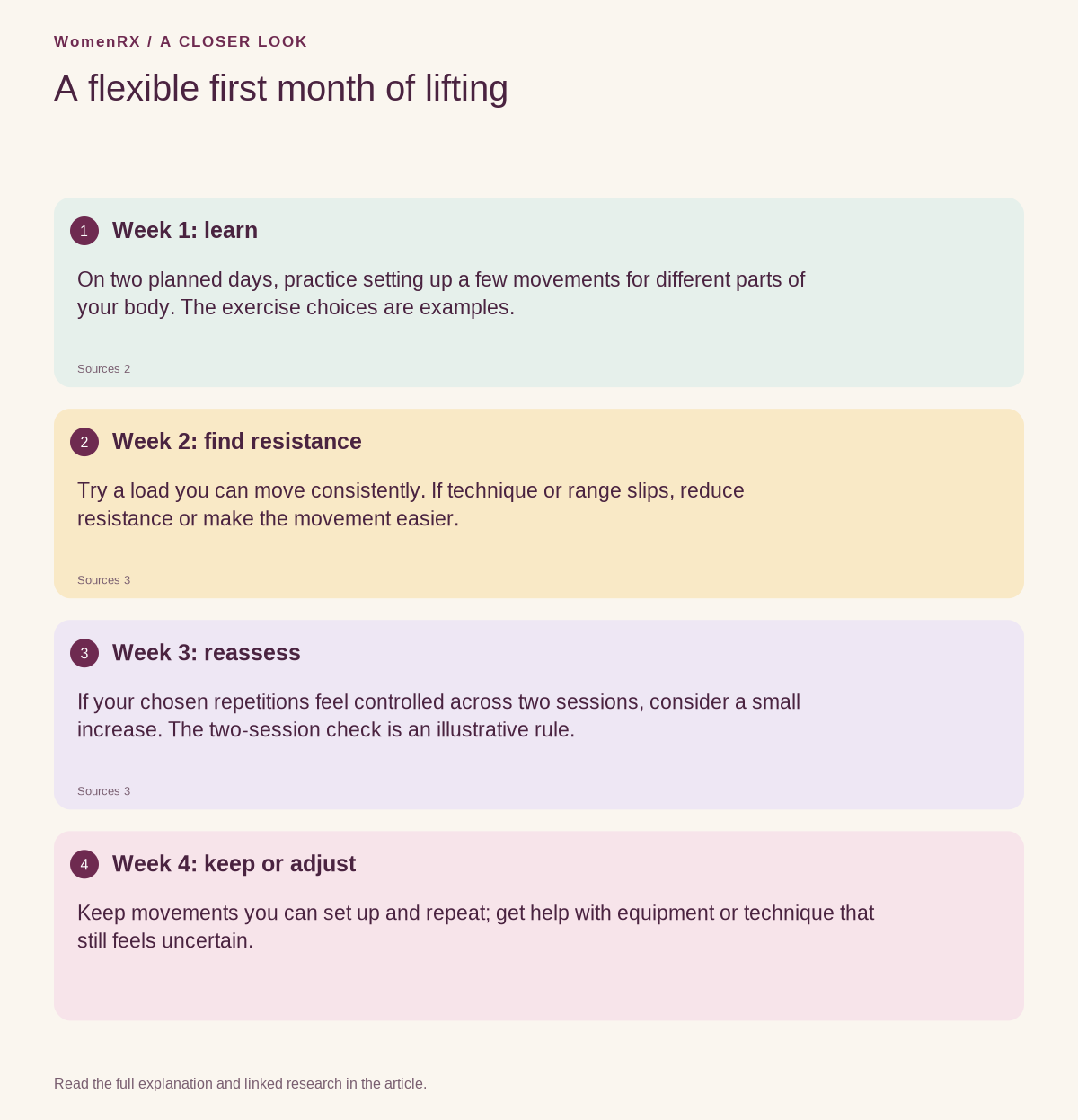
A flexible first month of lifting
Week 1: learn: On two planned days, practice setting up a few movements for different parts of your body. The exercise choices are examples.2
Week 2: find resistance: Try a load you can move consistently. If technique or range slips, reduce resistance or make the movement easier.3
Week 3: reassess: If your chosen repetitions feel controlled across two sessions, consider a small increase. The two-session check is an illustrative rule.3
Week 4: keep or adjust: Keep movements you can set up and repeat; get help with equipment or technique that still feels uncertain.
Read the figure as text
These week markers organize a starting example, not a four-week program tested in a trial. Repeat a stage if you need more practice.- Week 1: learn: On two planned days, practice setting up a few movements for different parts of your body. The exercise choices are examples.2
- Week 2: find resistance: Try a load you can move consistently. If technique or range slips, reduce resistance or make the movement easier.3
- Week 3: reassess: If your chosen repetitions feel controlled across two sessions, consider a small increase. The two-session check is an illustrative rule.3
- Week 4: keep or adjust: Keep movements you can set up and repeat; get help with equipment or technique that still feels uncertain.
More questions, answered
Do I need a different lifting plan after menopause?
The guidance cited here is general adult guidance, and the women’s trial included participants aged 40-77 but did not report a menopause-specific result. It doesn’t establish a separate routine for postmenopause. 2 3
Should I start by testing how much weight I can lift?
A maximum test isn’t needed for this first-month approach. Start with a load you can control for your chosen repetitions. If you can’t finish them with the same technique and range of motion, use less resistance or an easier version. That load-adjustment principle was used in a supervised trial; the first-month example here wasn’t tested by that study. 3
Sources you can check
- Benefits of Exercise: MedlinePlusAccessed 2026-09-25Return to first citation
- Exploring the Role of Resistance Training in the Prevention and Management of Chronic Conditions: A Narrative Review.Räisänen AM. · Clinics and practice · 2026Return to first citation
- Resistance versus concurrent training with three assigned protein targets in middle-aged and older women: a randomized 2 × 3 factorial trial.Bagheri R, Ghobadi H, Mansordehghan M, M Camera D, Kargarfard M. · Journal of the International Society of Sports Nutrition · 2026Return to first citation