Resistance Bands or Weights: Choose What You’ll Use
Both bands and free weights can build strength; the better fit depends on your exercises, setup, and how you’ll increase resistance over time.
You don’t need to choose one universal winner. In small trials, adults using elastic resistance and free weights both improved strength measures, but the studies were short and tested specific movements, not complete home programs. Choose based on the exercises you want to do, your space and budget, and whether you can increase resistance as you get stronger. A mix can work, too. 12
Start with the training you’ll actually do
If you have room for weights and enjoy exercises such as squats, free weights may suit your setup. If storage or carrying equipment is the main obstacle, bands take up little space and are easy to pack away. These are practical tradeoffs, not evidence that one format produces better results for women.
The direct comparison evidence is limited but useful. In an eight-week randomized study of older adults of both sexes, the groups using free weights and elastic resistance both increased their 10-repetition-maximum training loads for knee extension and flexion. There were no significant differences between groups in the measured strength or functional performance outcomes. The final evaluation included 29 people. The reported findings don’t establish a menopause-specific choice. 1
A separate 10-week study enrolled 32 women and compared free-weight squats with squats using free weights plus elastic bands. Both groups improved their free-weight squat performance. Strength and jumping outcomes improved in both, although the free-weight-only group’s results were more consistent across the tested angles. Because the band group also used free weights, this study doesn’t show that bands alone perform the same as weights. 2
Compare setup, exercises, and progression
Setup and space: Bands are compact and don’t need a weight rack. Some band exercises require a secure anchor or room to position the band, so consider whether your intended setup works at home. Free weights need somewhere to store them and enough space to move through the exercises you want to do.
Exercise fit: Think about the movements you want to train, not just the equipment itself. For example, the direct comparisons here tested knee flexion and extension or squats, not every possible exercise. A band may be convenient for one movement while a dumbbell or barbell feels more straightforward for another. Try to choose equipment that lets you perform the movements you value with control.
Budget and progression: There’s no single price comparison that applies to every setup. Before buying, consider the total equipment you’d need for your preferred exercises and how you’d make those exercises more challenging later. With weights, that may mean adding heavier weights; with bands, it may mean having access to bands with different resistance. Either choice can involve buying more equipment as your needs change. The practical question is whether your budget can accommodate a way to progress, not which category is always cheaper.
For either option, progression matters more than the label on the equipment. The older-adult trial measured changes in 10-repetition-maximum loads, while the women’s squat study assessed changes in squat performance after training. Together, these findings support choosing a setup that lets you keep challenging the movement as your capacity changes. They don’t establish a single best way to progress for every exercise or person. 12
What changes when you use bands
Bands don’t feel exactly like a dumbbell or barbell. In a study of trained women doing squats with free weights, adding bands changed how resistance varied through parts of the movement. That’s a reminder that combining equipment changes the exercise’s loading pattern, not proof that the added bands improve results. 3
Choose equipment you can store, use and progress with
Choose bands first if storage or portability is your biggest barrier, and you can set them up for the movements you want to train. Before settling on bands, check that you have a way to make those exercises more challenging over time.
Choose free weights first if you prefer weight-based exercises, have a workable place to use and store them, or want to focus on lifts like the squats tested in the women’s study. That trial’s findings apply to its squat program, not every free-weight exercise. 2
Use a mix if each tool works well for different exercises or makes your routine easier to maintain. The research on women’s mixed equipment tested bands added to free-weight squats; it doesn’t establish that a mixed routine is better than either tool alone. 2
The direct comparisons are short and exercise-specific. Their reported findings don’t establish that bands or weights are categorically better for women at a particular age or life stage. Use your space, budget, preferred movements, and options for progression to make the choice that fits your training.
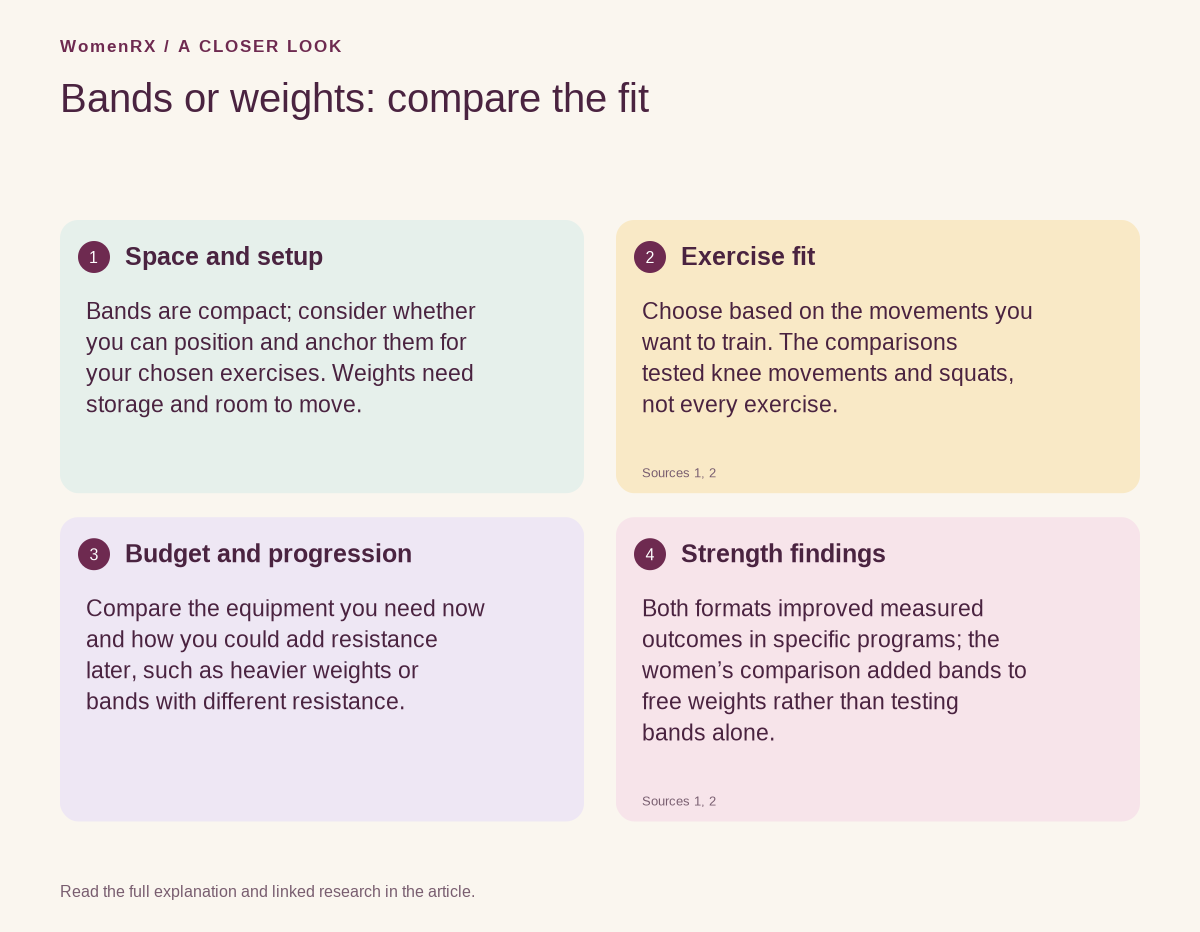
Bands or weights: compare the fit
Space and setup: Bands are compact; consider whether you can position and anchor them for your chosen exercises. Weights need storage and room to move.
Exercise fit: Choose based on the movements you want to train. The comparisons tested knee movements and squats, not every exercise.12
Budget and progression: Compare the equipment you need now and how you could add resistance later, such as heavier weights or bands with different resistance.
Strength findings: Both formats improved measured outcomes in specific programs; the women’s comparison added bands to free weights rather than testing bands alone.12
Read the figure as text
Compare common practical tradeoffs, then see what the direct strength comparisons do and don’t establish.- Space and setup: Bands are compact; consider whether you can position and anchor them for your chosen exercises. Weights need storage and room to move.
- Exercise fit: Choose based on the movements you want to train. The comparisons tested knee movements and squats, not every exercise.12
- Budget and progression: Compare the equipment you need now and how you could add resistance later, such as heavier weights or bands with different resistance.
- Strength findings: Both formats improved measured outcomes in specific programs; the women’s comparison added bands to free weights rather than testing bands alone.12
More questions, answered
Can bands replace free weights completely?
Bands can be a practical choice, but the direct evidence here doesn’t establish that bands alone match free weights across all exercises. The older-adult study found improvements with both tools in specific knee movements; the women’s study combined bands with free weights. 12
Does the research show a better option after menopause?
The reported findings don’t establish a menopause-specific choice. The older-adult study included people of both sexes, and the women’s study tested a particular squat program rather than comparing equipment by menopause stage. 12
Sources you can check
- Effects of strength training with free weights and elastic resistance in older adults: A randomised clinical study.Ferreira RZ, Souza Gomes AF, Ferreira Baldim MA, Alves RS, Carvalho LC, Simão AP. · Journal of bodywork and movement therapies · 2025Return to first citation
- Elastic Bands in Combination With Free Weights in Strength Training: Neuromuscular Effects.Andersen V, Fimland MS, Kolnes MK, Saeterbakken AH. · Journal of strength and conditioning research · 2015Return to first citation
- Comparison of Kinematics and Muscle Activation in Free-Weight Back Squat With and Without Elastic Bands.Saeterbakken AH, Andersen V, van den Tillaar R. · Journal of strength and conditioning research · 2016Return to first citation