Can Resistance Bands Build Strength During Menopause?
Bands can provide a real strength challenge, but the key is adjusting resistance as your body adapts.
Yes. Resistance bands can challenge your muscles, and studies in older adults, including older women, have found strength improvements with band training. Those studies weren’t designed specifically for perimenopause or menopause, so applying them to this stage is an extrapolation. As an exercise gets easier, you can increase band tension or choose a more demanding variation. 3 5
What bands can do for strength
Changing how much a band stretches can alter the exercise challenge. You can also adjust the challenge by changing the band or the exercise itself. That makes bands a practical option if you’re training at home or don’t have access to weights or machines. 4
There is evidence that band programs can improve strength, although it comes from populations other than women specifically in the menopause transition. A randomized trial in women with an average age of about 75 found improved handgrip strength and several measures of functional fitness after a 12-week elastic-band program. Participants were older women, not a group selected by menopausal stage, so the result supports bands as a strength tool in older women but does not show that menopause changes the response. 5
A systematic review of four trials in frail adults aged 65 and older also found improvements in handgrip and lower-limb strength, with larger improvements particularly in programs that used progressive intensity and lasted longer. The authors noted that several included studies had a high risk of bias. 3
The useful question: Is the exercise still challenging?
Bands don’t provide a fixed load in the same way a particular dumbbell does. Resistance changes as the band stretches, and the setup affects how much tension you feel. If you can move through an exercise comfortably and it no longer feels like much work, try one change at a time: use a stronger band, increase its stretch, or choose a variation that makes the movement more demanding. Band resistance, elongation, and exercise selection are all ways to adjust training intensity. 4
For example, if a band row has become easy, you could use a band with more resistance or adjust your position so the band starts under greater tension. If that makes the movement awkward, a different band or exercise may be a better fit. The goal is not to make every repetition difficult at any cost; it’s to keep the muscles working as your current setup becomes easier.
A trial in older women used low-load bands at two or three weekly sessions for 12 weeks; both groups improved in several fitness measures, and the group training three times weekly had a larger increase in handgrip strength. That was one study in women around age 75, not a universal schedule for women in perimenopause or menopause. 5
Bands, weights, and machines: a tradeoff
Bands are portable and can be adjusted without a rack of equipment, which may make strength training easier to do at home. Their resistance varies with stretch, so the load can be less straightforward to measure. Weights and machines are other ways to add resistance, but the studies summarized above do not establish that one option produces better results than another for women in menopause. Elastic bands are an alternative, not a requirement or a guarantee that every strength goal will be met. 4
| Option | What it may offer | What to keep in mind |
|---|---|---|
| Resistance bands | Portable; tension can be adjusted through band choice, stretch, and exercise selection. 4 | Resistance changes as the band stretches, and the evidence cited here does not directly compare bands with weights or machines. |
| Weights or machines | Another way to provide resistance for strength training. 4 | These studies don’t show that these options are superior to bands for women in menopause. |
Strength is not the same outcome as weight loss or symptom relief
Band studies measuring strength or functional fitness don’t establish that bands cause weight loss or specifically reduce menopause-related body fat. Exercise can be part of weight management, but that broader point is not evidence that band training alone changes body weight. 1
Likewise, strength gains shouldn’t be treated as proof that bands relieve hot flashes or night sweats. The North American Menopause Society’s 2023 nonhormone therapy statement does not recommend exercise as a treatment for vasomotor symptoms, which include hot flashes and night sweats. That guidance addresses symptom treatment, not the separate value of exercise for strength and fitness. 2
The practical takeaway: if bands are accessible and you can keep adjusting the challenge, they can be a useful way to work on strength during midlife. If you outgrow what your bands can provide for a particular movement, another resistance option may suit that goal better.
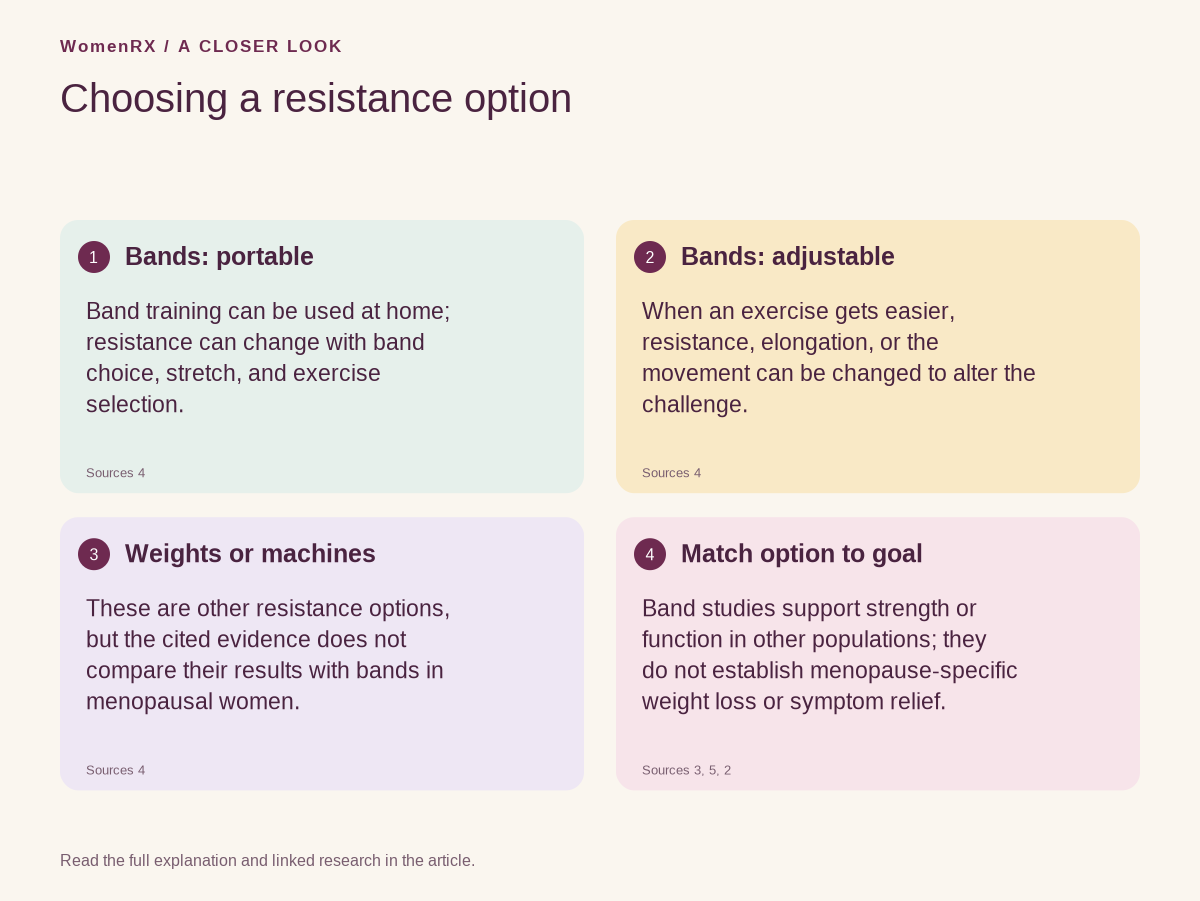
Choosing a resistance option
Bands: portable: Band training can be used at home; resistance can change with band choice, stretch, and exercise selection.4
Bands: adjustable: When an exercise gets easier, resistance, elongation, or the movement can be changed to alter the challenge.4
Weights or machines: These are other resistance options, but the cited evidence does not compare their results with bands in menopausal women.4
Match option to goal: Band studies support strength or function in other populations; they do not establish menopause-specific weight loss or symptom relief.352
Read the figure as text
Bands, weights, and machines can all provide resistance. This comparison focuses on access and progression, while noting that the cited evidence does not establish which option is best for women in menopause.- Bands: portable: Band training can be used at home; resistance can change with band choice, stretch, and exercise selection.4
- Bands: adjustable: When an exercise gets easier, resistance, elongation, or the movement can be changed to alter the challenge.4
- Weights or machines: These are other resistance options, but the cited evidence does not compare their results with bands in menopausal women.4
- Match option to goal: Band studies support strength or function in other populations; they do not establish menopause-specific weight loss or symptom relief.352
More questions, answered
Do I need special menopause-specific bands?
This research doesn’t identify a menopause-specific type of band. What matters for the exercise is whether the band and setup provide an appropriate challenge; resistance can be adjusted through band choice, stretch, and exercise selection. 4
Sources you can check
- Benefits of Exercise: MedlinePlusAccessed 2026-09-25Return to first citation
- The 2023 nonhormone therapy position statement of The North American Menopause Society.Menopause (New York, N.Y.) · 2023Return to first citation
- Effectiveness of elastic resistance training in frail older adults on muscle strength and functionality levels: A systematic review.Puelles-Diaz A, Bousellet-Laflor N, Pizarro-Torres S, Grau-Riveros J, González-Aroca J. · Rehabilitacion · 2026Return to first citation
- Effects of elastic-band resistance training on glycemic control, muscle strength, and functional outcomes in patients with type 2 diabetes mellitus: a systematic review and meta-analysis of randomized controlled trials.Zhu Y, Zhu Z, Wang H, Cao S, Shan C, Yuan X. · Frontiers in public health · 2026Return to first citation
- Effects of two versus three weekly sessions of low-load elastic band resistance training on functional fitness and metabolic biomarkers in older adults: a randomized controlled trial.Jezdimirović Stojanović T, Andrić N, Zenić N, Rincon Perez A, D M Stojanović M. · European review of aging and physical activity : official journal of the European Group for Research into Elderly and Physical Activity · 2026Return to first citation