Build a Beginner Resistance-Band Workout That Can Grow
A few simple moves and small resistance adjustments can turn one band into a flexible strength routine.
Choose a band you can move through a comfortable range with steady control, then try a simple full-body routine: a sit-to-stand, a row, a chest press, and a hip hinge. As the moves become easier, increase the band’s stretch slightly or use a stronger band, changing one thing at a time. Color labels alone don’t tell you how challenging a band will feel.
Start with the band you can control
Resistance bands can help build strength, including for older adults. 1 A review of four trials in frail adults aged 65 and older found improvements in some strength and function measures with elastic-band programs, but three trials had high risk of bias. Its summarized results don’t establish whether effects differed between women and men. 3
For a first workout, choose either a long, flat band or a tube band with handles. Both can work for the moves below. A loop band is another option, but it suits different positions and movements. Check the product’s resistance guidance rather than assuming a particular color means a particular challenge.
A band feels easier when it has less stretch and harder as you stretch it farther. Where you stand, where you anchor it, and how far you move all affect that stretch. Keep the pull lined up with the movement: a row pulls toward you, for example, while a chest press pushes away from you. A door anchor can help with those two moves; secure it according to its instructions and keep your face out of the band’s recoil path.
Try this four-move routine
Use a stable chair for the sit-to-stand. For the seated row, hold the band in place with your feet; for the chest press as described below, use a properly secured anchor. Move slowly enough to stay in control, and use a range that feels comfortable. As a practical starting suggestion, try one round of 6 to 10 controlled repetitions of each move, resting between exercises as needed. Stop a move early if you can’t keep it smooth and controlled.
- Sit-to-stand: Place the middle of the band under both feet and hold an end in each hand. Sit on the chair, then stand, keeping your feet planted. If the band gets in the way or makes balance uncertain, do the movement without it.
- Seated row: Sit with your legs comfortably extended and the band around your feet. Hold the ends, sit tall, and draw your hands toward your sides. Keep the band away from your face.
- Chest press: Anchor the band behind you around chest height. Hold an end in each hand and press forward, then return with control. Use a lighter band or a shorter range if you can’t keep the movement smooth.
- Hip hinge: Stand on the middle of the band with your feet about hip-width apart and hold the ends. Soften your knees, send your hips back, then stand tall. If you can’t keep the band secure under your feet, practice the hinge without it.
If you have to jerk, hold your breath, or change your position to finish, make the band easier or shorten the movement. If you can move smoothly and the band barely challenges you, adjust it a little.
Make the exercise harder in small steps
When a move feels easy and controlled, change just one factor:
- Stretch the same band a little farther. For a band anchored in front of you, stepping farther back usually increases tension. For a band under your feet, taking up more slack before you begin can do the same.
- Use a stronger band. Resistance labels and color systems can differ, so judge the band by how it feels during your movement, not its color alone.
- Use a larger comfortable range. Move farther only if you can keep your position and control the return. A longer range isn’t an improvement if it makes the exercise uncomfortable or sloppy.
- Adjust the anchor. Changing its height or your position changes the direction of the pull, which can alter how the exercise feels. Keep the anchor in line with the movement you’re practicing.
Change one thing, then test the movement again. That makes it easier to tell whether the adjustment helped. Progression matters: a systematic review in frail older adults found that programs with progressive intensity and longer duration were associated with better physical outcomes, although the included studies had important limitations. 3
What studies in older adults tell us about women
Resistance training can improve strength and other measures of muscular fitness in older adults overall. A review included 16 eligible studies with 801 adults aged 60 and older; data from 15 randomized trials were available for analysis. It found benefits compared with control groups, but examined resistance training broadly, not just bands. 2
The reported band-specific findings don’t tell us how women responded separately. One review covered four trials in frail adults aged 65 and older. A separate trial studied elastic-band and ball exercises in bedridden adults aged 80 and older, a different population from an independent beginner. These results cannot tell us whether women in midlife respond differently to a beginner band routine. 3 4
So bands are a reasonable way to practice resistance exercise, but these findings don’t show that women need a different band routine or that a particular routine works best for them. The practical takeaway is to choose resistance you can control and adjust it as your strength and comfort allow.
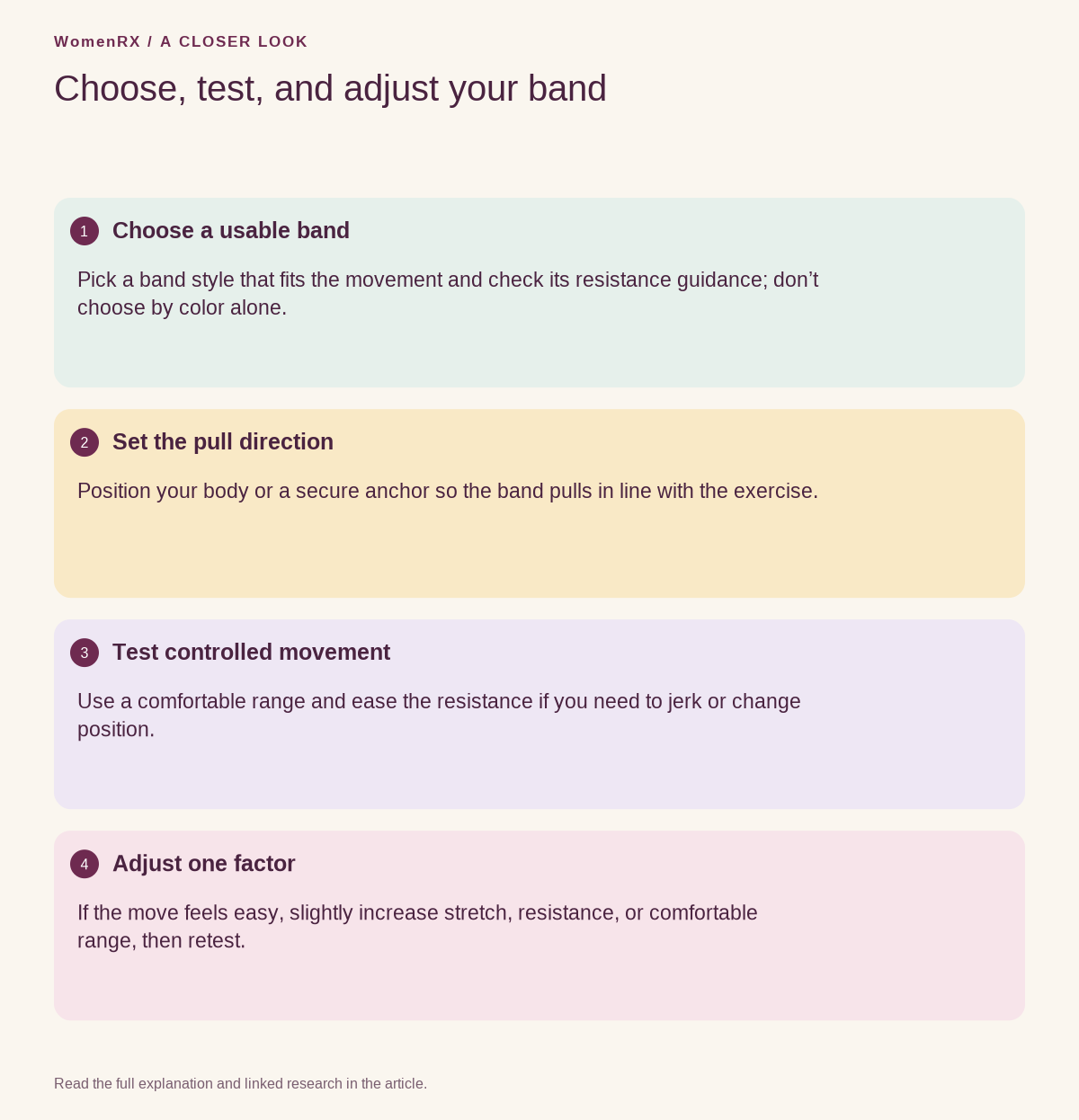
Choose, test, and adjust your band
Choose a usable band: Pick a band style that fits the movement and check its resistance guidance; don’t choose by color alone.
Set the pull direction: Position your body or a secure anchor so the band pulls in line with the exercise.
Test controlled movement: Use a comfortable range and ease the resistance if you need to jerk or change position.
Adjust one factor: If the move feels easy, slightly increase stretch, resistance, or comfortable range, then retest.
Read the figure as text
A practical sequence for finding a controlled starting resistance and making one adjustment at a time.- Choose a usable band: Pick a band style that fits the movement and check its resistance guidance; don’t choose by color alone.
- Set the pull direction: Position your body or a secure anchor so the band pulls in line with the exercise.
- Test controlled movement: Use a comfortable range and ease the resistance if you need to jerk or change position.
- Adjust one factor: If the move feels easy, slightly increase stretch, resistance, or comfortable range, then retest.
More questions, answered
Do I need a door anchor?
Not for the sit-to-stand, seated row, or hip hinge described here: your feet hold the band in place. The chest press as written does require a suitable anchor secured according to its instructions.
Should I buy a set with several colors?
A set can offer more resistance options, but color alone isn’t a reliable guide to how challenging a band will feel. Check the maker’s resistance information and test each band with the movement you plan to do.
Sources you can check
- Exercise for Older Adults: MedlinePlusAccessed 2026-09-25Return to first citation
- Effects of maximal versus submaximal intended velocity resistance training on muscular fitness adaptations in older adults: A systematic review and meta-analysis.Tao M, Liao K, Yin M, Chen Z, Zhong Y, Zhu C, Song Y, Thompson S, Bishop C, Li Y. · Sports medicine and health science · 2026Return to first citation
- Effectiveness of elastic resistance training in frail older adults on muscle strength and functionality levels: A systematic review.Puelles-Diaz A, Bousellet-Laflor N, Pizarro-Torres S, Grau-Riveros J, González-Aroca J. · Rehabilitacion · 2026Return to first citation
- Impact of resistance exercise program on muscle strength, cardiopulmonary function and glycolipid metabolism of bedridden population aged 80 years and above: A randomized controlled trial.Wang Y, Huo X, Wang X, Zhu H, Lai X, Yu T. · Medicine · 2024Return to first citation