How to Build Muscle After 50: Start Light, Progress Gradually
A repeatable strength routine starts with movements you can control, then grows more challenging as you get stronger.
Start with manageable resistance, such as your body weight, a band, or a weight, and practice movements that use your legs, back, chest, and arms. Twice-weekly training has been studied in older adults, including older women. When you can complete your chosen movements with control and feel ready to repeat them at the next session, consider making one small increase in resistance. 4 6
Strength work has a different job from balance and mobility
Strength training challenges your muscles against resistance. That resistance might be your body weight, an elastic band, or a weight. Balance practice challenges your steadiness, while mobility work focuses on moving joints through a comfortable range. These activities can complement each other, but balance or mobility work alone isn’t the same training stimulus as progressively challenging your muscles.
In a study of 16 older women, resistance training improved some measures of dynamic balance and endurance, but not handgrip strength or flexibility. That’s a reminder that changes tend to be specific to what you train; the study does not show that strength training prevents falls. 5
An example session you can scale
For a simple example, choose one movement for each of these patterns: sitting down and standing up; pushing; pulling; and bending at the hips. You could try a chair sit-to-stand, a wall push, a light-band row, and a hip hinge while holding a stable surface. These are example choices, not a package shown to be best in a trial. Use a stable setup and choose versions you can control.
Here’s one way to put them together: twice a week, work through those four movements, aiming for one comfortable set of each. If that feels manageable, you could build toward a second set and, eventually, 12 to 15 controlled repetitions per set. A trial in older women used two sets of 12 to 15 repetitions with elastic bands, including a twice-weekly group; the four-movement session here is an adaptable example, not that trial’s tested routine. 6
If a movement feels too difficult to control, make it easier: use a higher chair, push against a wall rather than a lower surface, or choose a lighter band. If it feels easy and steady, keep practicing at that level before making it harder. Having a chair or counter within reach can make a standing exercise feel more manageable.
When to make it harder
Use your next session as a practical check. If you can complete your chosen repetitions with steady movement and feel ready to do that work again, you might try a slightly stronger band or a little more weight for one exercise. Keep the other movements as they are and see how the change feels. If you’re still working toward your chosen repetitions, add a few controlled ones before increasing resistance. This is an example decision point, not a tested rule that everyone must follow.
If you’re returning after time away, you can stay with the same version for more than one session. If you’re recovering poorly or a movement feels uncomfortable, reduce the resistance or return to an easier version rather than progressing.
Bands are a workable starting option, not merely a step toward weights. In a study of 48 community-dwelling older adults, including 20 women, progressive band and free-weight groups trained twice weekly for 12 weeks. Both improved on several functional tasks compared with a control group; results weren’t reported separately for women. 4
What the women-specific evidence says
Resistance training can improve strength and function in older women, but gains in strength don’t guarantee a measurable increase in muscle mass. A review of 12 randomized trials involving 518 older women with diagnosed sarcopenia found improvements in several strength and function measures, while the pooled result for skeletal muscle mass index was not statistically significant. 1
Other trials show why outcomes shouldn’t be collapsed into one promise. In a 12-week study of 175 older women, resistance training improved knee-extension strength and thigh muscle thickness compared with a control group. 2 In a small 12-week study of women aged 60-79, both normal-weight women and women with obesity improved strength and physical performance, while some muscle-thickness and body-fat changes differed between groups. 3
These results aren’t a direct estimate for every woman just over 50. These studies don’t isolate a postmenopausal training effect or show that this example routine prevents osteoporosis. Muscle strength, muscle size, physical function, and bone health are related topics, but they are not interchangeable outcomes.
You don’t need a universally “best” exercise. You need a level of resistance you can repeat, with room to make it more challenging as your strength and control improve.
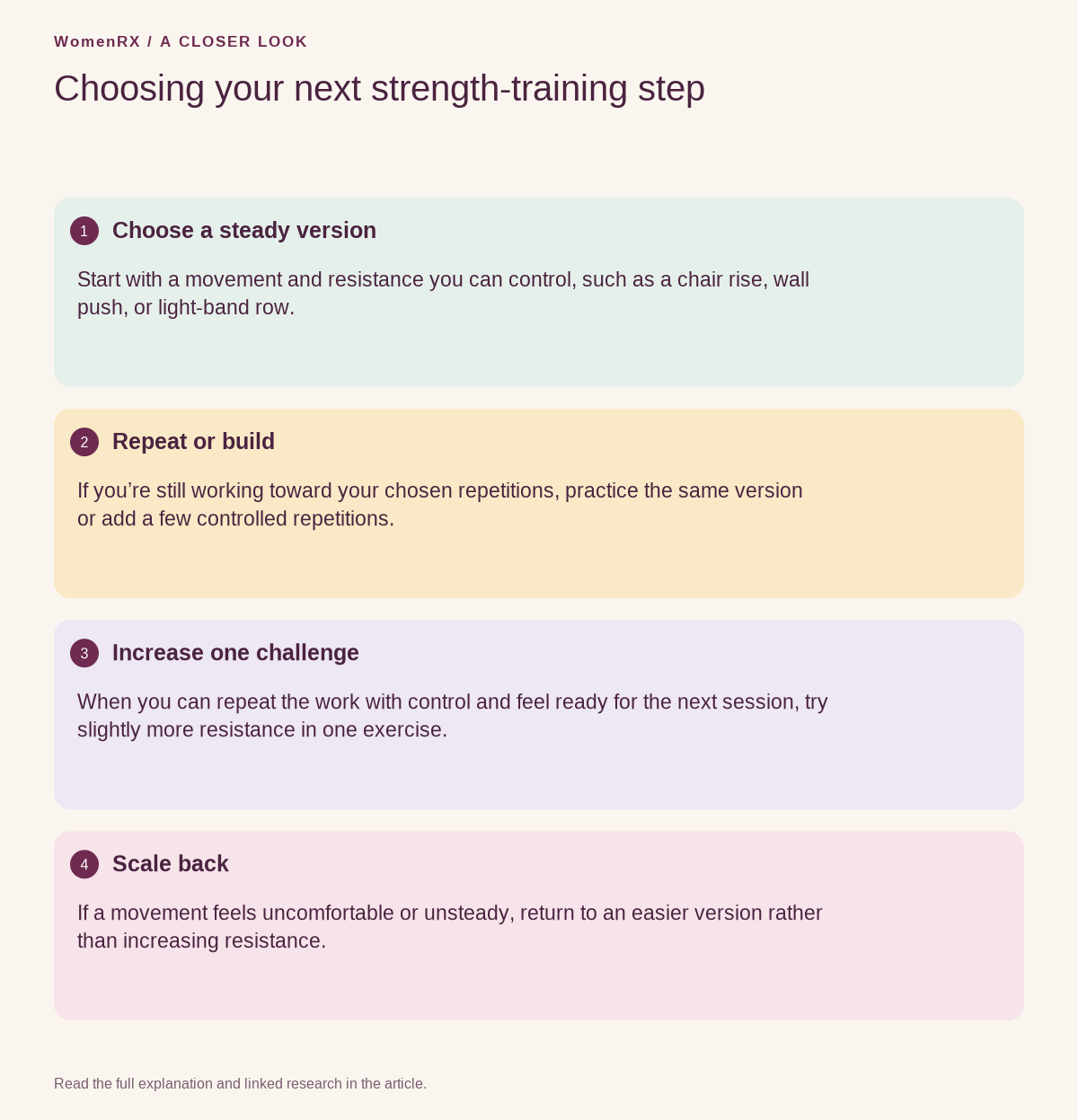
Choosing your next strength-training step
Choose a steady version: Start with a movement and resistance you can control, such as a chair rise, wall push, or light-band row.
Repeat or build: If you’re still working toward your chosen repetitions, practice the same version or add a few controlled repetitions.
Increase one challenge: When you can repeat the work with control and feel ready for the next session, try slightly more resistance in one exercise.
Scale back: If a movement feels uncomfortable or unsteady, return to an easier version rather than increasing resistance.
Read the figure as text
Use this example flow after a session to decide whether to repeat, adjust, or make one movement harder. It isn’t a validated progression test.- Choose a steady version: Start with a movement and resistance you can control, such as a chair rise, wall push, or light-band row.
- Repeat or build: If you’re still working toward your chosen repetitions, practice the same version or add a few controlled repetitions.
- Increase one challenge: When you can repeat the work with control and feel ready for the next session, try slightly more resistance in one exercise.
- Scale back: If a movement feels uncomfortable or unsteady, return to an easier version rather than increasing resistance.
Sources you can check
- Effects of resistance training on muscle mass, strength, and physical function in older women with sarcopenia: a systematic review and meta-analysis.Zhou Y, Wen K, Zhang X, Sun Y. · Frontiers in public health · 2025Return to first citation
- Muscle growth mediates the increases in muscle strength in untrained older women.Kassiano W, Stavinski N, Costa B, Kunevaliki G, Lisboa F, Santos-Melo V, Francsuel J, Rodrigues R, Ribeiro A, Cyrino E. · Applied physiology, nutrition, and metabolism = Physiologie appliquee, nutrition et metabolisme · 2026Return to first citation
- Effects of 12 weeks resistance training on muscle quality and physical performance in normal-weight and obese older women.Vidal-Seguel N, Sepúlveda-Lara A, Carranza-Leiva J, Márquez C, Huard N, Sapunar J, Salazar LA, Nova-Lamperti E, Marzuca-Nassr GN. · Frontiers in physiology · 2026Return to first citation
- Effects of elastic band training versus free weight training in community-dwelling older adults: A randomized controlled trial.Schott N, Straßer P, Holfelder B. · Experimental gerontology · 2026Return to first citation
- Effects of Resistance Training, Interval Training, and Detraining on Functional Performance in Older Women: A Longitudinal Study.Nascimento MAD, Graça Á, Silva Ribeiro A, Santos Fonseca H, Garcia de Sales A, Arthur Lopes W. · Journal of aging and physical activity · 2026Return to first citation
- Effects of two versus three weekly sessions of low-load elastic band resistance training on functional fitness and metabolic biomarkers in older adults: a randomized controlled trial.Jezdimirović Stojanović T, Andrić N, Zenić N, Rincon Perez A, D M Stojanović M. · European review of aging and physical activity : official journal of the European Group for Research into Elderly and Physical Activity · 2026Return to first citation