Building Muscle After 40: Train, Recover, and Track Progress
Resistance training can help build muscle later in life, and a simple record of your workouts can show progress the scale misses.
A workable starting plan is two repeatable full-body resistance sessions each week, with nontraining days between them. Record your exercises, resistance, and repetitions. Over the following weeks, increase a challenge when you can repeat the movement with control, and hold steady when you can’t. That schedule is an example, not a required formula: studies in older women found gains across varied programs. 23
Start with a plan you can repeat
If you’re in your 40s, the most directly relevant research here is a starting point, not a prediction: a review of resistance-training studies in women covered participants aged 50 to 80. Its meta-analysis of observational studies found small-to-moderate pre-to-post increases in lean body mass across varied programs. 3
For a practical structure, choose a small set of resistance exercises that covers the areas you want to strengthen. For example, you might include a leg movement, a pulling movement, and a pushing movement. Most studies in the women-specific review used full-body training, though the review doesn’t identify a best exercise list. 3
Here’s one way to put those movements into a plan: schedule two full-body sessions each week, with nontraining days between them. Repeat the same movements at each session for the first few weeks. Record the exercise, resistance, repetitions, and whether you could complete the movement with control. This is a flexible planning example, not a tested routine for women over 40. For context, a small supervised trial in older women trained twice weekly for 10 weeks using leg extensions, while the women-specific review reported an average of three training days per week across varied programs. 23
As sessions repeat, compare each exercise with your earlier record. If you can repeat it comfortably and with control, you can try making that exercise more challenging at a later session. If the movement becomes difficult to control, keep the challenge where it is or reduce it. After several weeks, look back across your records: are you doing more with comparable control, or does the plan need adjusting? A supervised trial of healthy adults aged 65 and older used progressive resistance training for 14 weeks, but it doesn’t specify the right starting resistance or pace of progression for you. 1
Give strength its own progress measure
Muscle size and strength can improve together, but they aren’t the same outcome. One study of adults averaging about 71 years old, including nine women and 10 men, found changes in muscle fibers after 12 weeks of progressive resistance training. Its small, mixed-sex sample can’t tell us exactly what to expect for every woman, but it illustrates why muscle adaptation can involve more than a change on the scale. 5
Track a few measures that matter to you. For instance, you could note whether you can lift more resistance with the same controlled movement, or whether a daily task feels easier. Compare like with like: the same exercise, equipment, and range of movement make a strength comparison more useful. If you also track body measurements or clothing fit, treat those as additional clues, not a direct measurement of muscle.
Body weight alone can’t tell you whether you’re gaining muscle. In a meta-analysis of observational resistance-training studies involving 745 postmenopausal and older women, researchers reported increases in lean body mass from before to after training but no statistically significant finding for fat mass. Lean body mass isn’t identical to muscle, and the studies varied in design and measurement. Your scale weight can’t separate those outcomes for you. 3
Let recovery shape the next session
Keep the nontraining days in your example plan rather than treating every day as a chance to add another session. When you return to an exercise, your record gives you a useful check: can you repeat the movement with comparable control? If not, there’s no need to increase the challenge that day. That’s a way to adjust your plan, not a recovery interval established by a trial.
What age and menopause do, and don’t, tell us
Menopause and aging are relevant to muscle health, but the studies in the women-specific review don’t establish a separate training formula for menopause. They document lean-mass changes in postmenopausal and older women across varied programs while noting differences between studies and a need for clearer training details. 3
A 2025 review of older adults reported similar quadriceps hypertrophy responses in men and women in a large dataset of people aged 60 to 79. That finding is specific to the muscle and age groups represented. Neither that review nor the women-specific review directly compares training responses across cycling years, perimenopause, and postmenopause. 34
So use age or menopausal stage as context, not a verdict on what you can gain. Start from what you can do now, keep a record of your training and strength, and assess your own progress over time.
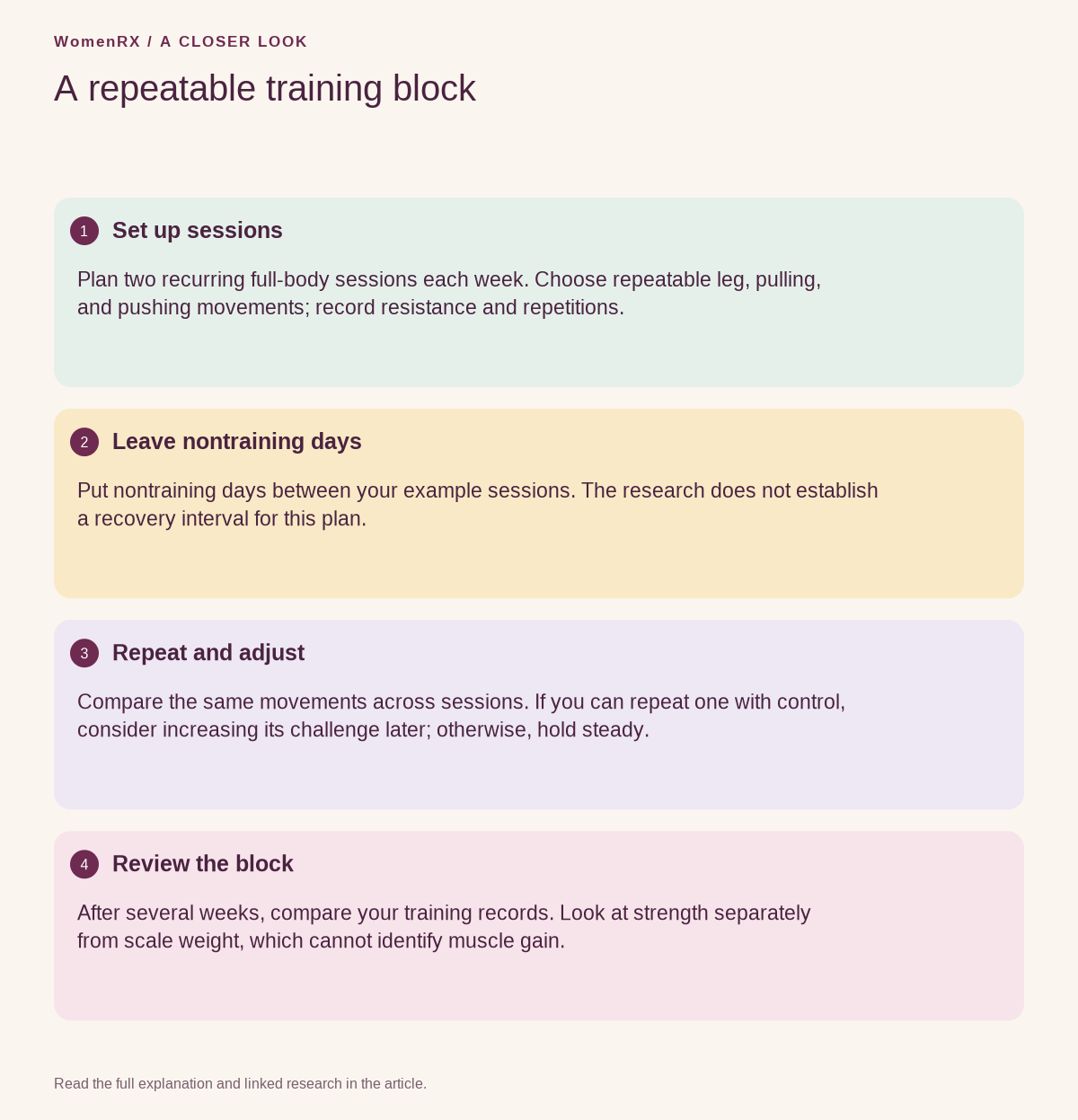
A repeatable training block
Set up sessions: Plan two recurring full-body sessions each week. Choose repeatable leg, pulling, and pushing movements; record resistance and repetitions.
Leave nontraining days: Put nontraining days between your example sessions. The research does not establish a recovery interval for this plan.
Repeat and adjust: Compare the same movements across sessions. If you can repeat one with control, consider increasing its challenge later; otherwise, hold steady.
Review the block: After several weeks, compare your training records. Look at strength separately from scale weight, which cannot identify muscle gain.
Read the figure as text
Follow this flexible example from the first sessions through a later review. It’s a planning aid, not a prescribed timetable.- Set up sessions: Plan two recurring full-body sessions each week. Choose repeatable leg, pulling, and pushing movements; record resistance and repetitions.
- Leave nontraining days: Put nontraining days between your example sessions. The research does not establish a recovery interval for this plan.
- Repeat and adjust: Compare the same movements across sessions. If you can repeat one with control, consider increasing its challenge later; otherwise, hold steady.
- Review the block: After several weeks, compare your training records. Look at strength separately from scale weight, which cannot identify muscle gain.
More questions, answered
What if the scale doesn’t change?
That alone doesn’t show whether training is working. A meta-analysis of observational studies in postmenopausal and older women reported pre-to-post increases in lean body mass, but no statistically significant finding for fat mass. Track strength or another measure that matters to you alongside weight. 3
Does the evidence show that women need a different routine after menopause?
These reviews don’t establish one. The women-specific review covered postmenopausal and older women but didn’t compare them directly with women in other menopausal stages. A separate older-adult review found similar responses in men and women for the quadriceps, not necessarily every muscle. 34
Sources you can check
- Metformin blunts muscle hypertrophy in response to progressive resistance exercise training in older adults: A randomized, double-blind, placebo-controlled, multicenter trial: The MASTERS trial.Walton RG, Dungan CM, Long DE, Tuggle SC, Kosmac K, Peck BD, Bush HM, Villasante Tezanos AG, McGwin G, Windham ST, Ovalle F, Bamman MM, Kern PA, Peterson CA. · Aging cell · 2019Return to first citation
- Effects of Photobiomodulation/Laser Therapy Combined With Resistance Training on Quadriceps Hypertrophy and Strength, and Postural Balance in Older Women: A Randomized, Triple-Blinded, Placebo-Controlled Study.Rodrigues CP, Jacinto JL, Roveratti MC, Merlo JK, Soares-Caldeira LF, Silva Ribeiro A, Nunes JP, Junior EO, Aguiar AF. · Journal of geriatric physical therapy (2001) · 2022Return to first citation
- The effect of resistance training programs on lean body mass in postmenopausal and elderly women: a meta-analysis of observational studies.Thomas E, Gentile A, Lakicevic N, Moro T, Bellafiore M, Paoli A, Drid P, Palma A, Bianco A. · Aging clinical and experimental research · 2021Return to first citation
- Human skeletal muscle-specific hypertrophy with exercise training and aging: a comprehensive review.Vincenty CS, Yoon G, Rogers K, Naruse M, Trappe S, Trappe TA. · Journal of applied physiology (Bethesda, Md. : 1985) · 2025Return to first citation
- Resistance exercise training promotes fiber type-specific myonuclear adaptations in older adults.Moro T, Brightwell CR, Volpi E, Rasmussen BB, Fry CS. · Journal of applied physiology (Bethesda, Md. : 1985) · 2020Return to first citation