How to Train Your Glutes After 40
Squats and hip thrusts can both build glute muscle; choose a version you can keep challenging as you get stronger.
Choose a squat variation, hip thrust, or another resistance exercise that fits your space and feels manageable. Both squats and hip thrusts have increased glute muscle size in training studies; getting stronger at a particular lift also takes practice with that lift. Build up the challenge gradually rather than looking for a special exercise to start at 40. 2 3
Start with a movement you can progress
Your glutes don’t require one signature exercise. A 2025 systematic review found that resistance training with several hip-extension exercises, including squats, hip thrusts, leg presses, and kneeling hip extensions, can increase the size of the gluteus maximus, the largest glute muscle. That gives you room to choose based on your equipment, preferences, and the movements you can perform consistently. 2
Building glute muscle and getting stronger at a lift aren’t quite the same goal. In a nine-week study of untrained college-aged participants, squat and hip-thrust groups had similar glute growth. But the squat group made greater gains on the squat strength test, while the hip-thrust group made greater gains on the hip-thrust strength test. If you want to get better at squatting, practice squatting; you don’t need to treat that as the only way to train your glutes. 3
Age 40 isn’t a dividing line established by these studies. The squat-versus-hip-thrust trial involved college-aged adults, and a separate comparison involved well-trained women whose average age was about 27. Neither establishes an ideal program for women in their 40s or beyond. 3 4
Match the exercise to your setting
At home: Bodyweight squat variations give you a place to start without a barbell or machine. The systematic review describes a study in previously sedentary women in which progressively trained bodyweight squat variations produced gluteus maximus thickness gains comparable to barbell back-squat training. This result doesn’t establish how the two approaches compare specifically for women over 40. A squat variation you can control now can become more demanding as your ability improves. 2
At a gym: A squat, hip thrust, or leg press gives you a way to train with external resistance. Squats work the thighs as well as the glutes; in the nine-week trial, the squat group had greater quadriceps and adductor growth than the hip-thrust group. A hip thrust may appeal if you want to put more of the exercise’s emphasis on hip extension. The review also identifies leg presses as an option for gluteus maximus growth. Pick the setup you can use regularly, not the one with the strongest claim to being the glute exercise. 2 3
The head-to-head findings don’t crown a winner. While the college-aged trial found similar glute growth with squats and hip thrusts, a 12-week study of 22 well-trained women found greater gluteus maximus thickness gains in its squat group. The groups and training histories differed between studies, so neither result promises that one movement will work best for you. 3 4
Progress the work, not just the exercise list
Once you’ve chosen a movement, give it time to become familiar. Then, as the current version becomes easier to perform with control, make one part of the work more demanding. For example, you might move to a harder bodyweight squat variation, increase resistance in a gym exercise, or gradually add work to your routine. The bodyweight program described in the review used progressive volume and squat variations; it doesn’t establish one required number of sets or repetitions for women over 40. 2
A practical way to make that gradual is to repeat the same version of an exercise until you can complete the work you planned with control. Then choose just one change for the next time: a harder variation, more resistance, or a little more total work. See how that change feels before adding another. If completing the planned work becomes difficult, keep it steady or scale it back rather than increasing everything at once. This is a way to manage progression, not a tested schedule for women over 40. 2
You also don’t need a crowded glute routine to cover every exercise in the review. As a practical example, you could begin with one squat-style movement that suits your setting. If you enjoy gym training, a hip thrust offers a different choice to practice alongside it. If your main goal is strength in a specific lift, keep that lift in the routine: the college-aged trial found that strength gains favored the movement each group trained. These are ways to organize your choices, not a tested age-specific program. 2 3
Leave room to recover and repeat
Progression works best as something you can keep doing, rather than a harder workout every time. After increasing the challenge, notice whether you can return to the movement and complete your planned work with control. If you can’t, repeat an easier version or do less work before trying to increase it again. That gives you a practical way to adjust without assuming every workout needs more weight or more repetitions. Food is part of recovery too: protein supplies what your body needs to build and repair muscle during resistance training. That doesn’t mean a special powder or a precisely timed post-workout snack is required. 1
If an exercise consistently hurts or feels unsuitable, you can choose another supported movement instead. There are several routes to training your glutes, whether you’re starting at home or already comfortable in a gym. 2
Choose a glute exercise that fits
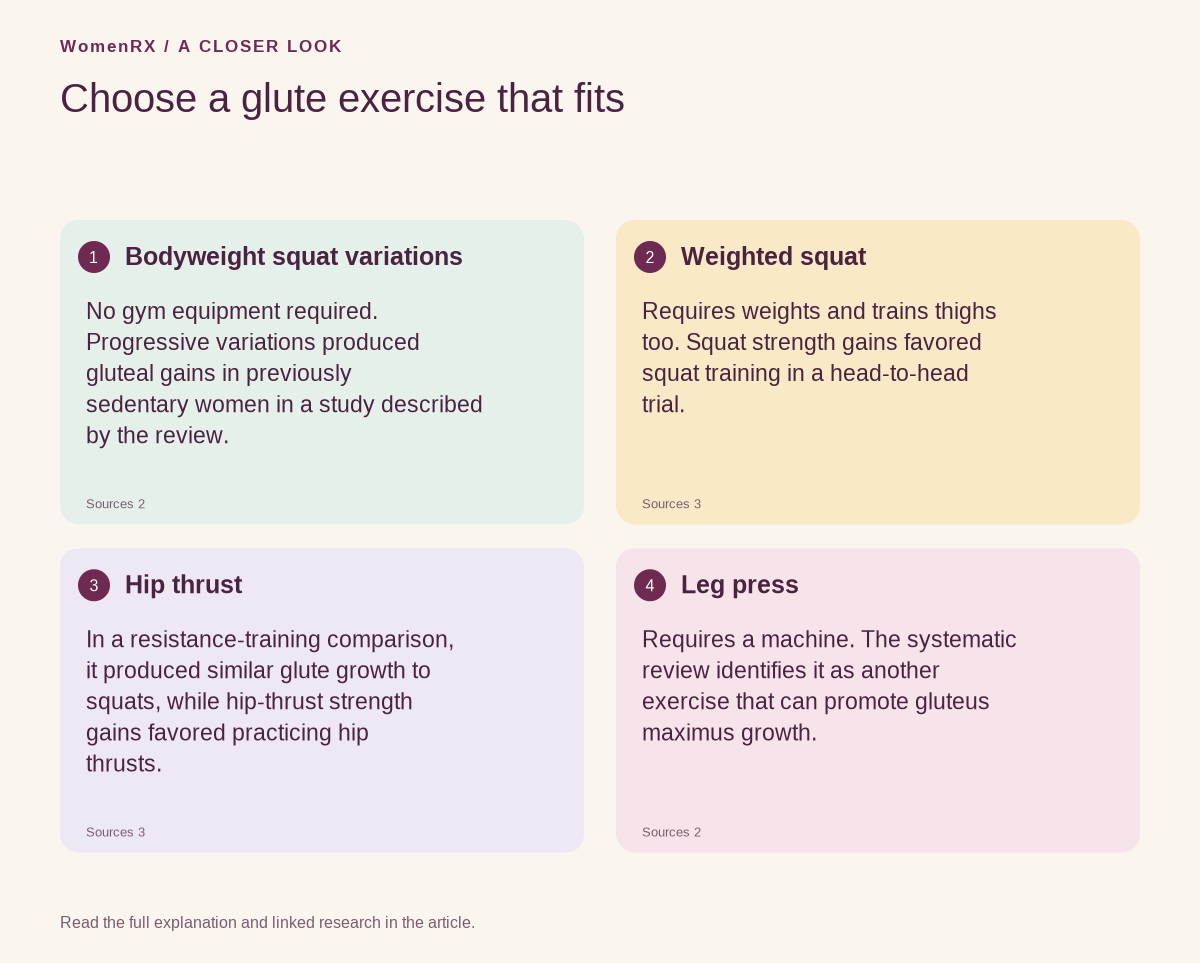
Bodyweight squat variations: No gym equipment required. Progressive variations produced gluteal gains in previously sedentary women in a study described by the review.2
Weighted squat: Requires weights and trains thighs too. Squat strength gains favored squat training in a head-to-head trial.3
Hip thrust: In a resistance-training comparison, it produced similar glute growth to squats, while hip-thrust strength gains favored practicing hip thrusts.3
Leg press: Requires a machine. The systematic review identifies it as another exercise that can promote gluteus maximus growth.2
Read the figure as text
Compare the setup and training emphasis of four options, without treating any one as a universal winner.- Bodyweight squat variations: No gym equipment required. Progressive variations produced gluteal gains in previously sedentary women in a study described by the review.2
- Weighted squat: Requires weights and trains thighs too. Squat strength gains favored squat training in a head-to-head trial.3
- Hip thrust: In a resistance-training comparison, it produced similar glute growth to squats, while hip-thrust strength gains favored practicing hip thrusts.3
- Leg press: Requires a machine. The systematic review identifies it as another exercise that can promote gluteus maximus growth.2
Sources you can check
- Dietary Supplements for Exercise and Athletic Performance - Health Professional Fact SheetAccessed 2026-09-25Return to first citation
- The impact of resistance training on gluteus maximus hypertrophy: a systematic review and meta-analysis.Krause Neto W, Krause TLV, Gama EF. · Frontiers in physiology · 2025Return to first citation
- Hip thrust and back squat training elicit similar gluteus muscle hypertrophy and transfer similarly to the deadlift.Plotkin DL, Rodas MA, Vigotsky AD, McIntosh MC, Breeze E, Ubrik R, Robitzsch C, Agyin-Birikorang A, Mattingly ML, Michel JM, Kontos NJ, Lennon S, Frugé AD, Wilburn CM, Weimar WH, B... · Frontiers in physiology · 2023Return to first citation
- Back Squat vs. Hip Thrust Resistance-training Programs in Well-trained Women.Barbalho M, Coswig V, Souza D, Serrão JC, Hebling Campos M, Gentil P. · International journal of sports medicine · 2020Return to first citation