Muscle, Strength Training, and Fat Loss: What to Track
Strength training can help protect strength and lean tissue during weight loss, while the scale alone can’t show how your body is changing.
Strength training supports strength and may help preserve lean tissue during weight loss, but it doesn’t guarantee a faster drop on the scale. This evidence doesn’t show how much ordinary muscle gain changes calorie use or support promises of a dramatic metabolism boost. To see more of the picture, track weight alongside strength, everyday function, and, if useful, waist measurement. 1 3 7
Strength training can make weight loss better reflect changes in body composition and function, even when it doesn’t make the scale fall faster. Its clearest role is supporting strength and helping preserve lean tissue. 2 7
That distinction matters if your weight changes slowly while your strength improves, or if the scale doesn’t seem to match how your clothes fit. Those observations can offer useful context, but none alone tells the full story.
Four changes that are easy to mix up
Muscle mass is the amount of muscle tissue. Lean mass is a broader category: it includes muscle, but also water, organs, connective tissue, and other non-fat components. A change in lean mass isn’t automatically a change in contractile muscle. 4 6
Strength is what your muscles can do. Muscle mass, strength, and physical function can change in different ways, so a body-composition estimate by itself can’t tell you whether strength or mobility has improved. 4
Fat loss is a change in the amount of body fat. During weight reduction, fat mass can fall alongside lean tissue. Resistance exercise is best understood as one part of a broader approach to body composition, with particular value for strength and lean-tissue preservation. 6 7
Scale weight is the total of your body’s tissues and water, not a direct measure of fat. A stable number can’t establish that nothing has changed, and a lower number can’t show what tissue was lost. 1 6
Muscle and calorie use: keep the claim modest
Muscle is part of the body’s lean tissue, and lean-tissue measurements are related to resting metabolic rate, the energy your body uses at rest. But that relationship doesn’t tell you how much muscle gained through ordinary strength training would change calorie use. 3
One small pilot study followed 26 adults after sleeve gastrectomy; 61.5% were women. Lean soft tissue measurements were associated with resting metabolic rate. A resistance-training intervention using whole-body vibration helped limit some loss of limb lean tissue, but the difference in the overall drop in resting metabolic rate between the training and usual-care groups was not statistically significant. Because this was a small study during recovery from surgery, it can’t quantify a metabolism effect from building muscle during everyday fat loss. 3
So strength training is worth valuing for strength, function, and possible lean-tissue preservation. This pilot study doesn’t establish a dramatic metabolism boost from muscle gain. 3 7
What strength training can realistically contribute
A strength-focused activity program studied in adults starting GLP-1 medication was associated with greater weight and body-fat-percentage reductions, and a larger increase in muscle-mass percentage, than usual care over 12 weeks. This was a quasi-experimental study, not a randomized trial; the program included personalized physical-activity coaching, and body composition was measured with home bioelectrical-impedance scales. It’s a promising example, not proof that lifting alone caused those differences or that every person will see the same results. 2
More broadly, a review of adults with obesity describes resistance training as supportive of strength, muscle function, and lean-tissue preservation during weight reduction. It presents exercise and adequate nutrition as complementary, rather than as a guaranteed way to maximize scale-weight loss. 7
It’s more useful to value strength training for what it can directly support: strength, function, and the quality of weight loss. 7
A practical way to read progress
Think in terms of a small set of signals rather than asking one number to answer everything:
- Weight trend: useful for seeing overall change, but it includes muscle, bone, and water as well as fat. 1
- Strength or function: note whether familiar exercises or everyday tasks are getting easier, staying steady, or becoming harder. Strength and physical function provide information that a lean-mass estimate alone cannot. 4
- Waist measurement: can add context about abdominal size; waist circumference is one factor used alongside weight and health history when considering health risk. It doesn’t measure muscle or identify the cause of a change. 1
- Body-composition estimates: treat them as estimates, not exact muscle readings. Methods that report lean mass include non-muscle tissue, and results can depend on the measurement method. 4 6
For example, if weight is broadly steady while your waist measurement decreases and your strength holds or improves, the scale by itself may be hiding a favorable change. That pattern is a reason to look at the whole set of signals, not proof that you gained muscle or lost a specific amount of fat.
If weight is falling but strength or everyday function is also getting worse, don’t assume the weight change is automatically a win. Muscle health involves function as well as mass, particularly for older adults. 4 6
What changes around menopause?
A review focused on perimenopause describes possible shifts in body composition, including increased visceral fat and reduced lean mass, that may occur even without a large change in body weight. It also identifies resistance training as a promising lifestyle strategy. 5
That makes weight alone a limited signal during perimenopause, but it doesn’t mean everyone experiences the same pattern. After menopause, preserving strength and everyday function remains a useful reason to include resistance training, especially as you get older. Guidance on body weight emphasizes keeping muscle and strength in older adults, while a review of exercise during weight reduction describes resistance training as supportive of both. These sources don’t establish a uniquely postmenopausal benefit or show that women respond differently from men. 1 7
At either stage, keep strength and function alongside weight and, if useful, waist measurement. For example, if your weight is steady but an everyday task feels easier, that’s a change worth noticing even though it doesn’t prove how much muscle or fat you’ve gained or lost. 1 4
Strength training is worth considering for the strength and function it supports. For fat-loss progress, pair the scale with signs that tell you more about your body, and avoid treating a change in lean-mass estimates as a direct measurement of muscle.
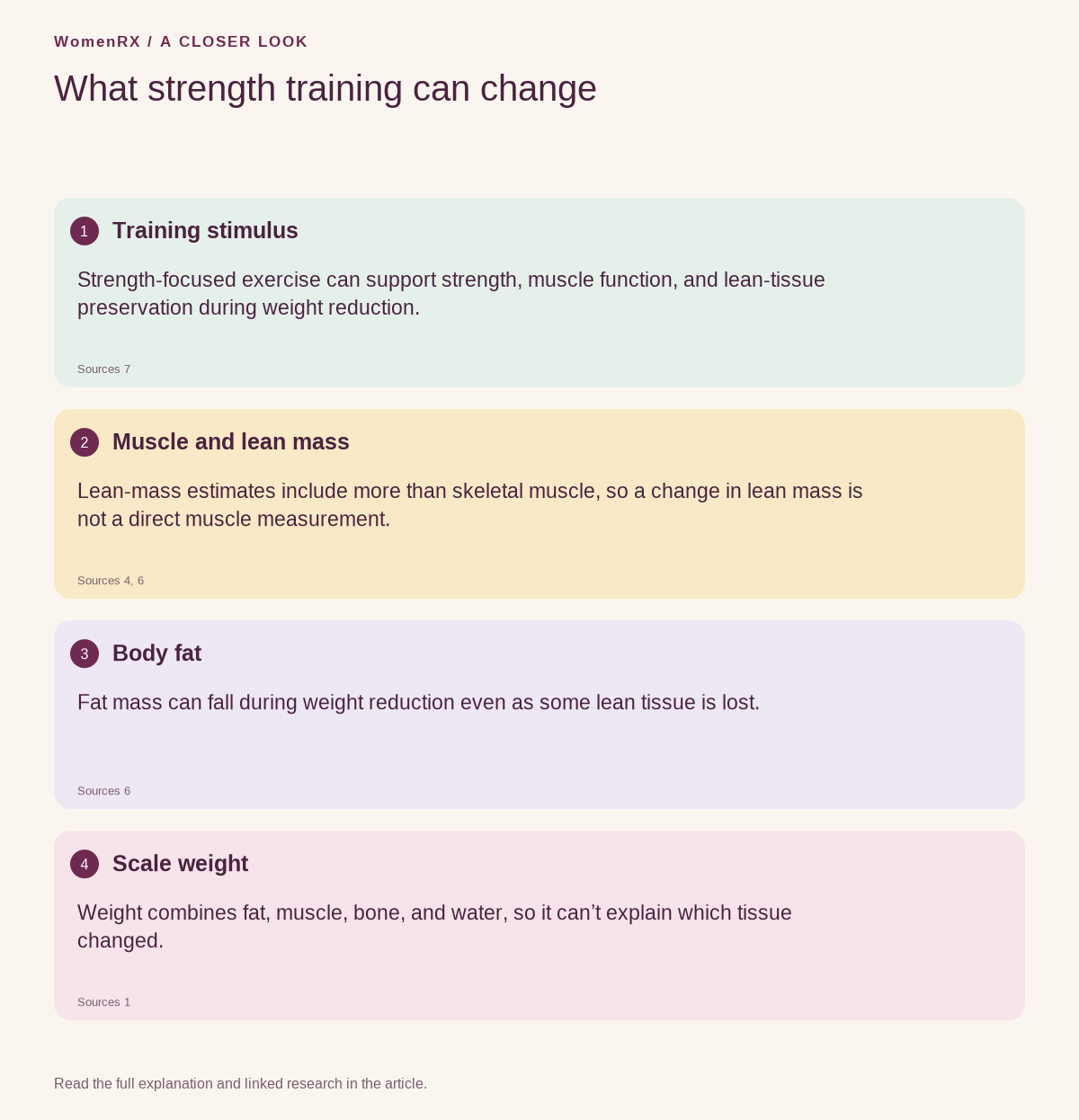
What strength training can change
Training stimulus: Strength-focused exercise can support strength, muscle function, and lean-tissue preservation during weight reduction.7
Muscle and lean mass: Lean-mass estimates include more than skeletal muscle, so a change in lean mass is not a direct muscle measurement.46
Body fat: Fat mass can fall during weight reduction even as some lean tissue is lost.6
Scale weight: Weight combines fat, muscle, bone, and water, so it can’t explain which tissue changed.1
Read the figure as text
Resistance training can support strength and lean-tissue preservation, while body weight reflects several tissues and water. Read the signals together rather than treating a scale change as a muscle or fat measurement.- Training stimulus: Strength-focused exercise can support strength, muscle function, and lean-tissue preservation during weight reduction.7
- Muscle and lean mass: Lean-mass estimates include more than skeletal muscle, so a change in lean mass is not a direct muscle measurement.46
- Body fat: Fat mass can fall during weight reduction even as some lean tissue is lost.6
- Scale weight: Weight combines fat, muscle, bone, and water, so it can’t explain which tissue changed.1
More questions, answered
Can I lose fat if my weight stays the same?
A stable scale reading can’t show whether fat, lean tissue, or water has changed. Weight includes all of these, so look at it alongside other signals, such as waist measurement and strength. Those signals add context but don’t, by themselves, prove exactly what changed. 1 4
Does gaining muscle make the scale go up?
It can, because muscle is part of body weight, but the scale can’t tell whether a change came from muscle, fat, water, or another tissue. A single weight reading isn’t enough to identify the cause. 1 4
Sources you can check
- Body Weight: MedlinePlusAccessed 2026-09-25Return to first citation
- Quality Plus Quantity: Evaluation of a Virtual GLP-1 Programme With Physical Activity Support to Promote Healthy Body Composition Change During GLP-1 Weight Loss.Stanton LA, Naqvi JB, Devaraj SM, McGuill A, Norwood T, Linke S. · Diabetes, obesity & metabolism · 2026Return to first citation
- Effects of Sleeve Gastrectomy and Subsequent Whole-Body Vibration Training on Resting Metabolic Rate and Body Composition: A Pilot Randomized Controlled Trial.Ara-Gimeno S, Gómez-Bruton A, Moradell A, Lozano-Berges G, Palacios Fanlo MJ, Sánchez-Luengo M, Irún P, Matute-Llorente Á, Lanas Á, González-Agüero A, Casajús JA. · Obesity surgery · 2026Return to first citation
- Beyond Fat Loss: Addressing the Sarcopenia Challenge of Incretin-Based Therapies.Kim JY, Kim NH. · Diabetes & metabolism journal · 2026Return to first citation
- Perimenopause and metabolic vulnerability: hormones, body composition and lifestyle changes.Lobato VA, Minari TP, Pisani LP. · Climacteric : the journal of the International Menopause Society · 2026Return to first citation
- Sparing Muscle While Losing Fat: A Narrative Review of Ketogenic Diets and Lean Mass Preservation During Weight Loss.Caturano A, Mocini E, Titi L, Leva F, Cannavaro D, Tarsitano MG, Conte C. · Nutrients · 2026Return to first citation
- Higher-Protein Nutrition and Concurrent Exercise in Obesity: A Narrative Review of Body Composition, Metabolic Health, and Physical Function.Reytor-González C, Loor-Cedeño A, Gavilanes DJ, Matos A, Parise-Vasco JM, Angamarca-Iguago J, Cagua-Ordoñez J, Campuzano-Donoso M, Simancas-Racines D. · Nutrients · 2026Return to first citation