How to Monitor Muscle and Strength on Wegovy
The scale can show weight change, but it can’t tell you whether everyday strength or function is changing too.
Wegovy-related weight loss includes more fat loss than lean-mass loss on average, but lean mass can decrease as weight comes down. That finding doesn’t predict what will happen to your strength or function. Check in on both: note your weight trend if useful, and pay attention to changes in familiar activities such as climbing stairs or getting up from a chair. Bring meaningful changes and eating difficulties to your care team. 1 2
Look beyond the scale
Wegovy (semaglutide) reduces calorie intake, and its prescribing information says that weight loss generally includes more loss of fat mass than lean mass. That describes an average body-composition pattern, not a promise about any one person. A scale measures total weight; it can’t show which tissues account for a change or whether you’re feeling stronger. 1 2
Lean mass and muscle strength are related questions, but they aren’t interchangeable. A body-composition scan estimates tissue amounts; noticing how you manage familiar daily activities can give you a different kind of information. Neither one, by itself, tells the whole story about your health or treatment goals.
Research summaries also use different ways to describe lean mass. One review of 20 randomized trials estimated that lean mass accounted for 35.2% of total weight lost in semaglutide trials. A separate review of seven trials found that absolute lean mass decreased across the included GLP-1 medicines, while lean mass as a percentage of total weight increased. Those findings aren’t necessarily contradictory: an amount can fall while its share of a smaller total rises. These group results aren’t a forecast for your body. 3 5
A practical check-in between visits
You don’t need to turn every workout or weigh-in into a test. If tracking feels useful, make a simple note you can compare over time:
- Weight trend: If you weigh yourself, look at the pattern rather than treating one reading as a verdict. Weight includes more than muscle or fat, and everyday factors can affect it. 2
- Strength: Notice whether familiar tasks or activities feel consistently harder than before. Use your own usual baseline, not a comparison with someone else.
- Function: Pay attention to ordinary examples such as getting up from a chair, carrying groceries, or climbing stairs. These observations aren’t a validated test; they’re prompts to help you describe a change clearly.
- Food and fluids: Note whether nausea, vomiting, or diarrhea is making it difficult to eat or drink. Wegovy’s prescribing information links gastrointestinal reactions that lead to dehydration with reported acute kidney injury. 1
A short note might say, for example, “stairs have felt harder for several weeks, and nausea is limiting meals.” That gives your care team something more specific to discuss than “I think I’m losing muscle.”
Bring the pattern into your treatment plan
Tell your prescriber or dietitian if you notice a sustained change in strength or everyday function, or if side effects are interfering with eating and drinking. Ask whether your nutrition and activity plan fits your current needs. A 2026 review of randomized trials reported a more favorable lean-mass share of weight lost in programs combining lifestyle intervention with resistance training, but that finding doesn’t establish a specific routine or guarantee that an individual will preserve muscle. 3
Don’t change your medication or treat a body-composition number as a reason to do so on your own. The useful question is how your weight change fits with your health goals, strength, function, and ability to maintain your usual activities. If you’re an older adult, strength deserves particular attention; MedlinePlus notes that maintaining muscle and strength is key for older adults. 2
What these findings say about women
The reported results from two reviews don’t separate lean-mass changes by sex or by cycling years, perimenopause, or postmenopause. One real-world study included people with obesity and type 1 diabetes and adjusted analyses for age and sex, but its reported findings don’t establish a separate response for women or for a particular life stage. These findings don’t show that sex or menopausal stage predicts a specific amount of lean-mass change. 3 4 5
Your own trend in function, side effects, and treatment goals is more useful than trying to match yourself to an average from a study.
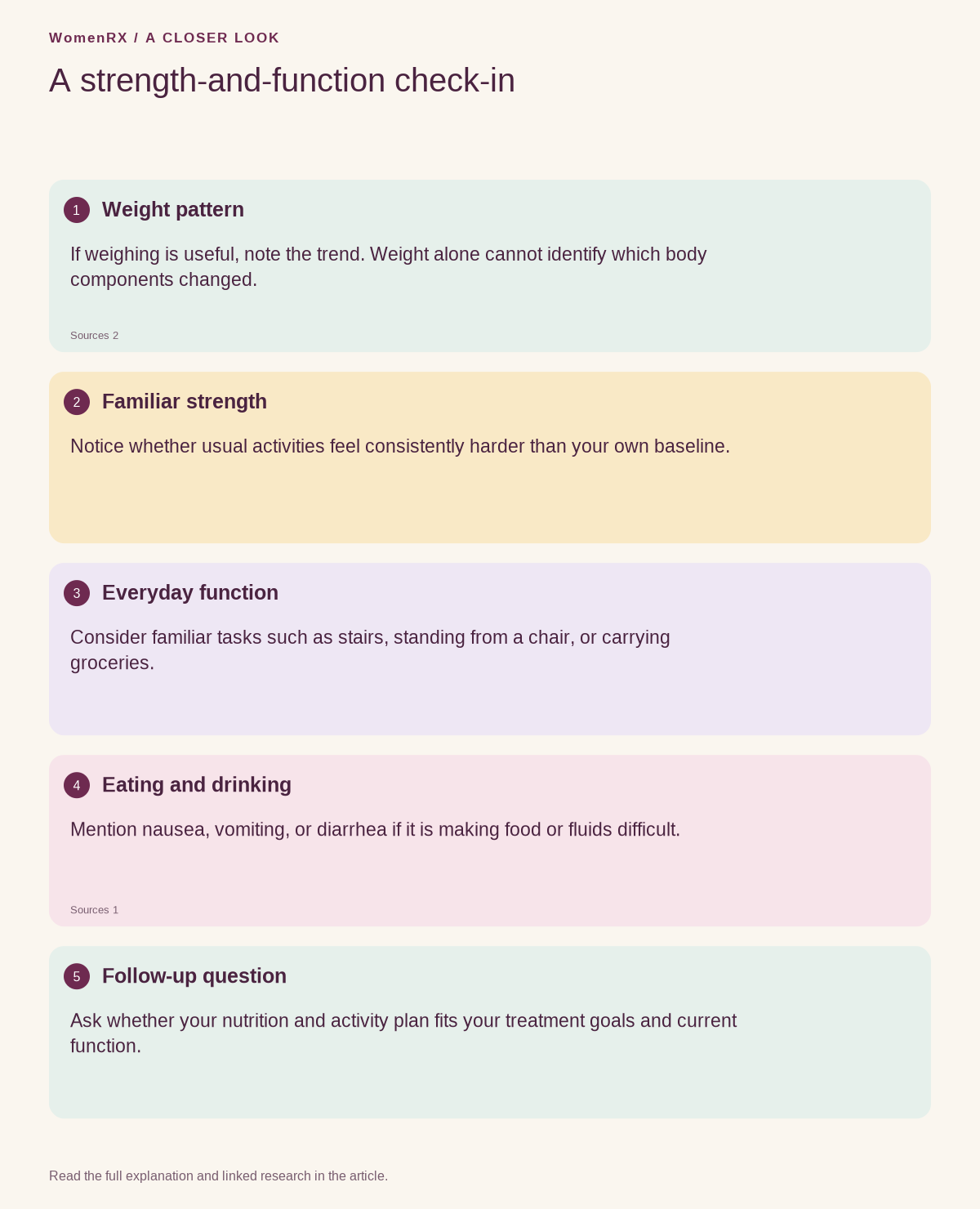
A strength-and-function check-in
Weight pattern: If weighing is useful, note the trend. Weight alone cannot identify which body components changed.2
Familiar strength: Notice whether usual activities feel consistently harder than your own baseline.
Everyday function: Consider familiar tasks such as stairs, standing from a chair, or carrying groceries.
Eating and drinking: Mention nausea, vomiting, or diarrhea if it is making food or fluids difficult.1
Follow-up question: Ask whether your nutrition and activity plan fits your treatment goals and current function.
Read the figure as text
These prompts can help you describe changes over time. They are conversation aids, not a diagnostic score, validated monitoring tool, or required tracking routine.- Weight pattern: If weighing is useful, note the trend. Weight alone cannot identify which body components changed.2
- Familiar strength: Notice whether usual activities feel consistently harder than your own baseline.
- Everyday function: Consider familiar tasks such as stairs, standing from a chair, or carrying groceries.
- Eating and drinking: Mention nausea, vomiting, or diarrhea if it is making food or fluids difficult.1
- Follow-up question: Ask whether your nutrition and activity plan fits your treatment goals and current function.
Sources you can check
- WEGOVY (SEMAGLUTIDE) INJECTION, SOLUTION WEGOVY (SEMAGLUTIDE) TABLET [NOVO NORDISK PHARMACEUTICAL INDUSTRIES, LP] | US prescribing information and patient instructionsAccessed 2026-09-25Return to first citation
- Body Weight: MedlinePlusAccessed 2026-09-25Return to first citation
- Lean Mass Changes With Incretin Therapy Versus Lifestyle Intervention: A Systematic Review and Meta-Analysis of Randomised Controlled Trials.Eisa N, Barood O. · Diabetes, obesity & metabolism · 2026Return to first citation
- Weight Loss-Dependent Changes in Body Composition and Bone Health in People With Obesity and Type 1 Diabetes Treated With Liraglutide, Semaglutide, or Tirzepatide.Al Ozairi E, Irshad M, Alkandri J, Mashankar A, Gray SR, le Roux CW. · Diabetes/metabolism research and reviews · 2026Return to first citation
- Effect of GLP-1 receptor agonists at doses for obesity management on muscle health: systematic review and meta-analysis of randomized controlled trials (RCTs).Laverde LP, Muñoz-Velandia OM, Alfonso D, Gómez Medina AM. · International journal of obesity (2005) · 2026Return to first citation