How to Track Wegovy Progress Beyond the Scale
A useful progress check considers your weight trend, treatment stage, side effects, and the health goals you set with your clinician.
Look for patterns over time, not a verdict from one weigh-in. Track your weight under consistent conditions if you choose to weigh yourself, and note where you are in dose escalation, how you’re tolerating treatment, and any changes in goals you and your clinician care about. Trial timelines aren’t personal deadlines, and the scale can’t show the whole picture. 1 2
Build a progress picture, not a pass-or-fail score
A scale measures total body weight, which includes water, muscle, bone, and fat. It can be useful for following a trend, but it can’t tell you by itself what changed or whether your health is improving. 1
If you weigh yourself, try to make the measurements comparable: use the same scale and similar conditions, and look at the pattern rather than letting one reading decide how treatment is going. You can also bring a simple record of those readings to a follow-up. There’s no need to turn weighing into a daily task if that doesn’t feel useful to you.
It may help to keep four things together:
- Weight trend: Your measurements over time, rather than a single number.
- Treatment stage: Whether you’re still following a dose-escalation plan or are at a maintenance stage. Record changes to that plan as your prescriber directs.
- Tolerability: Symptoms that affect eating, drinking, daily life, or your ability to continue treatment as planned. In a meta-analysis of trials in adults with overweight or obesity without type 2 diabetes, gastrointestinal adverse events overall were more frequent with semaglutide than with placebo. Nausea, vomiting, diarrhea, and constipation were among the commonly reported symptoms. 4
- Your health goals: The outcomes that matter to you and your clinician, such as waist measurement when it’s relevant to your care, or everyday changes you want to discuss. Body weight alone doesn’t capture every aspect of health. 1
Put the number in the context of treatment stage
Weight-management trials don’t treat dose escalation as the same thing as time on a stable dose. In STEP 1, a trial of injectable semaglutide in adults with overweight or obesity without diabetes, dose escalation lasted 16 weeks and was followed by 52 weeks of maintenance. That describes the study design, not a required timetable or a promise about when you should see a particular result. 2
The practical takeaway is to review progress alongside your current treatment stage. If your dose plan is still changing, or has been adjusted because of tolerability, discuss that context rather than comparing your progress with a headline trial result. The dose plan and whether it needs review belong in the conversation with your prescriber; if you’re considering a change because of a short-term scale reading, discuss that question with them.
Add useful outcomes, without tracking everything
Choose a small number of measures you and your clinician can actually use. Waist measurement may add context to weight because abdominal fat distribution is relevant to health risk, although a measurement on its own is not a full health assessment. 1 You might also note a change in appetite or how often thoughts about food interrupt your day if that matters to you.
One US survey offers a reason to consider that second kind of change, but not to treat it as a proven measure of success: 550 adults taking injectable semaglutide were asked to recall food-related thoughts before treatment and report them afterward. Most respondents were women, but the retrospective survey can’t establish that semaglutide caused the reported changes or show that they predict health outcomes. 5 If food preoccupation is part of your experience, a brief note about whether it’s changing may still help you describe your experience at a follow-up.
You don’t need a long list. A simple record of weight trend, treatment stage, tolerability, and one or two agreed health or day-to-day goals is often easier to review than a detailed log that becomes a burden.
When progress calls for a review
Bring the picture to your clinician if you’re unsure whether the plan is working for you, if your treatment stage or dose plan has changed, or if side effects are making treatment difficult to continue. A useful review asks more than “How much did I lose?” It can also ask whether the current plan is tolerable, whether the outcomes you chose are changing, and whether your goals still fit your health needs.
These studies don’t establish a personal weight-loss cutoff or deadline for deciding whether treatment is working. Trial averages describe groups, not an individual forecast. The overall results reported in these studies also can’t tell an individual reader whether women respond differently. 2 3 If a life-stage change or another health issue is relevant to your goals, mention it as context rather than assuming it explains a change in weight or treatment response.
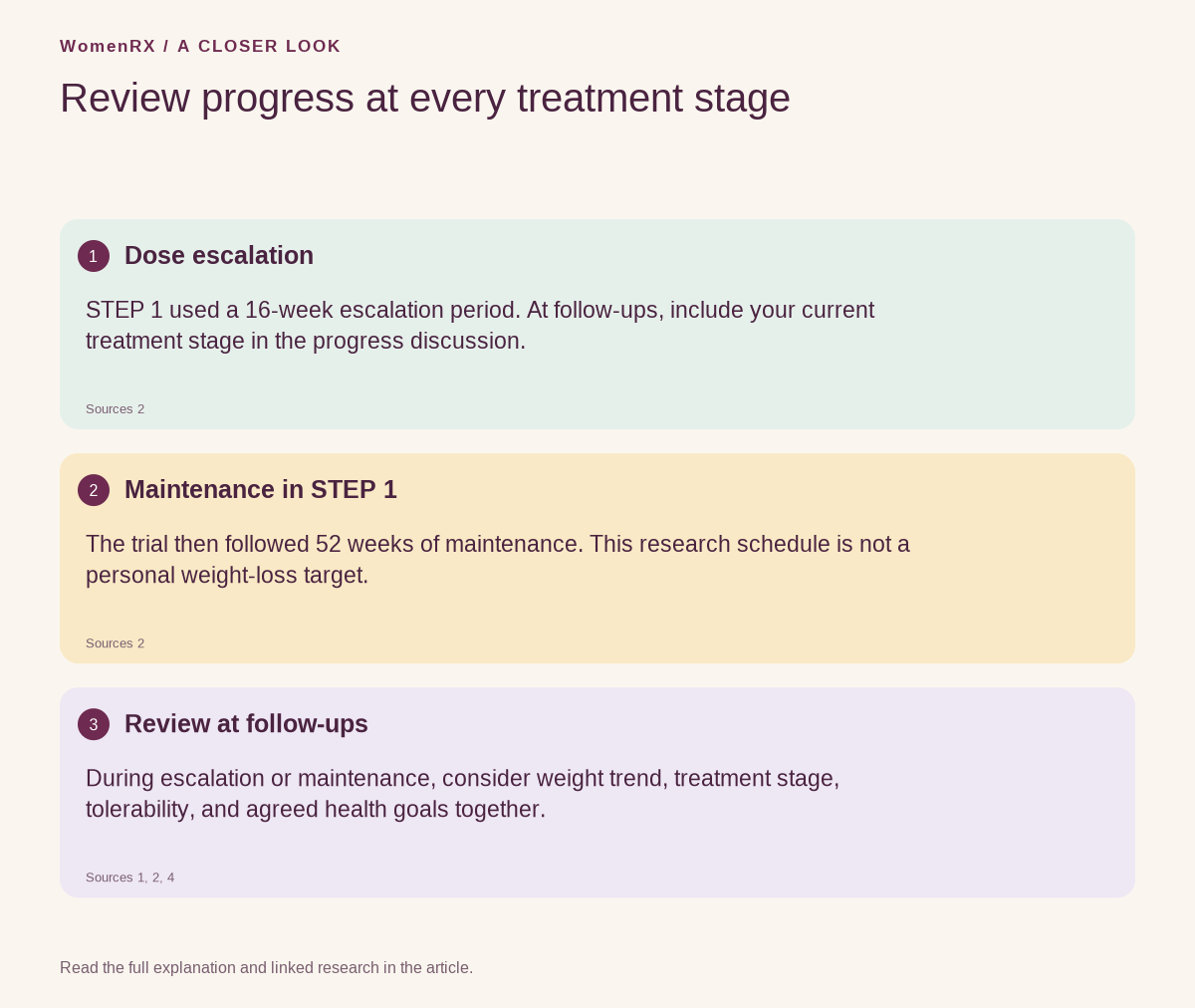
Review progress at every treatment stage
Dose escalation: STEP 1 used a 16-week escalation period. At follow-ups, include your current treatment stage in the progress discussion.2
Maintenance in STEP 1: The trial then followed 52 weeks of maintenance. This research schedule is not a personal weight-loss target.2
Review at follow-ups: During escalation or maintenance, consider weight trend, treatment stage, tolerability, and agreed health goals together.124
Read the figure as text
STEP 1’s escalation and maintenance periods describe one study’s design. The four-part progress review is useful at follow-ups during either stage, not only after the study periods end.- Dose escalation: STEP 1 used a 16-week escalation period. At follow-ups, include your current treatment stage in the progress discussion.2
- Maintenance in STEP 1: The trial then followed 52 weeks of maintenance. This research schedule is not a personal weight-loss target.2
- Review at follow-ups: During escalation or maintenance, consider weight trend, treatment stage, tolerability, and agreed health goals together.124
More questions, answered
Should I track appetite or thoughts about food?
You can, if those changes matter to you. A retrospective survey of adults taking injectable semaglutide, most of them women, found lower reported food-noise scores after treatment began, but it relied on people recalling their earlier experience and doesn’t establish cause or show that this is a validated measure of treatment success. 5
Does a study’s dose timeline set my personal deadline?
No. STEP 1 used 16 weeks of dose escalation followed by 52 weeks of maintenance, but that is the structure of one clinical trial, not an individual deadline for weight loss or a rule for when to change treatment. 2
Sources you can check
- Body Weight: MedlinePlusAccessed 2026-09-25Return to first citation
- Semaglutide 25 mg Oral Versus Semaglutide 2.4 mg Injectable: An Indirect Treatment Comparison of Weight Loss Outcomes.Plotkin M, Ivkovic M, Smith I, Rathor N, Chowdhury R, Hodkinson A, Kushner RF. · Diabetes, obesity & metabolism · 2026Return to first citation
- Effects of subcutaneous semaglutide on weight loss and inflammatory markers in adults with overweight or obesity without diabetes: a systematic review and meta-analysis.Milluzzo A, Oteri V, Manuella L, Pulvirenti A, Frittitta L. · International journal of obesity (2005) · 2026Return to first citation
- Effectiveness & safety of semaglutide in weight reduction in obese nondiabetic patients: A systematic review and meta-analysis.Naz F, Qaiser F, Mumtaz A, Din SU, Mustafa A, Ullah A, Perveen A, Malik J. · Medicine · 2026Return to first citation
- Retrospective Assessment of Food Noise Changes After Initiation of Injectable Semaglutide for Weight Management in the USA: The INFORM Survey.Arnaut T, Duncan S, Faurby M, Hahn-Pedersen JH, Kvist K, Steenackers N, Buse JB. · Advances in therapy · 2026Return to first citation