How to Review Your Progress on Zepbound
A useful check-in looks at your weight trend, treatment stage, side effects, and health goals together.
Zepbound may be working even if the scale hasn’t changed much yet, especially early in treatment. Review your weight trend alongside side effects, how the treatment fits your health goals, and where you are in dose escalation. In a tirzepatide trial analysis, many participants who had lost less than 5% by week 12 reached that mark later, so one early weigh-in isn’t a verdict. 2
Look for a trend, not a single weigh-in
Weight is useful information, but it includes more than body fat: muscle, bone, and water also affect the number. Everyday factors can shift it, too. Consider the direction of your weight over time rather than treating one reading as a pass-or-fail result. Waist circumference and your health history can add context, though neither tells the whole story on its own. 1
At follow-up, you might compare your recent weight pattern with the goals you set together. Those goals could include weight change, waist measurement, or a health concern that matters to you. A useful review asks not only “How much has my weight changed?” but also “Is this treatment helping with the goals we chose, and is the plan manageable?” Your goals may change, and that can be part of the discussion.
Your treatment stage changes what the numbers mean
A 12-week result is not automatically a final answer. In a post hoc analysis of SURMOUNT-1, researchers grouped 1,545 participants who had received at least 75% of assigned treatment doses and had weight measurements at weeks 0, 12, 24, and 72. Of these, 278 had lost less than 5% by week 12. Among that selected late-responder group, 70% had reached at least 5% weight loss by week 24 and 90% by week 72. These are trial findings, not a promise about what will happen for you. 2
Treatment stage helps explain why an early check can be hard to interpret. In SURMOUNT-1, participants’ assigned target doses were reached at week 4, 12, or 20, depending on their trial group. That study schedule isn’t a dosing instruction for you; it shows that some participants were still in the dose-escalation period at week 12. Your prescriber can interpret your progress in light of your own treatment plan and time on it. 2
So if your loss is slower than you hoped, bring the trend and the timeline into the conversation. A slower start doesn’t establish that treatment has failed, and the trial analysis doesn’t mean everyone should wait a particular length of time. The decision depends on your response, tolerability, goals, and individual plan.
Side effects are part of the effectiveness review
A treatment’s benefit is harder to sustain if side effects make it difficult to continue. Nausea, diarrhea, constipation, and reflux are among the gastrointestinal symptoms discussed in a review of incretin-based weight-management medicines. The review describes these symptoms as often appearing during dose escalation and notes that they can affect quality of life and adherence. Its findings cover several medicines, including tirzepatide, rather than Zepbound alone. 3
At follow-up, describe which symptoms you’re having, when they happen, and how much they interfere with eating, drinking, or everyday activities. You can also say plainly if side effects are making you consider stopping or changing treatment. That gives your prescriber a clearer picture of whether the current plan is both effective and tolerable; there isn’t one universally agreed strategy for managing these symptoms. 3
Put weight change beside the goals that matter to you
Your review can include more than the scale. MedlinePlus notes that weight alone doesn’t capture overall health, and that waist circumference and health history can help put weight in context. If you and your prescriber are following a particular health measure, bring that result into the discussion too. Avoid assuming that a weight change automatically means a specific health outcome has changed. 1
Women-specific evidence deserves careful interpretation. A retrospective UK digital weight-management service study compared women with and without self-reported PCOS, not women with men. At 10 months, the reported average weight changes were similar, but only 40 women with PCOS and 397 without PCOS had reached that follow-up point. Because it was an observational study of women in one service, it can’t establish whether women respond differently from men or predict an individual woman’s results. 4
A practical follow-up summary can be short: your weight trend, how far along you are in treatment, any side effects and their impact, and which health goals you want to revisit. That gives you and your prescriber more to work with than a single number.
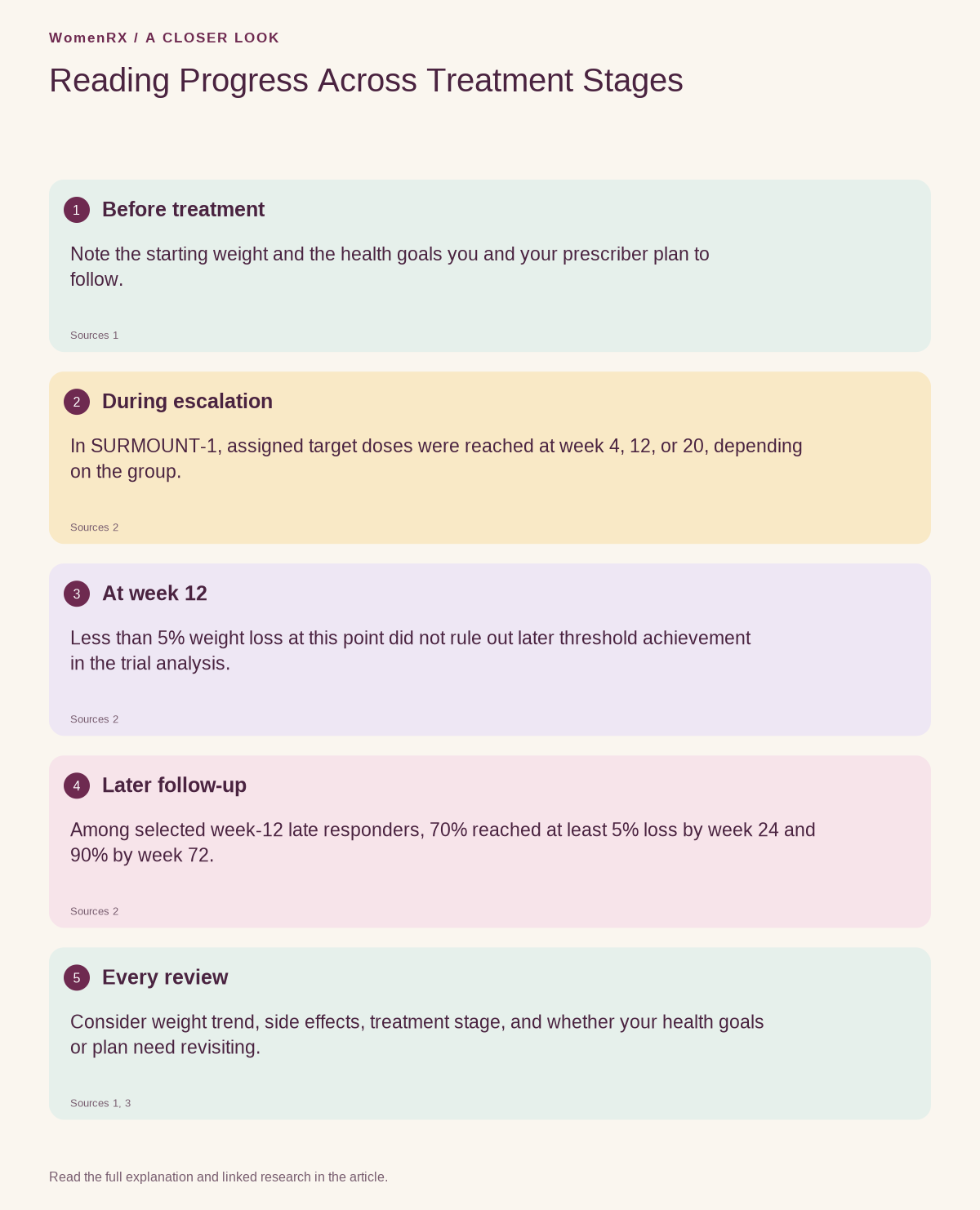
Reading Progress Across Treatment Stages
Before treatment: Note the starting weight and the health goals you and your prescriber plan to follow.1
During escalation: In SURMOUNT-1, assigned target doses were reached at week 4, 12, or 20, depending on the group.2
At week 12: Less than 5% weight loss at this point did not rule out later threshold achievement in the trial analysis.2
Later follow-up: Among selected week-12 late responders, 70% reached at least 5% loss by week 24 and 90% by week 72.2
Every review: Consider weight trend, side effects, treatment stage, and whether your health goals or plan need revisiting.13
Read the figure as text
These trial milestones show why a week-12 result may need context and why weight trend and tolerability belong in the same review.- Before treatment: Note the starting weight and the health goals you and your prescriber plan to follow.1
- During escalation: In SURMOUNT-1, assigned target doses were reached at week 4, 12, or 20, depending on the group.2
- At week 12: Less than 5% weight loss at this point did not rule out later threshold achievement in the trial analysis.2
- Later follow-up: Among selected week-12 late responders, 70% reached at least 5% loss by week 24 and 90% by week 72.2
- Every review: Consider weight trend, side effects, treatment stage, and whether your health goals or plan need revisiting.13
More questions, answered
Does losing less than 5% by week 12 mean Zepbound isn’t working?
Not by itself. In a post hoc analysis of selected SURMOUNT-1 participants who had lost less than 5% at week 12, 70% had reached at least 5% by week 24 and 90% by week 72. Those trial results don’t predict an individual outcome, but they show why an early threshold alone may not settle the question. 2
Sources you can check
- Body Weight: MedlinePlusAccessed 2026-09-25Return to first citation
- Weight reduction over time in tirzepatide-treated participants by early weight loss response: Post hoc analysis in SURMOUNT-1.Ard J, Lee CJ, Gudzune K, Addison B, Lingvay I, Cao D, Mast CJ, Stefanski A, Falcon B, Mojdami D. · Diabetes, obesity & metabolism · 2025Return to first citation
- Gastrointestinal Symptoms in Obesity Therapy: Mechanisms, Epidemiology, and Management Strategies.Witaszek T, Biesiada A, Iskra-Trifunović J, Babicki M, Mastalerz-Migas A, Kłoda K. · Biomedicines · 2025Return to first citation
- Weight loss outcomes with tirzepatide in women with and without self-reported polycystic ovary syndrome.Clift AK, Reisel D, Johnson H, Sattar N, Huang DR. · Journal of the Endocrine Society · 2026Return to first citation