How to Review and Potentially Lower Your Zepbound Costs
Start with what you pay for each fill, then compare that amount with the options available under your insurance and the manufacturer’s current self-pay terms.
The best cost check depends on how you pay. If you have insurance, ask your plan what it would charge for your prescribed Zepbound product and whether approval is required. If you pay yourself, compare a pharmacy quote with LillyDirect’s price for the same product and supply. On September 25, 2026, LillyDirect advertised four 2.5 mg single-dose vials, a 28-day supply, starting at $299; that isn’t a quote for every strength or format. 3
First, find the cost that keeps coming back
A Zepbound bill can contain more than the medication. To see where a change might help, separate the amount paid for each fill from any visits, lab work, injection supplies, delivery charges, or pharmacy fees you’re actually billed. A lower medication price won’t necessarily lower those other costs. LillyDirect, for example, describes its vial prices as medication prices rather than a complete visit or lab package, and says needles and syringes must be purchased. 3
Write down the product and format on your prescription, the quantity dispensed, what you paid for the medication, and any separate charges. This matters when comparing offers: a price for four single-dose vials over 28 days is not a price for a pen or for a full course of care. 3 If you haven’t filled the prescription yet, use the same details to request quotes you can compare side by side.
If you have insurance, check the price of your fill
Ask your plan whether it covers Zepbound for your situation, whether it requires approval before the fill, and what you would pay at the pharmacy you intend to use. Then ask that pharmacy to check the claim for the prescribed product and quantity. Your plan’s answer is more useful than a general statement that it covers weight-loss medications.
Coverage can also change during treatment. In a health-system survey of people prescribed semaglutide or tirzepatide for weight management, 512 respondents reported stopping treatment; among them, 37.7% cited discontinued insurance coverage and 20.3% cited high medication costs. The survey doesn’t predict your costs, but it shows why it’s worth checking what happens after the first fill, not just whether the first prescription goes through. 2
If you have Medicare Part D, there’s a separate question to ask. The Medicare GLP-1 Bridge is a temporary program for eligible beneficiaries that runs from July 1, 2026, through December 31, 2027. CMS lists a $50 copay for drugs furnished through the Bridge, outside the usual Part D payment flow. That does not mean every person with Medicare, or every Zepbound prescription, qualifies. Check the program’s drug and eligibility rules through Medicare.gov’s GLP-1 Bridge information or 1-800-MEDICARE before counting on that price. 4
If you pay yourself, compare the same product and supply
A dated manufacturer price gives you a reference point, not a guaranteed bill. On September 25, 2026, LillyDirect advertised starting prices of $299 for four 2.5 mg single-dose Zepbound vials and $399 for four 5 mg single-dose vials, each described as a 28-day supply. Its listed starting price for four vials at the 7.5 mg and higher strengths was $449 under Journey Program conditions, including a refill within 45 days; without that timing, the listed regular prices were $499 for 7.5 mg and $699 for each higher strength. Eligibility and savings limits apply, and prices can change. The 2.5 mg strength is a starting dose, not a maintenance-price estimate. 3
For a useful comparison, ask a pharmacy for the total price of your prescribed format, strength, and quantity, including any separate pharmacy charge. Compare that with the applicable LillyDirect terms and any supplies you’d need. LillyDirect listed delivery as free for its vial offering but required a separate needle and syringe purchase. Its vial prices shouldn’t be treated as KwikPen or single-dose pen prices. 3 If a program’s refill condition doesn’t fit your treatment plan, ask about the regular price rather than changing when or how you take the medicine to meet a discount rule.
Keep a treatment change separate from a price change
Cost options generally turn on coverage and program rules, not whether you’re a woman. One planning question may be specific to you, though: if you’re pregnant or planning pregnancy, Zepbound’s prescribing information says to tell your healthcare provider because of potential fetal risk. Ask how that affects the treatment plan and any medication costs you’re projecting. 1
Your next move is the one that matches your bill: get a plan-and-pharmacy cost for the prescribed fill if you’re insured, or a like-for-like pharmacy and manufacturer comparison if you’re paying yourself. Keep separate charges alongside those figures so a promising medication price doesn’t hide the total you’d pay.
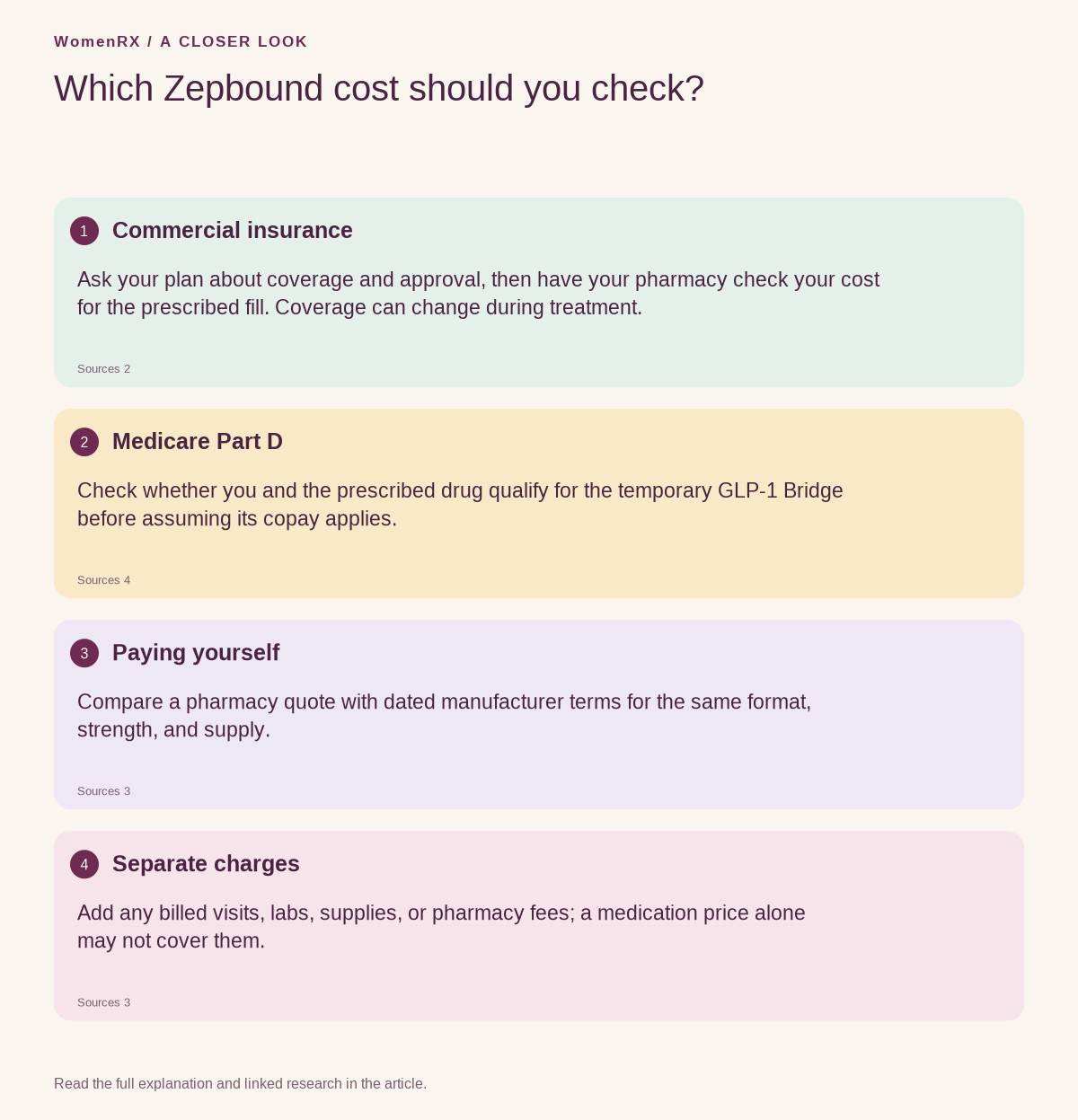
Which Zepbound cost should you check?
Commercial insurance: Ask your plan about coverage and approval, then have your pharmacy check your cost for the prescribed fill. Coverage can change during treatment.2
Medicare Part D: Check whether you and the prescribed drug qualify for the temporary GLP-1 Bridge before assuming its copay applies.4
Paying yourself: Compare a pharmacy quote with dated manufacturer terms for the same format, strength, and supply.3
Separate charges: Add any billed visits, labs, supplies, or pharmacy fees; a medication price alone may not cover them.3
Read the figure as text
Start with how you pay, then compare prices for the prescribed product and identify charges outside the medication price.- Commercial insurance: Ask your plan about coverage and approval, then have your pharmacy check your cost for the prescribed fill. Coverage can change during treatment.2
- Medicare Part D: Check whether you and the prescribed drug qualify for the temporary GLP-1 Bridge before assuming its copay applies.4
- Paying yourself: Compare a pharmacy quote with dated manufacturer terms for the same format, strength, and supply.3
- Separate charges: Add any billed visits, labs, supplies, or pharmacy fees; a medication price alone may not cover them.3
More questions, answered
Does a manufacturer vial price include appointments and supplies?
Not necessarily. LillyDirect describes its Zepbound vial prices as medication prices, not a visit or lab package, and says needles and syringes must be purchased separately. 3
Is the Medicare GLP-1 Bridge copay part of my Part D deductible?
No. CMS says eligible drugs furnished through the Bridge have a $50 copay outside the Part D payment flow. The Part D deductible doesn’t apply, and that copay doesn’t count toward true out-of-pocket costs under Part D. Eligibility still has to be checked. 4
Sources you can check
- ZEPBOUND (TIRZEPATIDE) INJECTION, SOLUTION ZEPBOUND (TIRZEPATIDE) INJECTION, SOLUTION ZEPBOUND KWIKPEN (TIRZEPATIDE) INJECTION, SOLUTION [ELI LILLY AND COMPANY] | US prescribing information and patient instructionsAccessed 2026-09-25Return to first citation
- Patient characteristics and early experiences with anti-obesity medications: the CAMP study.Tewksbury C, Soliva EA, Scheffey K, Kwong PL, Glanz K. · Frontiers in nutrition · 2026Return to first citation
- LillyDirect: Zepbound self-pay product pricesAccessed 2026-09-25Return to first citation
- Medicare GLP-1 BridgeAccessed 2026-09-25Return to first citation