Is a Compounded Tirzepatide Offer Worth the Lower Price?
A lower quote tells you what you might pay, not whether the compounded product matches an approved tirzepatide medicine.
Compare the full bill, not just the advertised starting price. On September 25, 2026, Lilly listed four 2.5 mg Zepbound single-dose vials for a 28-day supply at $299; Mochi advertised compounded tirzepatide starting at $90 per month, plus a separate membership starting at $79 for one month.67 Those aren’t matched product quotes. Check the formulation, independently check the dispensing pharmacy, and establish who provides follow-up before judging the savings.2
A compounded tirzepatide offer may look simpler than the bill for an approved product. But the two prices may not buy the same formulation, services, or degree of evidence. Before deciding whether the savings matter to you, compare the actual offers in four parts.
Find out what the offer contains
Ask for the exact product description in writing: its ingredients, form, and dispensing pharmacy. Don’t assume that “tirzepatide” on an advertisement means the product is the same as Zepbound or Mounjaro.
Zepbound is an approved tirzepatide product with product-specific prescribing information. A compounded preparation is not that approved product, and an advertisement calling it “personalized” does not establish equivalent safety or effectiveness. A 2026 editorial described restrictions on compounded copies after shortages resolved. Whether a particular offer meets applicable rules depends on the actual prescription and product, not the wording of the ad.12
In a search of compounding websites conducted in early 2025, researchers found semaglutide and tirzepatide offerings that differed from approved products. Across the offerings, some had added ingredients, while others were made for use under the tongue or as orally disintegrating tablets. The abstract does not specify which of those formulation types applied to tirzepatide. That was a search of selected websites at a particular time, not an inventory of every offer available now. The authors concluded that the safety and effectiveness of these distinct formulations were largely unknown.2
An added ingredient deserves its own question: Why is it there, and what evidence supports this combination? In one laboratory study, researchers detected a previously unidentified impurity in samples of compounded tirzepatide combined with certain forms of vitamin B12. They did not establish what clinical effects, if any, that impurity has. The finding is a reason to ask about a particular combination, not proof that every compounded vial contains it.3
Identify the people behind the prescription and supply
Ask who evaluates you and writes the prescription, the name of the pharmacy that dispenses the medication, and whom you can reach with a question about the product you receive. If an offer names only a platform or clinic, ask it to identify the dispensing pharmacy before you pay. Then contact your state board of pharmacy to ask how to check that pharmacy’s license for dispensing to you. A name on a seller’s website isn’t an independent check. Even a license check won’t tell you whether a particular compounded formulation has the same evidence as Zepbound or whether a specific prescription meets compounding rules.12
Also ask how your usual care team will know what you’re taking. A U.S. primary-care record study covering 2021 through 2024 found compounded semaglutide or tirzepatide documented for 8.2% of patients with recorded use of either drug. Because the study identified compounded use from clinical notes, it cannot tell whether every other patient’s clinician was unaware of it. It does, however, show why a clear medication record is worth arranging when care involves more than one provider.5
Compare the bill you would actually pay
Published prices show why the first number you see may not settle the comparison. On September 25, 2026, Lilly listed a starting price of $299 for four Zepbound 2.5 mg single-dose vials, a 28-day supply. Needles and syringes were a separate purchase; delivery was listed as free. That price is for the medication, not a package of visits or labs, and 2.5 mg is a starting dose rather than an approved maintenance dose.61
On the same date, Mochi advertised compounded tirzepatide starting at $90 per month, with medication pricing dependent on dose and pharmacy, and a separate $79 one-month membership. Its FAQ said shipping was included in the medication price. Adding those two advertised starting charges gives $169 for a month of membership and medication if you qualify for that starting medication price. The FAQ does not specify the exact quantity dispensed at that price, so $169 cannot be treated as a like-for-like price for Lilly’s four 2.5 mg vials.7
Put your actual offers on the same time basis. Request a written breakdown of the medication charge and any separate charges for visits, membership, supplies, and shipping. Ask whether the quoted price changes later, what happens if treatment is paused, and whether follow-up is included or billed separately. These are questions for the seller, not costs you should assume every program charges.
Then compare what each quote includes. An offer that looks cheaper at checkout may leave questions about ongoing care or the dispensed product unanswered. Conversely, a higher price isn’t proof that every service you need is included. You don’t need a universal price threshold to make this comparison useful; you need the terms for the two options actually available to you.
Make room for clinical follow-up
Zepbound’s prescribing information documents safety warnings for that approved product. It describes nausea, vomiting, or diarrhea that can lead to dehydration and kidney injury, as well as symptoms of possible pancreatitis, including persistent or severe abdominal pain that may spread to the back.1 Those warnings matter in a conversation about tirzepatide, but Zepbound’s label does not establish the safety or quality of any particular compounded formulation.
Ask the prescriber who will respond if side effects make it hard to drink fluids, and what to do if you develop persistent or severe abdominal pain. If you’re pregnant, planning a pregnancy, or breastfeeding, bring that up before choosing either option so the prescriber can discuss your circumstances. Zepbound’s labeling warns about use during pregnancy and notes that information on effects in breastfed infants is unavailable.1 Don’t assume advice about an approved product answers every question about a compounded mixture.
It’s also worth keeping the limits of safety comparisons straight. An analysis of U.S. adverse-event reports found signals involving side effects, medication errors, and product-quality problems among reports involving compounded GLP-1 medicines. It pooled several drugs, including tirzepatide, and reports cannot establish how often an event occurs or prove that compounding caused it.4 That evidence raises questions worth asking; it doesn’t produce a reliable personal risk estimate.
The decision is not simply “lower price versus higher price.” It’s whether you can identify the product, independently check the dispensing pharmacy, understand the complete bill, and get a clear plan for follow-up, while recognizing that a compounded offer hasn’t been shown equivalent to an approved product.2
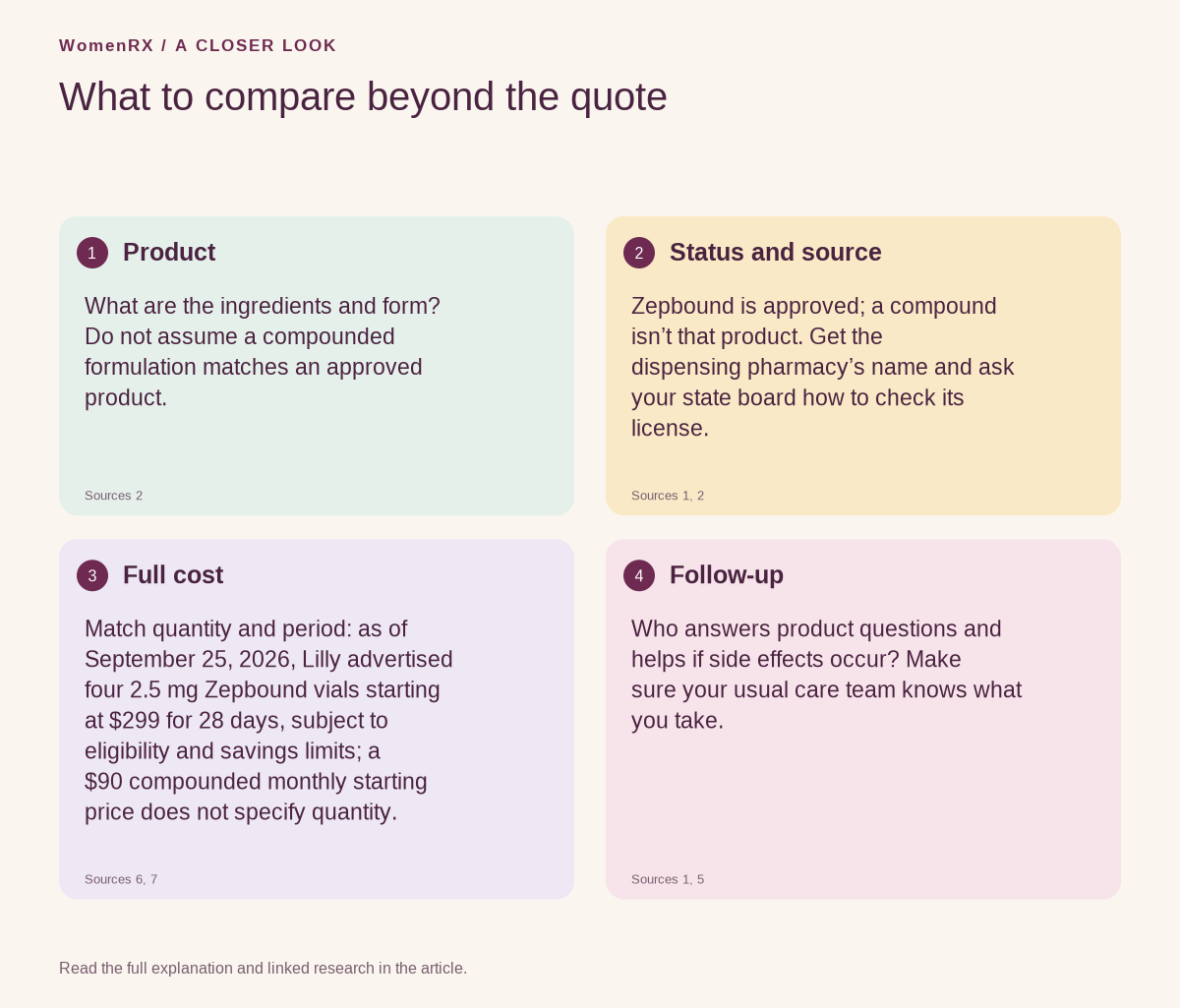
What to compare beyond the quote
Product: What are the ingredients and form? Do not assume a compounded formulation matches an approved product.2
Status and source: Zepbound is approved; a compound isn’t that product. Get the dispensing pharmacy’s name and ask your state board how to check its license.12
Full cost: Match quantity and period: as of September 25, 2026, Lilly advertised four 2.5 mg Zepbound vials starting at $299 for 28 days, subject to eligibility and savings limits; a $90 compounded monthly starting price does not specify quantity.67
Follow-up: Who answers product questions and helps if side effects occur? Make sure your usual care team knows what you take.15
Read the figure as text
Use the same questions for a compounded offer and an approved-product offer; record the answers for the specific options you’re considering.- Product: What are the ingredients and form? Do not assume a compounded formulation matches an approved product.2
- Status and source: Zepbound is approved; a compound isn’t that product. Get the dispensing pharmacy’s name and ask your state board how to check its license.12
- Full cost: Match quantity and period: as of September 25, 2026, Lilly advertised four 2.5 mg Zepbound vials starting at $299 for 28 days, subject to eligibility and savings limits; a $90 compounded monthly starting price does not specify quantity.67
- Follow-up: Who answers product questions and helps if side effects occur? Make sure your usual care team knows what you take.15
More questions, answered
Does an added vitamin make compounded tirzepatide more effective?
Don’t assume it does. An editorial reporting a limited website search found little justification for some added nutrients in distinct compounded semaglutide and tirzepatide offerings, while the safety and effectiveness of the resulting formulations remained largely unknown.2 Ask what benefit is claimed for the specific ingredient and what evidence supports that claim.
Can adverse-event reports tell me which option is safer?
Not on their own. Reports can flag problems that merit attention, but they don’t establish how many people used each product or whether the product caused a reported event. The available analysis also combined tirzepatide with other GLP-1 medicines.4
Sources you can check
- ZEPBOUND (TIRZEPATIDE) INJECTION, SOLUTION ZEPBOUND (TIRZEPATIDE) INJECTION, SOLUTION ZEPBOUND KWIKPEN (TIRZEPATIDE) INJECTION, SOLUTION [ELI LILLY AND COMPANY] | US prescribing information and patient instructionsAccessed 2026-09-25Return to first citation
- Compounded Semaglutide and Tirzepatide Products Use Unique Formulations but Efficacy and Safety Largely Unknown.Belcourt J, Sapowadia A, White CM. · The Annals of pharmacotherapy · 2026Return to first citation
- A novel, widespread impurity in mass-compounded tirzepatide/B12 products: potential patient safety implications.Jordan B, Arbogast L, Clemens M, Huang L, Snyder M. · Expert opinion on drug safety · 2026Return to first citation
- Safety analysis of compounded GLP-1 receptor agonists: a pharmacovigilance study using the FDA adverse event reporting system.McCall KL, Mastro Dwyer KA, Casey RT, Samana TN, Sulicz EK, Tso SY, Yalanzhi ER, Piper BJ. · Expert opinion on drug safety · 2026Return to first citation
- Documentation of Compounded GLP-1 Receptor Agonists in a Large Primary Care Dataset.Hendrix N, Velásquez EE, Pham H, Bazemore A. · Pharmacoepidemiology and drug safety · 2025Return to first citation
- LillyDirect: Zepbound self-pay product pricesAccessed 2026-09-25Return to first citation
- Mochi: monthly membership and dose-dependent compounded medication pricesAccessed 2026-09-25Return to first citation