What to Ask Before Choosing Compounded Tirzepatide
Before agreeing to a compounded preparation, get clear on why it’s being proposed, exactly what you’d receive, and which approved options you can compare it with.
Start with the reason for compounding. Ask what need the proposed preparation meets, which pharmacy would make it, what’s in it, and how you’d use it. Ask what currently permits this specific preparation to be supplied, then compare it with approved options and agree on follow-up. Compounded incretin medicines aren’t FDA-approved, and evidence about their safety and effectiveness is limited. 347
The useful first question isn’t simply “Is compounding safe?” It’s “What problem is this preparation meant to solve, and what else could address it?” Compounded tirzepatide isn’t FDA-approved, and available evidence doesn’t establish that altered formulations work as well as approved products or have the same safety profile. 37
Begin with the reason
Ask your prescriber to name the specific reason for proposing compounding. Is there a documented concern about an ingredient in an approved medicine, or another reason a different preparation is being considered? A 2026 report for nurse practitioners describes a narrow potential role for compounded medicines in people with documented allergies. Separately, an American College of Clinical Pharmacy review recommends making efforts to help patients obtain approved medicines whenever possible. 47
If cost or insurance coverage is the barrier, say that directly. In a US electronic-health-record study, insurance and cost were among the most commonly documented reasons for difficulty starting or continuing treatment. That finding describes access barriers; it doesn’t show that a compounded product will be less expensive or a suitable substitute. Ask which approved options and access routes are realistic for you. 5
Ask what you would actually receive
“Compounded tirzepatide” isn’t enough information to compare preparations. Ask for the dispensing pharmacy’s name and written details: the active ingredient, concentration and amount in each dose, route, any added ingredients, storage instructions, and beyond-use date. Ask how the dose is measured and for clear instructions you can refer to at home.
These are practical questions because compounded products identified in an online search included different routes and added ingredients. In that sample, many listings did not report storage preferences or a beyond-use date. The findings don’t describe every pharmacy or product, but they show why it’s worth asking for the details of the specific preparation rather than relying on a general description. The authors also found little justification for some added ingredients and noted that evidence for altered formulations is limited. 3
Ask who you can contact if the label, measuring device, or directions are unclear. Approved Mounjaro and Zepbound products have product-specific preparation and use instructions; don’t assume those instructions apply to a different preparation. 12
Compare evidence and practical tradeoffs
Ask how the proposed preparation differs from an approved product, including its ingredients and form. If it’s described as “the same,” ask what is known about this exact formulation and what is being inferred from research on approved tirzepatide. If availability is part of the proposal, ask the named pharmacy whether it can fill this specific prescription now. 37
Ask your prescriber or the pharmacy a separate question: What is the current regulatory basis for compounding and supplying this exact preparation? Reports published after tirzepatide shortages were resolved describe restrictions on compounded copies, but they can’t determine whether a particular prescription may be supplied today. A pharmacy’s ability to fill an order, the product’s lack of FDA approval, and whether supplying it is permitted are different questions. 34
A clinical-practice review reports limited data on positive outcomes in small groups of people using compounded incretin medicines. A separate study of FDA adverse-event reports found stronger reporting signals for some events and product-quality problems with compounded GLP-1 medicines. That study included tirzepatide along with other medicines in the class. Because spontaneous reports don’t provide the number of people who used each product, they can’t show how often harm occurs or prove that a product caused an event. 67
Compare the proposed preparation with approved medicines and other options your prescriber considers appropriate. Discuss the product form, clarity of instructions, access, and follow-up, not just the quoted price. A price alone doesn’t establish that two products or their overall costs are comparable.
Include the questions that are personal to you
If you’re pregnant, planning pregnancy, breastfeeding, or using contraception, tell your prescriber before deciding. Ask what guidance applies to the exact product and your circumstances, including whether your contraception plan needs attention. Don’t assume that information about an approved product answers every question about a different preparation.
Before choosing, agree on who will follow up, how you’ll raise a product or dosing question, and how the plan will be reviewed for safety and effectiveness. The clinical-practice review recommends routine monitoring when someone chooses a compounded incretin medicine. 7
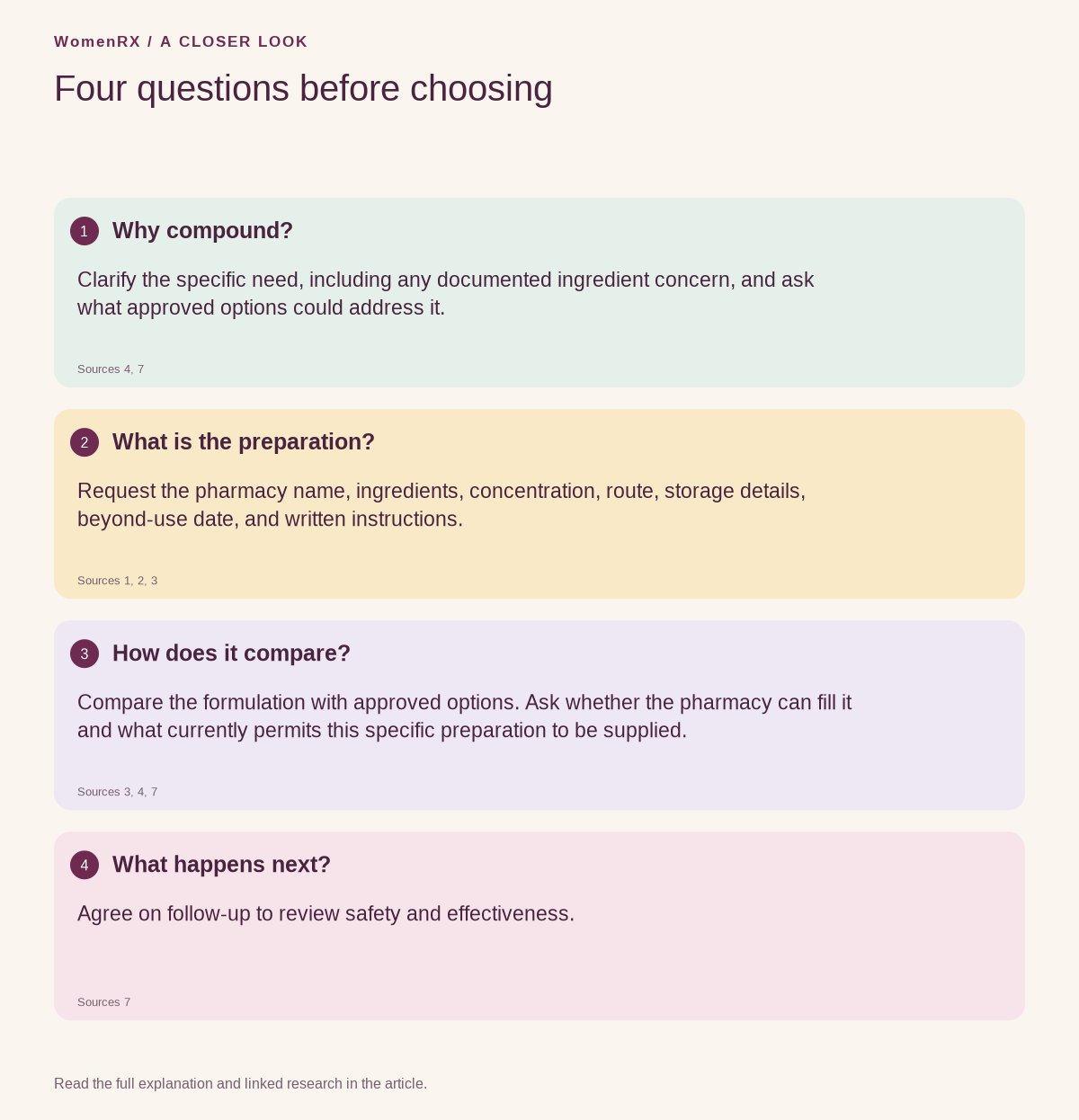
Four questions before choosing
Why compound?: Clarify the specific need, including any documented ingredient concern, and ask what approved options could address it.47
What is the preparation?: Request the pharmacy name, ingredients, concentration, route, storage details, beyond-use date, and written instructions.123
How does it compare?: Compare the formulation with approved options. Ask whether the pharmacy can fill it and what currently permits this specific preparation to be supplied.347
What happens next?: Agree on follow-up to review safety and effectiveness.7
Read the figure as text
Move from the reason for compounding to the exact preparation, a comparison with alternatives, and a follow-up plan.- Why compound?: Clarify the specific need, including any documented ingredient concern, and ask what approved options could address it.47
- What is the preparation?: Request the pharmacy name, ingredients, concentration, route, storage details, beyond-use date, and written instructions.123
- How does it compare?: Compare the formulation with approved options. Ask whether the pharmacy can fill it and what currently permits this specific preparation to be supplied.347
- What happens next?: Agree on follow-up to review safety and effectiveness.7
More questions, answered
What if I’m concerned about an ingredient in an approved product?
Ask which ingredient is the concern and whether the proposed preparation avoids it. A nurse-practitioner report describes documented allergies as a possible narrow reason to consider compounding. Separately, an American College of Clinical Pharmacy review recommends making efforts to obtain approved medicines whenever possible. 47
Do adverse-event reports prove compounded tirzepatide is more dangerous?
No. The study analyzed spontaneous reports for several GLP-1 medicines, including tirzepatide. It found stronger reporting signals for some events and product-quality concerns, but those reports can’t show the rate of harm among users or prove that a compounded product caused an event. 6
Sources you can check
- ZEPBOUND (TIRZEPATIDE) INJECTION, SOLUTION ZEPBOUND (TIRZEPATIDE) INJECTION, SOLUTION ZEPBOUND KWIKPEN (TIRZEPATIDE) INJECTION, SOLUTION [ELI LILLY AND COMPANY] | US prescribing information and patient instructionsAccessed 2026-09-25Return to first citation
- MOUNJARO (TIRZEPATIDE) INJECTION, SOLUTION MOUNJARO KWIKPEN (TIRZEPATIDE) INJECTION, SOLUTION [ELI LILLY AND COMPANY] | US prescribing information and patient instructionsAccessed 2026-09-25Return to first citation
- Compounded Semaglutide and Tirzepatide Products Use Unique Formulations but Efficacy and Safety Largely Unknown.Belcourt J, Sapowadia A, White CM. · The Annals of pharmacotherapy · 2026Return to first citation
- The "microdosing" dilemma: Balancing patient anecdotes with clinical safety amid GLP-1 compounding restrictions.Trainer N. · Journal of the American Association of Nurse Practitioners · 2026Return to first citation
- Auditable large language model curation of clinical notes refines glucagon-like peptide-1 initiation, persistence ascertainment, and compounding use beyond prescription records.Varma G, Murugadoss K, Kurian ME, Varghese J, Venkatakrishnan AJ, Soundararajan V. · Biology methods & protocols · 2026Return to first citation
- Safety analysis of compounded GLP-1 receptor agonists: a pharmacovigilance study using the FDA adverse event reporting system.McCall KL, Mastro Dwyer KA, Casey RT, Samana TN, Sulicz EK, Tso SY, Yalanzhi ER, Piper BJ. · Expert opinion on drug safety · 2026Return to first citation
- Compounded incretins in clinical practice: An opinion of the endocrine and metabolism practice and research network of the American College of Clinical Pharmacy.Courtney LA, Clements JN, Isaacs D, Pitlick JM, Reece SM, Whitley HP. · Diabetes & metabolic syndrome · 2025Return to first citation