When Is Compounded Semaglutide Worth Considering?
The useful first question is why you need this particular preparation instead of an approved option.
Compounded semaglutide may address an individual need, but it isn’t an FDA-approved equivalent to a branded product, and evidence for many compounded formulations is limited. Ask why compounding is proposed, exactly what would be prescribed, which pharmacy would prepare it, and what approved alternatives fit your situation. If pregnancy or breastfeeding is relevant, ask about the exact product and its ingredients. 3 7 1 2
Start with the reason for compounding
If compounded semaglutide has been offered to you, ask your prescriber: What need does this specific preparation meet that an approved product doesn’t? That question is different from asking whether semaglutide itself can help with weight management. Compounded incretin medicines don’t undergo FDA approval, and a pharmacy practice review describes only limited clinical-outcome evidence from small groups of people using them. The review recommends helping patients obtain approved medicines when possible. 7
There may be an individual reason to discuss a different preparation. A brief report describes a narrow potential role for compounding in people with documented allergies. It doesn’t establish that any particular compounded formulation is suitable for someone with an allergy. Ask which ingredient is the concern and how the proposed preparation addresses it. 4
If the reason is cost or difficulty obtaining an approved medicine, say that plainly. Ask what options are available to you and what each would cost in your circumstances. Don’t assume compounding is cheaper or that an access problem, by itself, explains why this particular prescription can be compounded. Ask the prescriber to check the rules that apply to it now. 3 7
Get the exact prescription, not just the word “semaglutide”
Ask whether the proposed product is an injection or another form, what ingredients it contains, and what concentration and amount the prescription specifies. If it’s supplied in a vial, have the prescriber or dispensing pharmacist show you how the prescribed amount matches the markings on the device you’d actually use. Instructions for a prefilled pen aren’t instructions for a different product.
This detail matters because compounded preparations aren’t all the same. A review of compounded semaglutide and tirzepatide products advertised online found differing routes of administration and combinations with added ingredients. Its authors said the safety and effectiveness of these formulations were largely unknown; they had not established that alternate oral forms offered an advantage over approved oral tablets. A separate review raises concerns about dosing errors and product quality. 3 5
If an added ingredient is presented as a benefit, ask what evidence supports that claim for the combination you’d receive. For example, the review of advertised products found little justification for adding several ingredients, including nutrients, to injectable combinations. An ingredient’s presence doesn’t show that it improves weight-loss results. 3
Know the pharmacy and the plan for questions
Get the compounding pharmacy’s name and contact information. Ask who can explain the product label, storage instructions and beyond-use date, and who you should contact if the preparation or directions differ from what you expected. Information about storage and beyond-use dates was often absent from the advertised products examined in one review. That finding isn’t a judgment about the pharmacy you’re considering, but it makes these details worth confirming directly. 3
Also ask who will assess how you’re doing and help resolve a dosing concern. In an analysis of US adverse-event reports for several GLP-1 medicines, reports involving compounded products had higher reporting odds for some symptoms, preparation problems and product-quality issues than reports involving noncompounded products. Reports can flag concerns, but they can’t tell you your chance of having a problem or prove that compounding caused a reported event. 6
Compare the option you can actually use
Ask which approved treatment fits your reason for considering semaglutide and what you’d gain or give up with each option. Compare the form of medicine, the instructions you’d need to follow, access, cost and who would answer questions afterward. An approved semaglutide product and a compounded preparation may contain the same named active ingredient without having the same formulation, instructions or evidence behind them. 3 7
Pregnancy planning or breastfeeding makes the exact product especially important. Wegovy injection information warns of potential harm to an unborn baby and says to stop that product two months before a planned pregnancy. Patient information for certain approved oral semaglutide tablets says breastfeeding isn’t recommended during treatment. These are product-specific instructions, not evidence that a compounded preparation, including one with added ingredients, is safe during pregnancy or breastfeeding. Tell your prescriber if either situation applies before choosing a product. 1 2 7
You don’t need a blanket answer about whether compounding is “good” or “bad.” You need an answer about this prescription: why it’s proposed, what you’d receive, who prepares and supports it, and which approved options you’ve compared.
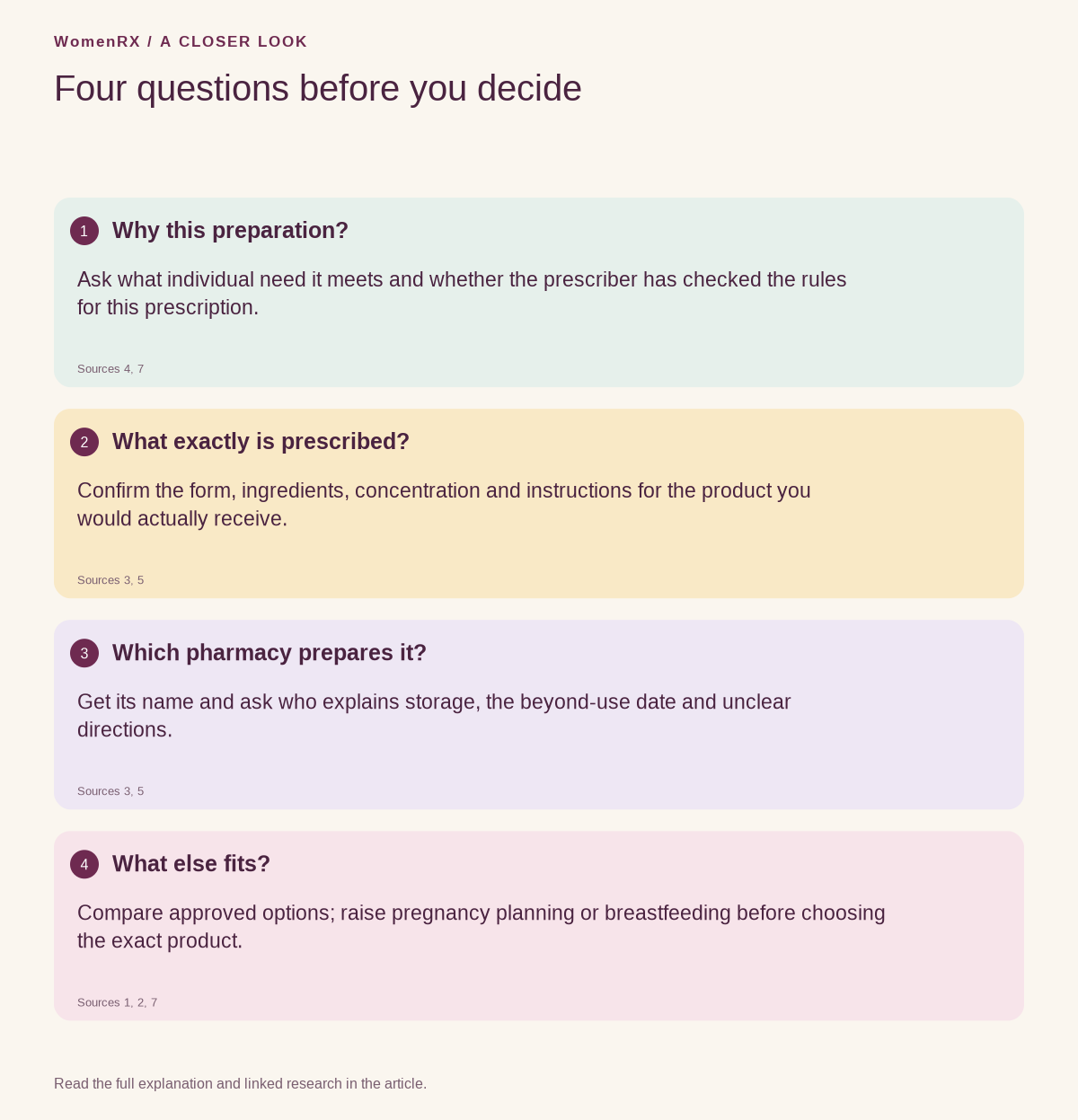
Four questions before you decide
Why this preparation?: Ask what individual need it meets and whether the prescriber has checked the rules for this prescription.47
What exactly is prescribed?: Confirm the form, ingredients, concentration and instructions for the product you would actually receive.35
Which pharmacy prepares it?: Get its name and ask who explains storage, the beyond-use date and unclear directions.35
What else fits?: Compare approved options; raise pregnancy planning or breastfeeding before choosing the exact product.127
Read the figure as text
Move from the reason for compounding to the product, the pharmacy and the alternatives.- Why this preparation?: Ask what individual need it meets and whether the prescriber has checked the rules for this prescription.47
- What exactly is prescribed?: Confirm the form, ingredients, concentration and instructions for the product you would actually receive.35
- Which pharmacy prepares it?: Get its name and ask who explains storage, the beyond-use date and unclear directions.35
- What else fits?: Compare approved options; raise pregnancy planning or breastfeeding before choosing the exact product.127
More questions, answered
Does added vitamin B12 mean compounded semaglutide works better?
No added benefit has been established just because B12 is included. A review of advertised compounded semaglutide and tirzepatide products found little justification for adding several ingredients, including nutrients, to injectable combinations. Ask what evidence supports a claimed benefit for the specific product offered to you. 3
Sources you can check
- WEGOVY (SEMAGLUTIDE) INJECTION, SOLUTION WEGOVY (SEMAGLUTIDE) TABLET [NOVO NORDISK PHARMACEUTICAL INDUSTRIES, LP] | US prescribing information and patient instructionsAccessed 2026-09-25Return to first citation
- OZEMPIC (ORAL SEMAGLUTIDE) TABLET RYBELSUS (ORAL SEMAGLUTIDE) TABLET [NOVO NORDISK PHARMACEUTICAL INDUSTRIES, LP] | US prescribing information and patient instructionsAccessed 2026-09-25Return to first citation
- Compounded Semaglutide and Tirzepatide Products Use Unique Formulations but Efficacy and Safety Largely Unknown.Belcourt J, Sapowadia A, White CM. · The Annals of pharmacotherapy · 2026Return to first citation
- The "microdosing" dilemma: Balancing patient anecdotes with clinical safety amid GLP-1 compounding restrictions.Trainer N. · Journal of the American Association of Nurse Practitioners · 2026Return to first citation
- Navigating compounded semaglutide: what health care providers need to know.Liu G, Jarema M, Mo M, Stievater T. · The American journal of managed care · 2025Return to first citation
- Safety analysis of compounded GLP-1 receptor agonists: a pharmacovigilance study using the FDA adverse event reporting system.McCall KL, Mastro Dwyer KA, Casey RT, Samana TN, Sulicz EK, Tso SY, Yalanzhi ER, Piper BJ. · Expert opinion on drug safety · 2026Return to first citation
- Compounded incretins in clinical practice: An opinion of the endocrine and metabolism practice and research network of the American College of Clinical Pharmacy.Courtney LA, Clements JN, Isaacs D, Pitlick JM, Reece SM, Whitley HP. · Diabetes & metabolic syndrome · 2025Return to first citation