What to Review Before Continuing Tirzepatide Long Term
A three-year trial offers useful reassurance for one group, but continuing tirzepatide still calls for a personal review of benefit, side effects, and changing plans.
Tirzepatide has been studied for 176 weeks in adults with obesity and prediabetes, with sustained weight loss and no new safety signals identified in that trial. 5 Both product labels also warn about thyroid C-cell tumors found in rats and must not be used by people with a personal or family history of medullary thyroid carcinoma or MEN 2; whether the rat finding applies to humans is unknown. 12 The trial doesn’t establish that tirzepatide is safe for every person to take indefinitely. The useful question is whether its benefits still outweigh its side effects and uncertainties for you, given why you take it and what may be changing in your life. 54
What longer follow-up tells us
If tirzepatide is helping, it’s reasonable to wonder whether staying on it is different from taking it for a few months. One longer-duration weight-management result comes from a randomized trial of adults with obesity and prediabetes. Participants received tirzepatide or placebo for 176 weeks, followed by 17 weeks off treatment. At week 176, average weight change ranged from a 12.3% to a 19.7% reduction across the tirzepatide groups, compared with a 1.3% reduction with placebo. Type 2 diabetes was diagnosed in 1.3% of participants assigned tirzepatide versus 13.3% assigned placebo during treatment. The researchers identified no new safety signals. 5
That’s meaningful evidence of sustained benefit in that group. It isn’t a lifetime safety study, and its diabetes-prevention result shouldn’t be applied unchanged to someone who already has type 2 diabetes or takes tirzepatide for another reason. A separate review of seven weight-management trials, involving adults with and without type 2 diabetes, covered treatment periods of 12 to 72 weeks. A broader review of weight-management drugs found that evidence remained limited for outcomes including mortality, major cardiovascular events, and serious adverse events in that setting. 34
The side effects that can change the decision
Before reviewing side effects, check an important reason not to take tirzepatide. Both product labels warn that thyroid C-cell tumors increased in rats with greater dose and treatment duration. Whether this finding applies to humans is unknown. Neither product should be used by someone with a personal or family history of medullary thyroid carcinoma (MTC) or with multiple endocrine neoplasia syndrome type 2 (MEN 2). Tell your prescriber if either applies to you or if you develop a neck lump, trouble swallowing or breathing, or persistent hoarseness. 12
Stomach and bowel effects deserve more attention than a simple “they’re common.” In pooled placebo-controlled Mounjaro trials in adults with type 2 diabetes, gastrointestinal adverse reactions were reported by 37.1% to 43.6% of tirzepatide recipients, depending on dose, versus 20.4% of placebo recipients. Most reports of nausea, vomiting, or diarrhea occurred while doses were being increased and decreased over time. Some people stopped treatment because of these effects. These figures describe those Mounjaro trials, not your personal odds or the results of every Zepbound trial. 2
Both products’ US prescribing information warns that gastrointestinal reactions can sometimes be severe. Persistent vomiting or diarrhea matters for another reason: dehydration can contribute to acute kidney injury. The labeling calls for kidney-function monitoring when symptoms could lead to fluid loss, particularly when starting or increasing treatment. These are reasons to discuss symptoms promptly rather than simply put up with them until the next routine visit. 12
Severe abdominal pain, sometimes spreading to the back and with or without vomiting, is a possible sign of pancreatitis in both products’ safety information. If pancreatitis is suspected, the labeling says to stop the medication promptly and contact a prescriber. 12
Review the reason you take it, not just the number on the scale
Zepbound is indicated for long-term weight reduction and maintenance in eligible adults, and for moderate to severe obstructive sleep apnea in adults with obesity. Mounjaro is indicated for type 2 diabetes and to reduce major cardiovascular events in adults with type 2 diabetes who are at high risk. Those are different reasons to assess whether treatment is helping. A Mounjaro cardiovascular outcomes trial in adults with type 2 diabetes and established cardiovascular disease followed participants for a median of about four years: tirzepatide was noninferior to dulaglutide for its primary cardiovascular outcome, but superiority was not established. That finding should not be treated as the result of a weight-management or sleep-apnea trial. 12
For example, a woman whose weight-related benefit has held steady and whose early nausea resolved faces a different tradeoff from someone with repeated vomiting or little benefit she can recognize. The three-year trial makes continued benefit plausible for some people; the product warnings make ongoing tolerability part of the decision, not an afterthought. Neither point supplies a universal rule for when to continue or stop. 512
When pregnancy or breastfeeding changes the picture
If you’re planning a pregnancy, the reason you take tirzepatide matters especially. Zepbound’s labeling says weight loss offers no benefit during pregnancy, may cause fetal harm, and that Zepbound should be discontinued when pregnancy is recognized. Mounjaro’s labeling says it should be used during pregnancy only if the potential benefit justifies the potential fetal risk; poorly controlled diabetes also carries risks during pregnancy. Human pregnancy data are insufficient to determine the drug-related risk for either product. Bring pregnancy plans into the treatment discussion before making a change, particularly if you take Mounjaro for diabetes. 12
If you use an oral hormonal contraceptive, both labels say tirzepatide may reduce its effectiveness because it delays stomach emptying. They advise switching to a non-oral contraceptive method or adding a barrier method for four weeks after starting treatment and for four weeks after each dose increase. That’s a specific consideration even if you otherwise feel well on tirzepatide. 12
Breastfeeding raises a different question. In a study of 11 lactating women after a single tirzepatide dose, most milk samples had no detectable drug and the remaining samples contained low amounts. Neither label has data on effects in breastfed infants or on milk production, so a single-dose milk study cannot settle the decision about sustained treatment while breastfeeding. Both labels frame it as a balance between the mother’s clinical need for treatment and the potential effects on the infant. 12
Questions that make the review more useful
You can bring these questions to the prescriber who knows why you take tirzepatide:
- What benefit are we looking for now? Is the treatment meeting the goal for my indication, whether that’s weight maintenance, sleep apnea, or type 2 diabetes? If the benefit is smaller than expected, what other approaches are worth discussing? 12
- Does my personal or family history affect whether I should take it? Have I or a family member had MTC, or do I have MEN 2? 12
- Do my symptoms change the plan? If nausea, vomiting, or diarrhea is persistent, could I be losing enough fluid to need kidney-function monitoring? Don’t wait for this discussion if symptoms are severe or persistent. 12
- What diabetes-related monitoring applies to me? If I have diabetes, how should we review my blood glucose, particularly if I also use insulin or a sulfonylurea? If I have a history of diabetic retinopathy, how will we watch for changes? 12
- Could my reproductive plans change the decision? If I’m planning a pregnancy, breastfeeding, or using an oral hormonal contraceptive, what does the guidance for my product mean for my next steps? 12
A practical review, then, has four parts: the reason you’re taking tirzepatide, the benefit it’s giving you, side effects or symptoms that need attention, and whether another approach now fits your goals better. Longer follow-up makes this a more informed conversation. It doesn’t make it an automatic yes for everyone. 512
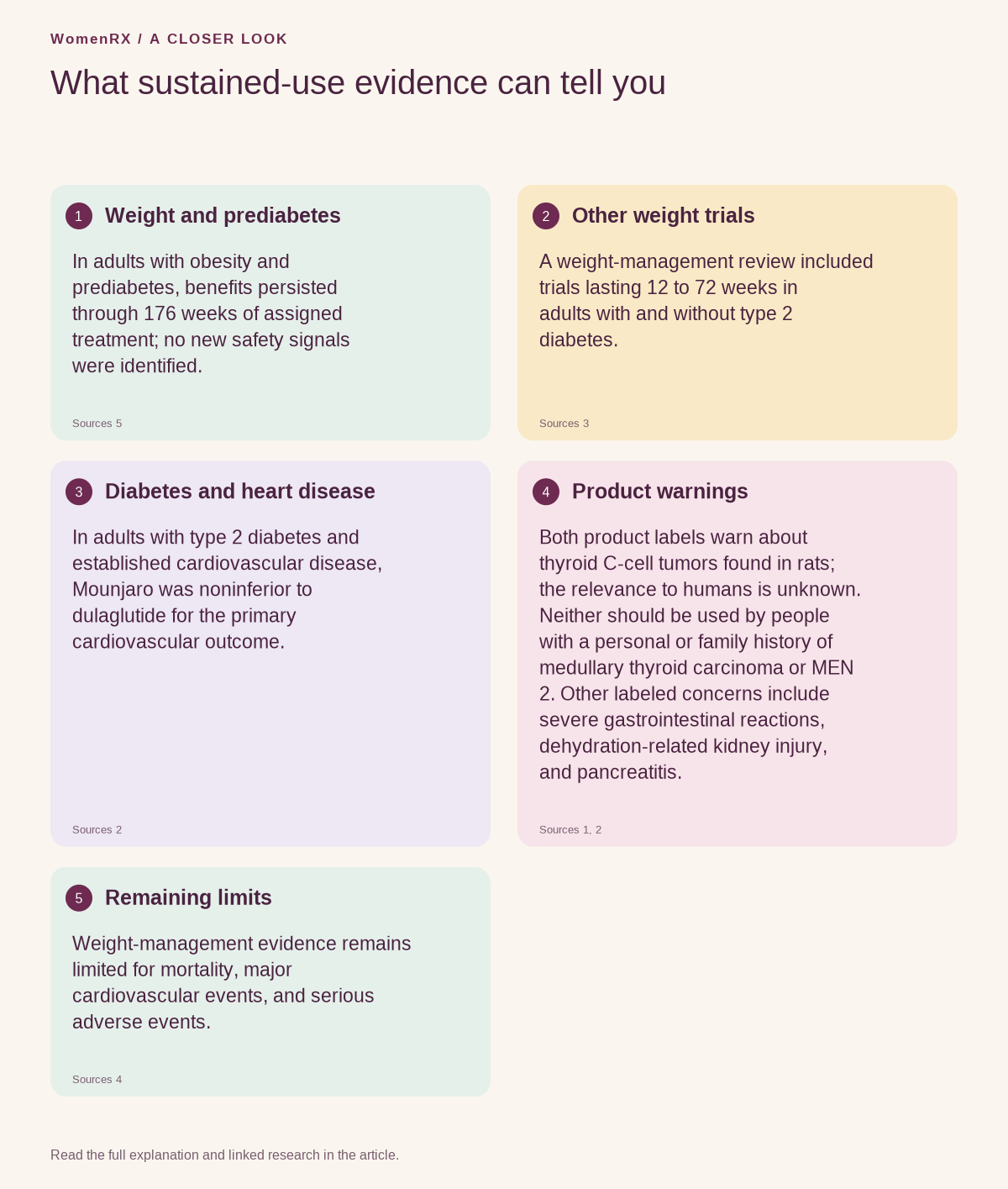
What sustained-use evidence can tell you
Weight and prediabetes: In adults with obesity and prediabetes, benefits persisted through 176 weeks of assigned treatment; no new safety signals were identified.5
Other weight trials: A weight-management review included trials lasting 12 to 72 weeks in adults with and without type 2 diabetes.3
Diabetes and heart disease: In adults with type 2 diabetes and established cardiovascular disease, Mounjaro was noninferior to dulaglutide for the primary cardiovascular outcome.2
Product warnings: Both product labels warn about thyroid C-cell tumors found in rats; the relevance to humans is unknown. Neither should be used by people with a personal or family history of medullary thyroid carcinoma or MEN 2. Other labeled concerns include severe gastrointestinal reactions, dehydration-related kidney injury, and pancreatitis.12
Remaining limits: Weight-management evidence remains limited for mortality, major cardiovascular events, and serious adverse events.4
Read the figure as text
Different evidence answers different parts of the continuing-treatment question.- Weight and prediabetes: In adults with obesity and prediabetes, benefits persisted through 176 weeks of assigned treatment; no new safety signals were identified.5
- Other weight trials: A weight-management review included trials lasting 12 to 72 weeks in adults with and without type 2 diabetes.3
- Diabetes and heart disease: In adults with type 2 diabetes and established cardiovascular disease, Mounjaro was noninferior to dulaglutide for the primary cardiovascular outcome.2
- Product warnings: Both product labels warn about thyroid C-cell tumors found in rats; the relevance to humans is unknown. Neither should be used by people with a personal or family history of medullary thyroid carcinoma or MEN 2. Other labeled concerns include severe gastrointestinal reactions, dehydration-related kidney injury, and pancreatitis.12
- Remaining limits: Weight-management evidence remains limited for mortality, major cardiovascular events, and serious adverse events.4
More questions, answered
Does the three-year trial prove tirzepatide is safe indefinitely?
No. It followed participants with obesity and prediabetes for 176 weeks on assigned treatment and found no new safety signals. 5 It cannot establish lifetime safety or predict every individual’s experience. Both product labels warn about thyroid C-cell tumors found in rats and are contraindicated for people with a personal or family history of medullary thyroid carcinoma or MEN 2; whether the rat finding applies to humans is unknown. 12 Evidence for serious adverse events in weight-management studies remains limited. 4
Sources you can check
- ZEPBOUND (TIRZEPATIDE) INJECTION, SOLUTION ZEPBOUND (TIRZEPATIDE) INJECTION, SOLUTION ZEPBOUND KWIKPEN (TIRZEPATIDE) INJECTION, SOLUTION [ELI LILLY AND COMPANY] | US prescribing information and patient instructionsAccessed 2026-09-25Return to first citation
- MOUNJARO (TIRZEPATIDE) INJECTION, SOLUTION MOUNJARO KWIKPEN (TIRZEPATIDE) INJECTION, SOLUTION [ELI LILLY AND COMPANY] | US prescribing information and patient instructionsAccessed 2026-09-25Return to first citation
- Efficacy and safety of once-weekly tirzepatide for weight management compared to placebo: An updated systematic review and meta-analysis including the latest SURMOUNT-2 trial.Qin W, Yang J, Ni Y, Deng C, Ruan Q, Ruan J, Zhou P, Duan K. · Endocrine · 2024Return to first citation
- Benefits and Harms of Pharmacologic Treatments in Adults With Overweight or Obesity: A Living Systematic Review and Network Meta-analysis for the American College of Physicians.Damen JAA, Idema DL, Vernooij RWM, Huis In 't Veld LF, Kusters MPT, Lokerse ME, de Kanter E, Spijker R, van der Braak K, Jenniskens K, Oerbekke MS, Hooft L. · Annals of internal medicine · 2026Return to first citation
- Tirzepatide for Obesity Treatment and Diabetes Prevention.Jastreboff AM, le Roux CW, Stefanski A, Aronne LJ, Halpern B, Wharton S, Wilding JPH, Perreault L, Zhang S, Battula R, Bunck MC, Ahmad NN, Jouravskaya I, SURMOUNT-1 Investigators. · The New England journal of medicine · 2025Return to first citation