Calcium Supplements Long Term: What to Review
Taking calcium for years isn’t automatically a problem, but your total intake and reason for taking it are worth revisiting.
There’s no single supplement duration that applies to everyone. Review why you started, add up calcium from food, fortified drinks, antacids, and supplements, and compare the total with your age-related target. 1 A 2015 review classified total calcium intake up to 2,500 mg per day as safe long term, but that’s a long-term intake assessment, not a personal target or supplement dose. 2
Taking a calcium supplement for months or years isn’t, by itself, a reason to stop. The more useful questions are whether it still fills a gap, how much calcium you get from all sources, and whether side effects or your circumstances have changed.
Count the whole day’s calcium
For adult women ages 19-50, the recommended daily total is 1,000 mg. It’s also 1,000 mg during pregnancy and lactation in this age group. For women ages 51 and older, it’s 1,200 mg. These amounts include food and supplements; they aren’t pill-dose recommendations. 1
Include calcium-rich foods, fortified drinks and foods, supplements, multivitamins, and some antacids. Check the Supplement Facts panel for the amount of calcium listed, rather than trying to calculate it from the weight of the calcium compound. Some calcium carbonate antacids also contribute calcium, and the amount varies by product. 1
For example, if you regularly have yogurt and a calcium-fortified plant drink, those may already provide a substantial share of your day’s calcium. That doesn’t determine what you personally need, but it’s a reason to count food before assuming the full supplement amount is still needed. 1
What the long-term safety finding means
A 2015 review concluded that total calcium intake of 2,500 mg per day from food and supplements was classified as safe over the long term, and said not to exceed that amount for an extended period. That figure is not a recommended intake, a supplement dose, or a guarantee that any amount is right for every person. It’s a long-term intake assessment from the review, not a schedule for how many months or years to take a supplement. 2
The same review found no convincing evidence in the research it assessed that calcium supplements increase cardiovascular risk. That finding addresses one outcome; it doesn’t settle every possible safety question or establish an individual’s risk. 2
Weigh the reason for taking it against the downsides
Calcium is needed for bone maintenance, but a supplement’s potential benefit can depend on how much calcium you were getting beforehand. The 2015 review described stronger reported fracture-prevention effects among people with low baseline intake and some higher-risk groups. This supports reviewing whether a supplement corrects a shortfall, rather than assuming more calcium always means more bone protection. 1 2
That distinction can matter after menopause: women over 50 have a higher recommended intake, and postmenopausal women are among the groups more likely to have inadequate calcium intake. Menopause alone, though, doesn’t tell you whether you need a supplement. Your intake from food and any bone-health plan you’re following also matter. 1
Some people get gas, bloating, or constipation from calcium supplements. The NIH Office of Dietary Supplements says these effects appear more common with calcium carbonate than calcium citrate, particularly in older adults with lower stomach acid. If you’ve noticed digestive symptoms, the supplement form and your total intake are useful parts of a review. 1
A practical review before continuing
- Name the reason. Was the supplement intended to fill a dietary gap or support a specific bone-health plan?
- Estimate your usual total. Count foods, fortified drinks, antacids, multivitamins, and supplements. 1
- Compare with your age-related target. Use the total-intake recommendation, not the supplement label alone. 1
- Keep the upper boundary in perspective. The review’s 2,500 mg/day finding refers to total calcium intake and is not a goal to reach. 2
- Revisit what has changed. Consider a change in diet, life stage, reason for taking calcium, or digestive side effects.
A review can support continuing, changing, or no longer using a supplement. The answer depends on the gap it fills and your circumstances, not simply on how long you’ve taken it.
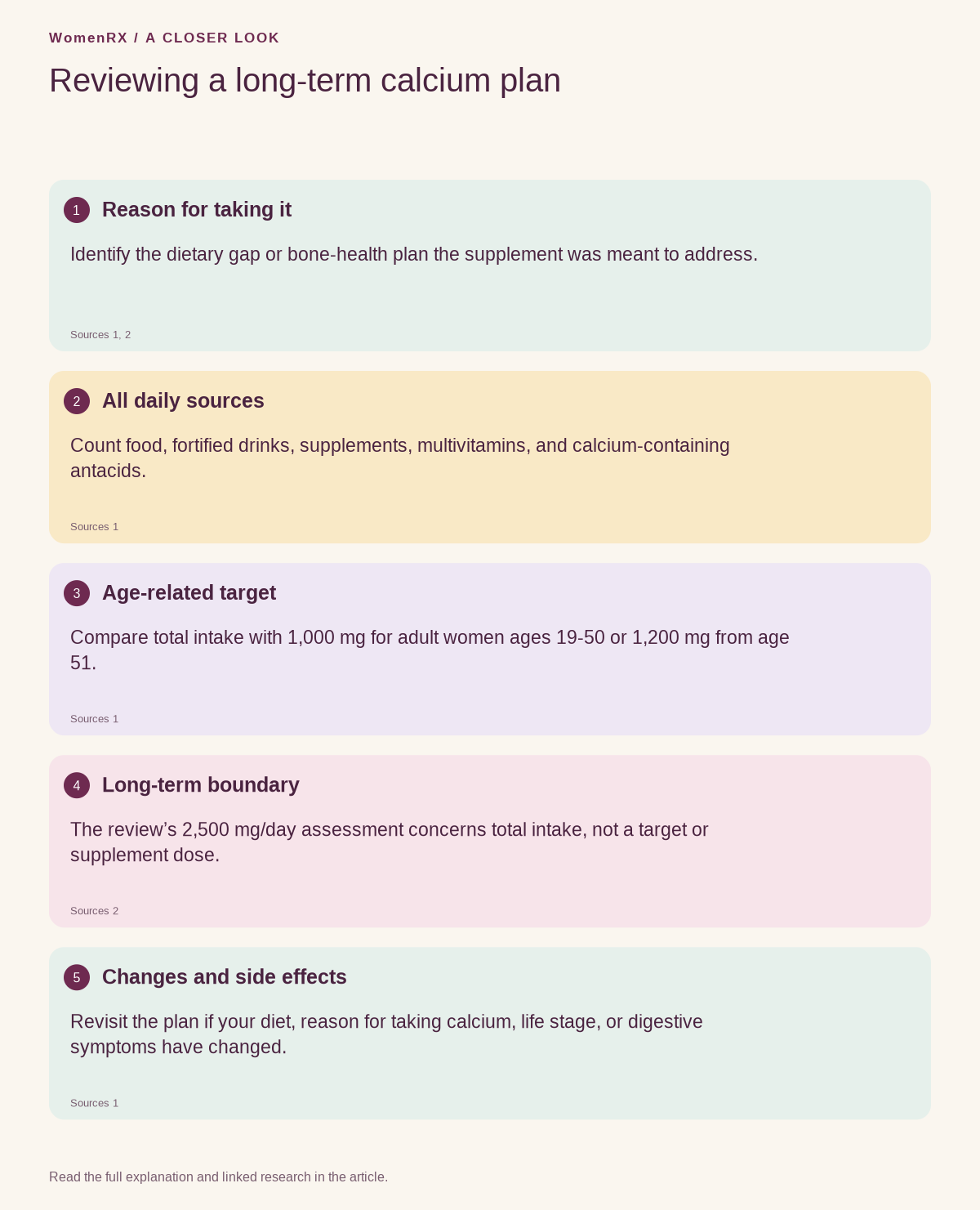
Reviewing a long-term calcium plan
Reason for taking it: Identify the dietary gap or bone-health plan the supplement was meant to address.12
All daily sources: Count food, fortified drinks, supplements, multivitamins, and calcium-containing antacids.1
Age-related target: Compare total intake with 1,000 mg for adult women ages 19-50 or 1,200 mg from age 51.1
Long-term boundary: The review’s 2,500 mg/day assessment concerns total intake, not a target or supplement dose.2
Changes and side effects: Revisit the plan if your diet, reason for taking calcium, life stage, or digestive symptoms have changed.1
Read the figure as text
Use these prompts to check why you take calcium, what your full daily total includes, and how the long-term intake finding applies.- Reason for taking it: Identify the dietary gap or bone-health plan the supplement was meant to address.12
- All daily sources: Count food, fortified drinks, supplements, multivitamins, and calcium-containing antacids.1
- Age-related target: Compare total intake with 1,000 mg for adult women ages 19-50 or 1,200 mg from age 51.1
- Long-term boundary: The review’s 2,500 mg/day assessment concerns total intake, not a target or supplement dose.2
- Changes and side effects: Revisit the plan if your diet, reason for taking calcium, life stage, or digestive symptoms have changed.1
More questions, answered
Do calcium antacids count toward my daily total?
Yes. Some antacids contain calcium carbonate, so include their calcium along with food, fortified drinks, and supplements. Check the product label because the amount varies. 1
Does pregnancy automatically mean I need a calcium supplement?
No. The recommended total for pregnant adults ages 19-50 is 1,000 mg per day, the same as for other adults in that age range. Whether a supplement fills a gap depends on calcium from all sources. 1
Sources you can check
- Calcium - Health Professional Fact SheetAccessed 2026-09-25Return to first citation
- Calcium and bone health--goodbye, calcium supplements?Ströhle A, Hadji P, Hahn A. · Climacteric : the journal of the International Menopause Society · 2015Return to first citation