Calcium Supplements: How to Decide What You Need
Start with your total calcium from food and drinks, then separate an intake gap from a concern about bone health or a medicine.
A calcium supplement may be worth discussing if your usual food and drink intake falls short of the amount recommended for your age. That target is a total from all sources, not a pill dose. If your intake meets it, or your question comes from a bone-density result, a fracture, a blood test, or a medicine, follow that concern separately rather than assuming a supplement is the answer. 1
Find the target for your age
Calcium recommendations are daily totals from food, drinks, and supplements combined. For women ages 19 to 50, the recommended amount is 1,000 mg a day; for women 51 and older, it’s 1,200 mg. During pregnancy or lactation, the target is also 1,000 mg for ages 19 to 50. Pregnant or lactating teens ages 14 to 18 have a higher target of 1,300 mg. These are recommendations for planning intake, not supplement doses or a diagnosis of deficiency. 1
After menopause, lower estrogen contributes to bone loss and affects how the body absorbs and loses calcium. That makes adequate intake relevant, but it doesn’t mean every woman after menopause needs a supplement. 1
Estimate what you usually get
Look at a few ordinary days rather than trying to calculate a perfect diet. Include fortified drinks and foods, any multivitamin or calcium product, and calcium-containing antacids. Product labels are especially helpful for fortified soy drinks, cereals, juices, and tofu, since calcium content can vary. 1
Calcium can come from dairy foods, fortified products, tofu made with calcium sulfate, and canned sardines or salmon with edible bones. Some greens contribute too. For example, the NIH reference lists about 300 mg in a cup of milk or calcium-fortified soy milk, and about 415 mg in an eight-ounce serving of plain low-fat yogurt. 1
An intake estimate below your target is a reason to look at your usual pattern, not proof that you have a medical calcium deficiency. If it’s practical, try adding calcium-rich or fortified foods you enjoy. If that still leaves a consistent gap, discuss whether a supplement would help cover it. 1 2
If you consider a supplement, count the gap
Check the Supplement Facts panel for elemental calcium, the amount to include in your total. Don’t count a supplement’s full tablet weight as calcium. Also check multivitamins and antacids: some chewable antacids contain calcium carbonate, so they can add to your daily intake. 1
Calcium carbonate and calcium citrate are common forms. Carbonate depends more on stomach acid and is generally taken with food; citrate is less dependent on stomach acid. Supplements can cause gas, bloating, or constipation, and the NIH reference describes these effects as appearing more common with carbonate than citrate, especially in older adults. Those differences may help guide a product discussion if you’re comparing forms. 1 2
More at once isn’t necessarily absorbed in the same proportion: the percentage absorbed from supplements is highest when the amount taken at one time is 500 mg or less. That’s an absorption finding, not a personalized dosing plan. 1 2
When the question is about bones or medicines
A supplement can help add calcium to your intake, but it can’t tell you whether you have low bone density or why a fracture happened. If you’ve been told you have low bone density or osteoporosis, or you’ve had a fracture after a minor event such as a fall from standing height, make the next step a bone-health discussion or evaluation. Don’t treat a supplement choice as a substitute for understanding that concern. 1
A blood-calcium result is also different from an estimate of calcium in your diet. Low blood calcium can have several causes, including vitamin D or magnesium deficiency, problems with parathyroid hormone, critical illness, and certain medicines. The NIH reference names bisphosphonates, cisplatin, and proton pump inhibitors as examples of medicines associated with low blood calcium. That doesn’t establish that you need a supplement or explain what’s happening in your case. If a medicine or a blood-test result prompted the question, ask the clinician who manages it what the result or medication means for you rather than adding calcium on your own. 1
A practical decision path
If your typical intake is below your age-based target, consider food changes first; if a gap remains, discuss a supplement sized to the gap. If your intake meets the target, a supplement may not be needed for intake alone. If the concern is a bone-density result, a fracture, a blood-calcium result, or a medicine, ask for that specific issue to be assessed. You may have both an intake gap and a separate bone-health concern, and each deserves its own answer.
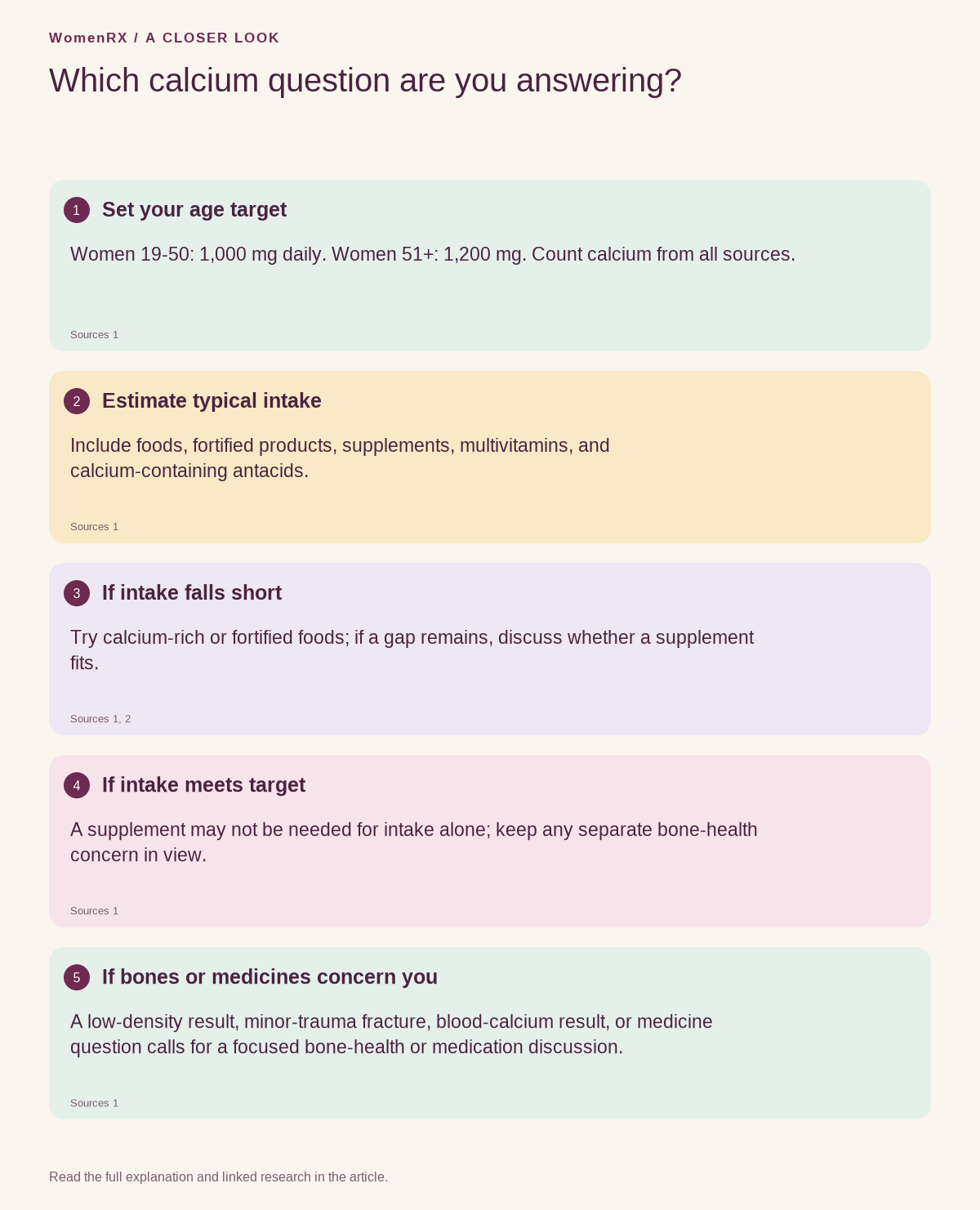
Which calcium question are you answering?
Set your age target: Women 19-50: 1,000 mg daily. Women 51+: 1,200 mg. Count calcium from all sources.1
Estimate typical intake: Include foods, fortified products, supplements, multivitamins, and calcium-containing antacids.1
If intake falls short: Try calcium-rich or fortified foods; if a gap remains, discuss whether a supplement fits.12
If intake meets target: A supplement may not be needed for intake alone; keep any separate bone-health concern in view.1
If bones or medicines concern you: A low-density result, minor-trauma fracture, blood-calcium result, or medicine question calls for a focused bone-health or medication discussion.1
Read the figure as text
Start with your age-based total and usual intake. A shortfall, an adequate intake, and a bone or medication concern lead to different next steps.- Set your age target: Women 19-50: 1,000 mg daily. Women 51+: 1,200 mg. Count calcium from all sources.1
- Estimate typical intake: Include foods, fortified products, supplements, multivitamins, and calcium-containing antacids.1
- If intake falls short: Try calcium-rich or fortified foods; if a gap remains, discuss whether a supplement fits.12
- If intake meets target: A supplement may not be needed for intake alone; keep any separate bone-health concern in view.1
- If bones or medicines concern you: A low-density result, minor-trauma fracture, blood-calcium result, or medicine question calls for a focused bone-health or medication discussion.1
More questions, answered
Does a blood calcium test show whether I eat enough calcium?
No. A low blood-calcium result can have causes beyond dietary intake, including vitamin D or magnesium deficiency, parathyroid problems, critical illness, and certain medicines. The result needs to be interpreted in context. 1
Sources you can check
- Calcium - Health Professional Fact SheetAccessed 2026-09-25Return to first citation
- Calcium | MedlinePlusAccessed 2026-09-25Return to first citation