Compounded Semaglutide: What to Verify Before You Decide
After the semaglutide shortage ended, a compounded prescription needs a product-specific explanation, not a blanket claim that it’s safe or legal.
The end of the semaglutide shortage narrowed when pharmacies can compound copies of approved products; it didn’t ban every individualized prescription. FDA’s April 2026 guidance describes conditions that can allow compounding for a specific patient. Check current FDA updates and your state pharmacy board, then ask why this exact preparation is needed, who will make it, and how to use it safely. 7 8
Start with what changed after the shortage
Compounding rules can change, and the legal answer may depend on the product and the circumstances of the prescription. After the semaglutide injection shortage ended, FDA’s temporary enforcement-discretion periods for compounding products that were essentially copies of approved medicines ended in 2025. That did not make every compounded semaglutide prescription unlawful. In guidance updated April 1, 2026, FDA explains that a state-licensed pharmacy compounding under section 503A generally needs a prescription for an individual patient. A prescriber can also document a change that makes a compounded product significantly different for that patient when an otherwise similar preparation would be considered a copy. Different requirements apply to outsourcing facilities under section 503B. 7
For the federal picture, read the FDA’s current GLP-1 compounding and drug-shortage updates. Look up the named dispensing pharmacy with your state board of pharmacy, then ask the prescriber what individual medical need the preparation meets and ask the pharmacist whether that pharmacy will make and dispense it. A review describes both lawful and unlawful sales, so a seller’s general claim about compounded semaglutide won’t tell you whether this prescription meets current requirements. 4 7
Identify the product, not just the ingredient
Compounded semaglutide is not FDA-approved. FDA does not review compounded drugs for safety, effectiveness, or quality before they’re marketed. That is separate from whether a particular prescription meets compounding requirements. 7 8
Ask the dispensing pharmacist to confirm that the product is compounded, what formulation and route it uses, and whether anything has been added to semaglutide. Ask for its concentration and product-specific storage and beyond-use instructions. These details matter because compounded products can differ from FDA-approved medicines. A search of online listings found varied formulations and combinations with added ingredients; it did not establish that every product has the same ingredients or risks. 3
Also ask which form of semaglutide is in it and verify the dispensing pharmacy rather than trusting a label alone. FDA says semaglutide sodium and semaglutide acetate are different active ingredients from the one in approved drugs; it also reports fraudulent compounded products with false pharmacy information on their labels. 8
If the product comes in a vial, ask the pharmacist to show you, in writing, how to measure the prescribed amount with the syringe supplied. Don’t rely on a dose stated only in “units” without an explanation of how it matches the product’s concentration. FDA has received reports of dosing errors with compounded injectable semaglutide, some requiring hospitalization. A US adverse-event database analysis also found higher reporting odds for preparation errors, prescribing errors, contamination, and compounding or manufacturing issues among reports involving compounded GLP-1 medicines. Those reporting odds cannot tell you how likely you are to have a problem or establish that a product caused each reported event. 8 5
Be cautious about claims that an unusual route or added ingredient makes a compounded product work better or more safely. The authors of the online listings study found limited evidence to support many of the additions and formulations they identified. They examined listings, not clinical outcomes for every product. 3
Ask how your own medicines and plans fit
Bring a complete list of medicines, vitamins, and supplements to the prescriber and pharmacist. The approved Wegovy prescribing information says semaglutide slows stomach emptying and can affect medicines that need to pass through the stomach quickly. It also calls out insulin and sulfonylureas as diabetes medicines to discuss. Ask how these considerations apply to your treatment plan rather than assuming every compounded formulation has been studied in the same way. 1
Include pregnancy plans in the conversation. If you’re trying to conceive, might become pregnant, are pregnant, or are breastfeeding, ask what guidance applies to the exact product and your circumstances. The US prescribing information for oral Rybelsus and Ozempic tablets says breastfeeding is not recommended during treatment, citing uncertainty about possible serious effects in a breastfed infant related to SNAC, an ingredient in those tablets. That tablet-specific information does not, by itself, settle advice for a compounded injectable formulation. 2
Ask what follow-up the prescriber recommends and whom to contact if you’re unsure about the product or its instructions. A professional pharmacy opinion recommends making efforts to obtain approved medicines when possible and monitoring patients who use compounded incretin products. 6
Questions worth taking with you
- Why was this particular preparation prescribed instead of an approved product, and what individual need does it meet?
- Which pharmacy will make and dispense it, and how can I verify that pharmacy with the state board?
- What are the formulation, route, concentration, form of semaglutide, and full list of ingredients?
- What are this product’s storage and beyond-use instructions?
- If it comes in a vial, can you show me how to measure the prescribed amount with the supplied syringe?
- How do my other medicines, pregnancy plans, or breastfeeding affect this decision?
- What follow-up is planned, and whom should I contact with a product or measuring concern?
A useful answer should identify the exact product and address your circumstances. If the explanation relies only on a familiar-sounding name, an online testimonial, or a blanket claim about legality or safety, ask for product-specific clarification before deciding.
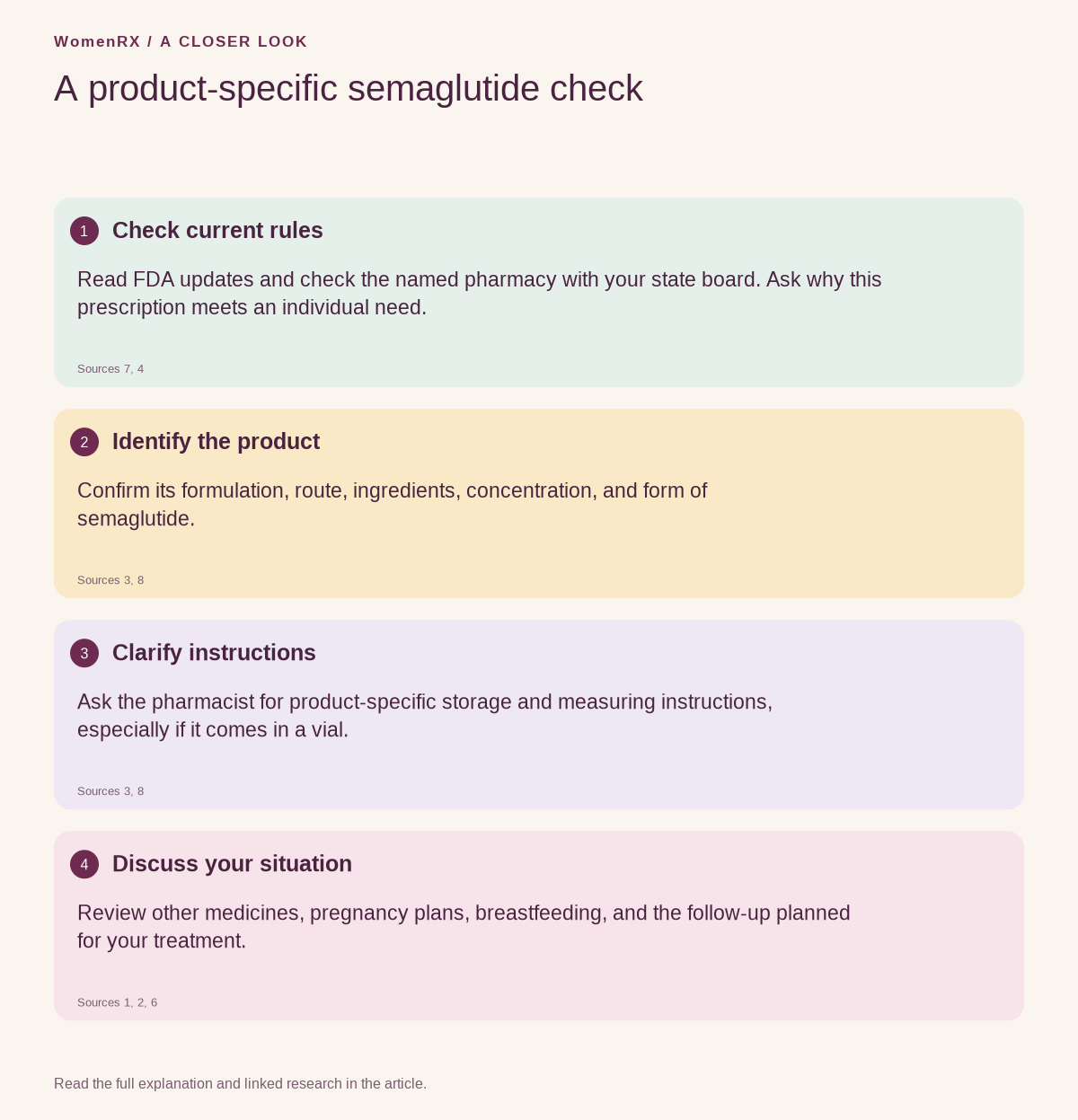
A product-specific semaglutide check
Check current rules: Read FDA updates and check the named pharmacy with your state board. Ask why this prescription meets an individual need.74
Identify the product: Confirm its formulation, route, ingredients, concentration, and form of semaglutide.38
Clarify instructions: Ask the pharmacist for product-specific storage and measuring instructions, especially if it comes in a vial.38
Discuss your situation: Review other medicines, pregnancy plans, breastfeeding, and the follow-up planned for your treatment.126
Read the figure as text
Check the current rules and named pharmacy first, then find out what the preparation contains and how it fits your health.- Check current rules: Read FDA updates and check the named pharmacy with your state board. Ask why this prescription meets an individual need.74
- Identify the product: Confirm its formulation, route, ingredients, concentration, and form of semaglutide.38
- Clarify instructions: Ask the pharmacist for product-specific storage and measuring instructions, especially if it comes in a vial.38
- Discuss your situation: Review other medicines, pregnancy plans, breastfeeding, and the follow-up planned for your treatment.126
Sources you can check
- WEGOVY (SEMAGLUTIDE) INJECTION, SOLUTION WEGOVY (SEMAGLUTIDE) TABLET [NOVO NORDISK PHARMACEUTICAL INDUSTRIES, LP] | US prescribing information and patient instructionsAccessed 2026-09-25Return to first citation
- OZEMPIC (ORAL SEMAGLUTIDE) TABLET RYBELSUS (ORAL SEMAGLUTIDE) TABLET [NOVO NORDISK PHARMACEUTICAL INDUSTRIES, LP] | US prescribing information and patient instructionsAccessed 2026-09-25Return to first citation
- Compounded Semaglutide and Tirzepatide Products Use Unique Formulations but Efficacy and Safety Largely Unknown.Belcourt J, Sapowadia A, White CM. · The Annals of pharmacotherapy · 2026Return to first citation
- Navigating compounded semaglutide: what health care providers need to know.Liu G, Jarema M, Mo M, Stievater T. · The American journal of managed care · 2025Return to first citation
- Safety analysis of compounded GLP-1 receptor agonists: a pharmacovigilance study using the FDA adverse event reporting system.McCall KL, Mastro Dwyer KA, Casey RT, Samana TN, Sulicz EK, Tso SY, Yalanzhi ER, Piper BJ. · Expert opinion on drug safety · 2026Return to first citation
- Compounded incretins in clinical practice: An opinion of the endocrine and metabolism practice and research network of the American College of Clinical Pharmacy.Courtney LA, Clements JN, Isaacs D, Pitlick JM, Reece SM, Whitley HP. · Diabetes & metabolic syndrome · 2025Return to first citation
- FDA clarifies policies for compounders as national GLP-1 supply begins to stabilize | FDAAccessed 2026-09-25Return to first citation
- FDA’s Concerns with Unapproved GLP-1 Drugs Used for Weight Loss | FDAAccessed 2026-09-25Return to first citation