How to Vet a Pharmacy for Compounded GLP-1 Medicine
Ask who prepares your medicine, exactly what is in it, how to use and store it, and who can answer if something seems wrong.
Ask for the pharmacy’s full name and location, who compounds the medicine, the exact ingredients and concentration, and clear product-specific directions for measuring, storing, and using it. Verify the pharmacy’s license with the regulator responsible for that location. These steps can help you spot unanswered questions, but a license or confident phone call can’t guarantee the quality of a particular preparation. 4 5
A call can clarify the product, not certify it
A useful pharmacy call should leave you with concrete details about the medicine in your hands, not just reassurance that the pharmacy is reputable. Compounded semaglutide and tirzepatide products can differ in ingredients, strength, and formulation. A review of products marketed online found that information about storage and beyond-use dates was often missing from the product listings it examined. That makes it reasonable to ask for those details directly about your prescription. 5
Compounding can serve a patient-specific need, but compounded products may have quality controls and dosing information that differ from those of established FDA-approved products. A review of compounded semaglutide described risks including dosing errors and fraudulent products. The point of the questions below isn’t to prove that a product is safe; it’s to get specifics, check the pharmacy’s identity, and know when to bring the prescriber back into the conversation. 4
Start with the pharmacy’s identity
Ask:
- “What is the pharmacy’s full legal name and physical location?”
- “Which pharmacy or facility actually compounds this medicine?”
- “What is its license number, and which regulator oversees that location?”
- “Where can I verify that license independently?”
Use the regulator responsible for the pharmacy’s jurisdiction to check the details yourself, rather than relying only on a link or claim supplied during a sales call. Rules and licensing arrangements vary by location. If the pharmacy uses another facility to prepare or ship the medicine, ask for that facility’s name too. A license helps establish who is responsible; it doesn’t tell you how a specific batch was made or whether the product is right for you.
Get the exact recipe and label details
Ask the pharmacist to identify the active ingredient by name: semaglutide, tirzepatide, or another medicine. Then ask whether anything else has been added, such as vitamin B12, and why that particular formulation was prescribed. If it is a combination, ask whether information about the combination applies to the exact product you’ll receive. Testing reported in one study identified an impurity in some sampled compounded tirzepatide-and-B12 products; that finding does not establish that every combination product has the same issue, but it makes questions about added ingredients worthwhile. 3
Ask the pharmacist to walk through the label with you: the medicine’s concentration, the prescribed amount, the units shown on the syringe or device, and how those pieces match. Get the instructions in writing. If any amount or unit is unclear, pause and ask the pharmacist or prescriber to resolve it rather than trying to calculate a conversion yourself. A review of compounded semaglutide has identified dosing errors as a safety concern. 4
Also ask for the product-specific beyond-use date, storage conditions, and what to do if the medicine arrives warm, damaged, or with a label that differs from the instructions you received. Don’t assume directions for a branded pen apply to a compounded vial or a different formulation. The pharmacy should be able to explain the product it actually dispensed. 1 5
Ask what oversight means at that facility
You can ask how the pharmacy oversees the preparation of this product, who is accountable for it, and whom to contact with a quality concern. If the preparation is sterile and injected, ask what quality and sterile-preparation standards apply to the compounding facility and how concerns are handled. A report from one Veterans Affairs health system described oversight that included environmental monitoring, applicable requirements, staff competency, and follow-up. That is an example of oversight topics, not proof that every pharmacy uses the same system or that asking about it verifies a particular batch. 2
A vague answer such as “we follow high standards” doesn’t give you much to work with. Ask for the name of the responsible pharmacist and a direct contact route for questions after dispensing. If the pharmacy can’t explain the medicine’s concentration, directions, storage, or who prepared it, take those unanswered questions to the prescriber before using it.
Keep the prescriber involved in the decisions
The pharmacist can clarify what is in the dispensed product and how its label works. Ask your prescriber about the treatment choice itself, including whether a compounded formulation is appropriate for your situation. If pregnancy, trying to conceive, or breastfeeding is relevant, ask the prescriber directly what that means for your medication plan; use the pharmacist to confirm the exact product details the prescriber needs.
A short script for the call
“I’d like to confirm the exact medicine and ingredients, who compounds it, its concentration and written use instructions, its storage and beyond-use date, and how I can verify the pharmacy’s license. Who should I contact if the label, shipment, or medicine doesn’t match what I was told?”
Write down the answers and the name of the person you spoke with. If an answer is unclear or conflicts with your prescription, ask the pharmacist and prescriber to sort it out before you use the product.
Questions for the Pharmacy Call
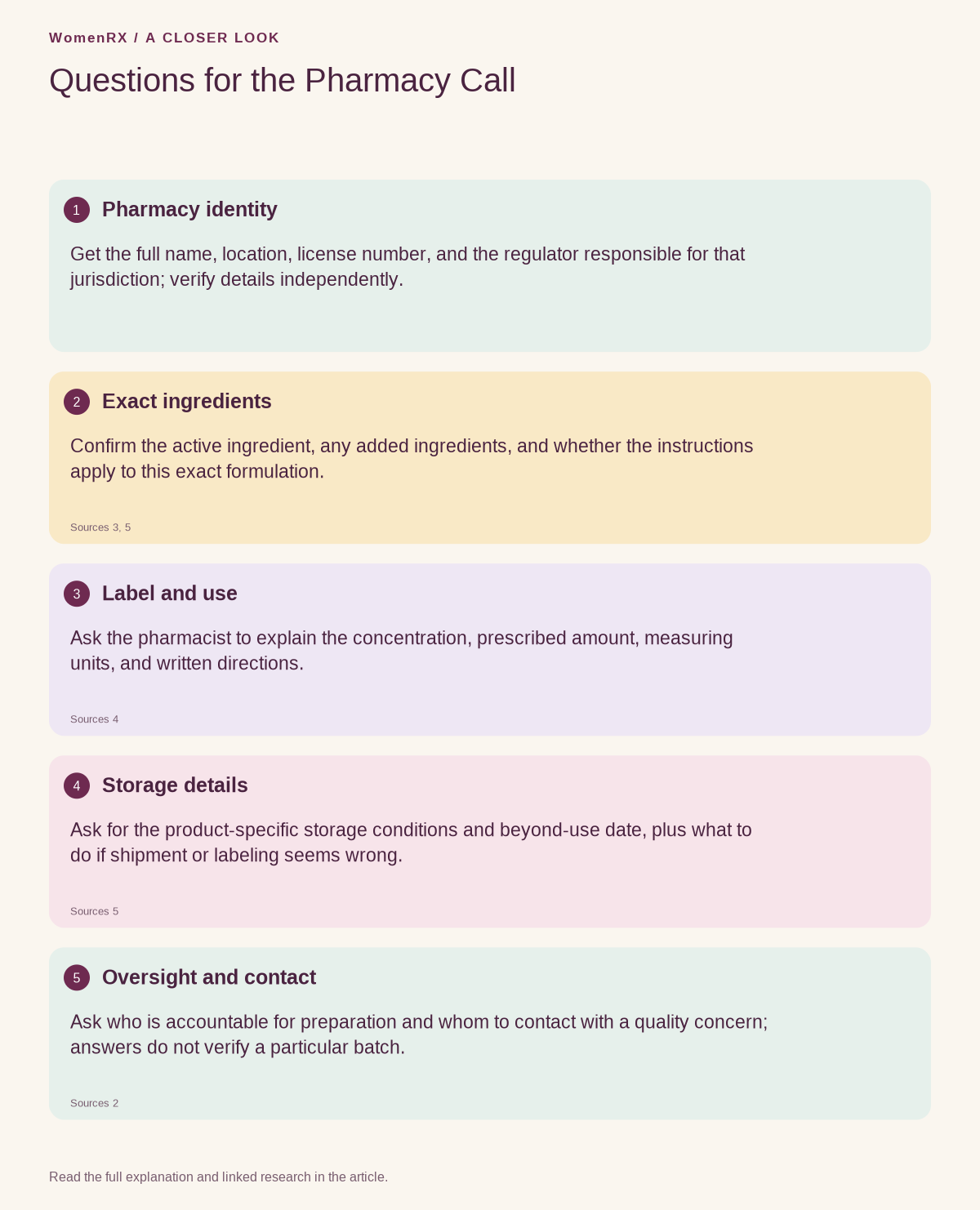
Pharmacy identity: Get the full name, location, license number, and the regulator responsible for that jurisdiction; verify details independently.
Exact ingredients: Confirm the active ingredient, any added ingredients, and whether the instructions apply to this exact formulation.35
Label and use: Ask the pharmacist to explain the concentration, prescribed amount, measuring units, and written directions.4
Storage details: Ask for the product-specific storage conditions and beyond-use date, plus what to do if shipment or labeling seems wrong.5
Oversight and contact: Ask who is accountable for preparation and whom to contact with a quality concern; answers do not verify a particular batch.2
Read the figure as text
Use these prompts to gather product-specific answers and verify who is responsible. They can guide a conversation, but they do not certify a preparation.- Pharmacy identity: Get the full name, location, license number, and the regulator responsible for that jurisdiction; verify details independently.
- Exact ingredients: Confirm the active ingredient, any added ingredients, and whether the instructions apply to this exact formulation.35
- Label and use: Ask the pharmacist to explain the concentration, prescribed amount, measuring units, and written directions.4
- Storage details: Ask for the product-specific storage conditions and beyond-use date, plus what to do if shipment or labeling seems wrong.5
- Oversight and contact: Ask who is accountable for preparation and whom to contact with a quality concern; answers do not verify a particular batch.2
More questions, answered
Does a pharmacy license guarantee the medicine’s quality?
No. A license helps you identify the responsible pharmacy and the regulator for its location, but it doesn’t verify how a particular preparation or batch was made. Ask separately about the exact formulation, instructions, storage, and quality-oversight process.
What if the compounded medicine includes vitamin B12?
Ask why it was added and whether the pharmacy can explain information specific to that combination. A study reported an impurity in tested compounded tirzepatide-and-B12 products, but that finding should not be generalized to every product or every added ingredient. 3
Sources you can check
- WEGOVY (SEMAGLUTIDE) INJECTION, SOLUTION WEGOVY (SEMAGLUTIDE) TABLET [NOVO NORDISK PHARMACEUTICAL INDUSTRIES, LP] | US prescribing information and patient instructionsAccessed 2026-09-25Return to first citation
- Leveraging a multidisciplinary oversight committee to ensure USP and compliance at a Veterans Affairs health system.Wrzesniewski CE, Park HK. · American journal of health-system pharmacy : AJHP : official journal of the American Society of Health-System Pharmacists · 2022Return to first citation
- A novel, widespread impurity in mass-compounded tirzepatide/B12 products: potential patient safety implications.Jordan B, Arbogast L, Clemens M, Huang L, Snyder M. · Expert opinion on drug safety · 2026Return to first citation
- Navigating compounded semaglutide: what health care providers need to know.Liu G, Jarema M, Mo M, Stievater T. · The American journal of managed care · 2025Return to first citation
- Compounded Semaglutide and Tirzepatide Products Use Unique Formulations but Efficacy and Safety Largely Unknown.Belcourt J, Sapowadia A, White CM. · The Annals of pharmacotherapy · 2026Return to first citation