How to Check a Compounded Semaglutide Pharmacy
A license check is a starting point, but the prescription, vial instructions, and a person who can answer questions matter too.
Before filling a compounded semaglutide prescription, check the pharmacy’s license through your state board of pharmacy, confirm that it requires a prescription, and make sure a pharmacist is available. Then ask who makes the medication, what’s in it, and how the label explains its concentration and your prescribed dose. Don’t accept an injectable you can’t confidently identify, store, and measure. 34
A website can look polished and still leave you with the wrong medication or unclear instructions. The useful test isn’t whether a pharmacy has reassuring language on its homepage. It’s whether you can verify who is dispensing your prescription and get clear answers about the particular preparation you’ll receive.
Start with the pharmacy, not its advertising
Look up the pharmacy in your state board of pharmacy’s license database rather than relying on a badge displayed on its website. For an online pharmacy, the FDA also recommends checking for a US physical address and phone number, a licensed pharmacist who can answer questions, and a requirement for a prescription. A seller that offers semaglutide without one is a reason to stop. 4
Confirm the name and location of the pharmacy that will actually fill the prescription. Ask whether it will make the medication itself or another facility will make it, and whom you should contact about the finished vial. This matters because the FDA has identified products falsely labeled with the name of a pharmacy that either does not exist or did not make the medication. A valid license helps you check the business’s identity; it cannot, by itself, tell you the quality of a specific vial. 34
Find out exactly what’s being prescribed
Ask your prescriber why a compounded preparation is being considered instead of an FDA-approved option. Compounded drugs are not FDA-approved, so they do not receive FDA review for safety, effectiveness, and quality before marketing. The FDA advises using one when a patient’s medical needs cannot be met by an approved drug. 3
Next, ask the pharmacy for the preparation’s full ingredient list. Specifically, ask which form of semaglutide it uses and whether anything else has been added. The FDA says semaglutide sodium and semaglutide acetate are different active ingredients from the one in approved semaglutide drugs, and it does not have information showing that these salts have the same chemical and pharmacologic properties. An editorial reporting a search of compounding websites also found products advertised with additional ingredients; the presence of an extra ingredient should prompt a question about its purpose, not an assumption that it improves results. 32
Make the dose understandable before accepting a vial
A vial may require you to draw up a dose with a syringe rather than use a prefilled pen. Ask the pharmacist to show you how the prescribed amount of semaglutide relates to the concentration printed on your vial and to the markings on your syringe. The prescription, label, and verbal explanation should agree. Don’t guess what a number in “units” means or use instructions intended for a different concentration. The FDA has received reports of dosing errors with compounded injectable semaglutide, including some that required hospitalization. 3
Before you leave or accept a shipment, check that the label identifies the pharmacy and medication and gives you usable instructions, including how to store it and whom to call with a question. Ask what date applies to your preparation and, if it’s a multidose vial, how long it may be used after first opening. The FDA recommends discarding a multidose vial of sterile medication within 28 days after first use, even if medication remains or the compounder’s instructions allow longer; don’t follow instructions that extend use beyond that point. If an injectable arrives warm or without enough cooling, don’t use it; contact the pharmacy to resolve the shipment. A broken package, unexpected appearance, or missing instructions also warrants a pause. 3
Keep the prescriber and pharmacist on the same page
Tell both what medicines you currently take, so the prescription and the medication you receive can be checked against your full list. If you’re pregnant, planning pregnancy, or breastfeeding, say so before the prescription is filled. These details don’t measure a pharmacy’s quality; they help your care team decide whether the treatment plan makes sense for you. Approved Ozempic prescribing information specifically calls for discussion of pregnancy plans and breastfeeding. That label describes an approved product, not the safety of every compounded preparation. 1
Finally, know who will answer questions after delivery: the dispensing pharmacist for label, storage, or measuring questions, and the prescriber for changes to your treatment plan or symptoms. If either is unreachable, or the vial and instructions don’t match what you were told to expect, resolve that discrepancy before using the medication. The FDA identifies missing follow-up access and unexpected or damaged products as warning signs. 34
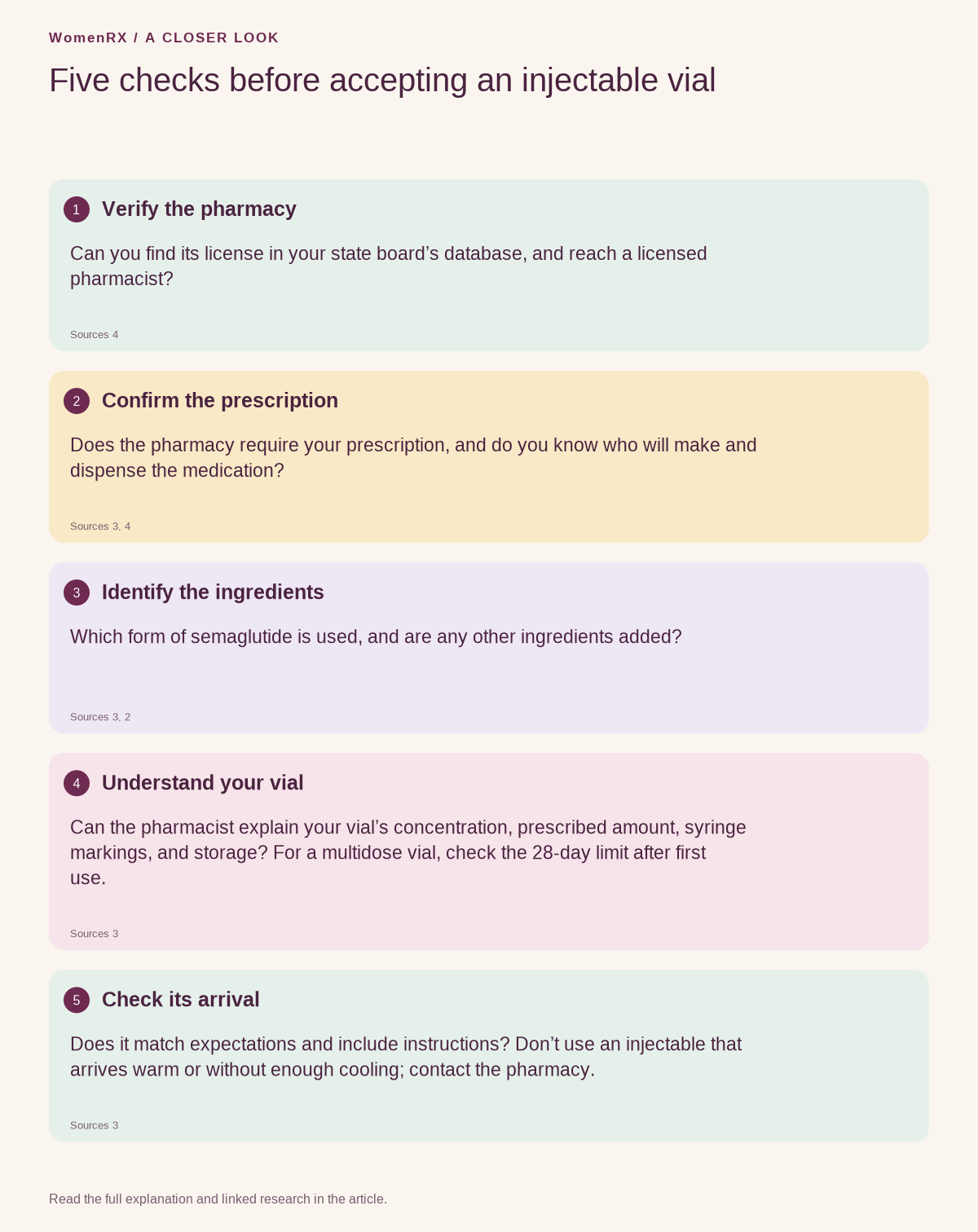
Five checks before accepting an injectable vial
Verify the pharmacy: Can you find its license in your state board’s database, and reach a licensed pharmacist?4
Confirm the prescription: Does the pharmacy require your prescription, and do you know who will make and dispense the medication?34
Identify the ingredients: Which form of semaglutide is used, and are any other ingredients added?32
Understand your vial: Can the pharmacist explain your vial’s concentration, prescribed amount, syringe markings, and storage? For a multidose vial, check the 28-day limit after first use.3
Check its arrival: Does it match expectations and include instructions? Don’t use an injectable that arrives warm or without enough cooling; contact the pharmacy.3
Read the figure as text
Use these questions to check the seller and the specific medication separately.- Verify the pharmacy: Can you find its license in your state board’s database, and reach a licensed pharmacist?4
- Confirm the prescription: Does the pharmacy require your prescription, and do you know who will make and dispense the medication?34
- Identify the ingredients: Which form of semaglutide is used, and are any other ingredients added?32
- Understand your vial: Can the pharmacist explain your vial’s concentration, prescribed amount, syringe markings, and storage? For a multidose vial, check the 28-day limit after first use.3
- Check its arrival: Does it match expectations and include instructions? Don’t use an injectable that arrives warm or without enough cooling; contact the pharmacy.3
More questions, answered
Does a pharmacy license prove its compounded semaglutide is safe?
No. Checking a state license helps establish that you’re dealing with a licensed pharmacy, but it does not verify the contents or quality of an individual vial. You still need clear preparation-specific answers and instructions. 34
What if the vial label names a pharmacy I didn’t expect?
Pause and contact the pharmacy named on the label and your prescriber before using it. Confirm who made and dispensed the medication. The FDA has identified fraudulent compounded GLP-1 products bearing pharmacy names that were false or used without that pharmacy having made the product. 3
Sources you can check
- OZEMPIC (SEMAGLUTIDE) INJECTION, SOLUTION [A-S MEDICATION SOLUTIONS] | US prescribing information and patient instructionsAccessed 2026-09-25Return to first citation
- Compounded Semaglutide and Tirzepatide Products Use Unique Formulations but Efficacy and Safety Largely Unknown.Belcourt J, Sapowadia A, White CM. · The Annals of pharmacotherapy · 2026Return to first citation
- FDA’s Concerns with Unapproved GLP-1 Drugs Used for Weight Loss | FDAAccessed 2026-09-25Return to first citation
- How to Buy Medicines Safely From an Online Pharmacy | FDAAccessed 2026-09-25Return to first citation