How to Check a Compounded Tirzepatide Pharmacy
Before accepting an injectable, make sure you know who prescribed it, what’s in it, how it should be handled, and whom to call with questions.
Ask for the pharmacy’s name and license information, confirm what prescription it received, and get clear details about the exact formulation, concentration, beyond-use date, storage, and injection instructions. A pharmacist should be reachable to explain anything you don’t understand. Compounded products can differ from FDA-approved pens, so don’t assume a branded product’s label or storage directions apply to your vial. 1 2
A pharmacy offering compounded tirzepatide should be able to answer specific questions about the pharmacy, the prescription, and the product you’ll receive. Use the checks below to make sure you can identify who is responsible for the medication and understand how it is meant to be used. These checks can help you spot missing information, but credentials alone don’t establish the quality of a particular preparation.
Start with the pharmacy and prescription
Ask for the pharmacy’s full name, location, and license information. If you want to verify its license or whether it may dispense in your state, ask the relevant state pharmacy regulator how to check. If you’re unsure which regulator to contact, ask the pharmacy to identify it.
Ask which prescriber sent the prescription and what exact product and instructions the pharmacy is filling. You should be able to connect the medication to a prescriber who knows your health history, not just to an online order. If the pharmacy can’t explain what prescription it received or who prescribed the medication, pause and get that clarified before accepting it.
A review of compounded GLP-1 products found that formulations varied, including products with added ingredients, and that information about storage and beyond-use dates was often missing from product descriptions. Those findings don’t tell you whether a particular pharmacy’s preparation is good or bad. They do make it sensible to ask for the details of your own product rather than rely on a general webpage or verbal promise. 2
Get the exact preparation details
Ask the pharmacy to identify the dosage form and every active ingredient, including any added ingredient. Confirm the concentration on the label, such as the amount of tirzepatide in a given volume, and ask the pharmacist to explain how that connects to the instructions you were given. Don’t convert a prescribed dose into a syringe volume yourself if the directions aren’t clear.
Before you leave or accept delivery, make sure you can find the product name, concentration, beyond-use date, storage directions, and route of administration on the product information. Ask what to do if the package arrives warm, damaged, or with unclear instructions. Don’t use the medication until the pharmacy or prescriber has resolved a question that could change how much you inject or how you handle it.
Be especially cautious about transferring directions from an FDA-approved pen to a compounded vial. The Zepbound instructions describe storage and use for that specific pen; they are not automatically the right instructions for a compounded preparation. Follow the directions supplied for your product, and ask the dispensing pharmacist to explain them. 1
Make sure the label is usable in real life
Read the label before accepting the medication. Check that the medication and concentration match what you were told to expect, and that you can identify the beyond-use date and storage conditions. Ask the pharmacist to walk you through the injection instructions, including any equipment you need and how to measure the prescribed amount. If the label uses unfamiliar units or the directions seem inconsistent with what your prescriber said, stop and ask for clarification rather than guessing.
This is a practical check, not a guarantee. A 2026 analysis of FDA adverse-event reports found higher reporting odds for several product-quality and preparation concerns involving compounded GLP-1 medicines than non-compounded products. Because the analysis used reports rather than a count of everyone who used each product, it can identify safety signals but can’t show how likely an individual patient is to have a problem or prove what caused a report. 3
Know who can answer questions afterward
Ask how to reach a pharmacist once you have the medication, including outside the moment of pickup. Find out whom to contact if you’re uncertain about storage, a missed or unclear instruction, a damaged package, or a possible dosing mistake. The answer should be a specific pharmacy contact or process, not only a general customer-service page.
Tell your prescriber about your other medicines and whether you’re pregnant, trying to become pregnant, or breastfeeding. Those details belong in a medication review with the prescriber; they aren’t a test of whether a pharmacy is legitimate.
If any key detail is missing, ask the pharmacy to explain it in writing before you accept or use the medication. A clear answer doesn’t certify the preparation, but it gives you the information you need to make a more informed decision and follow the directions you were actually given.
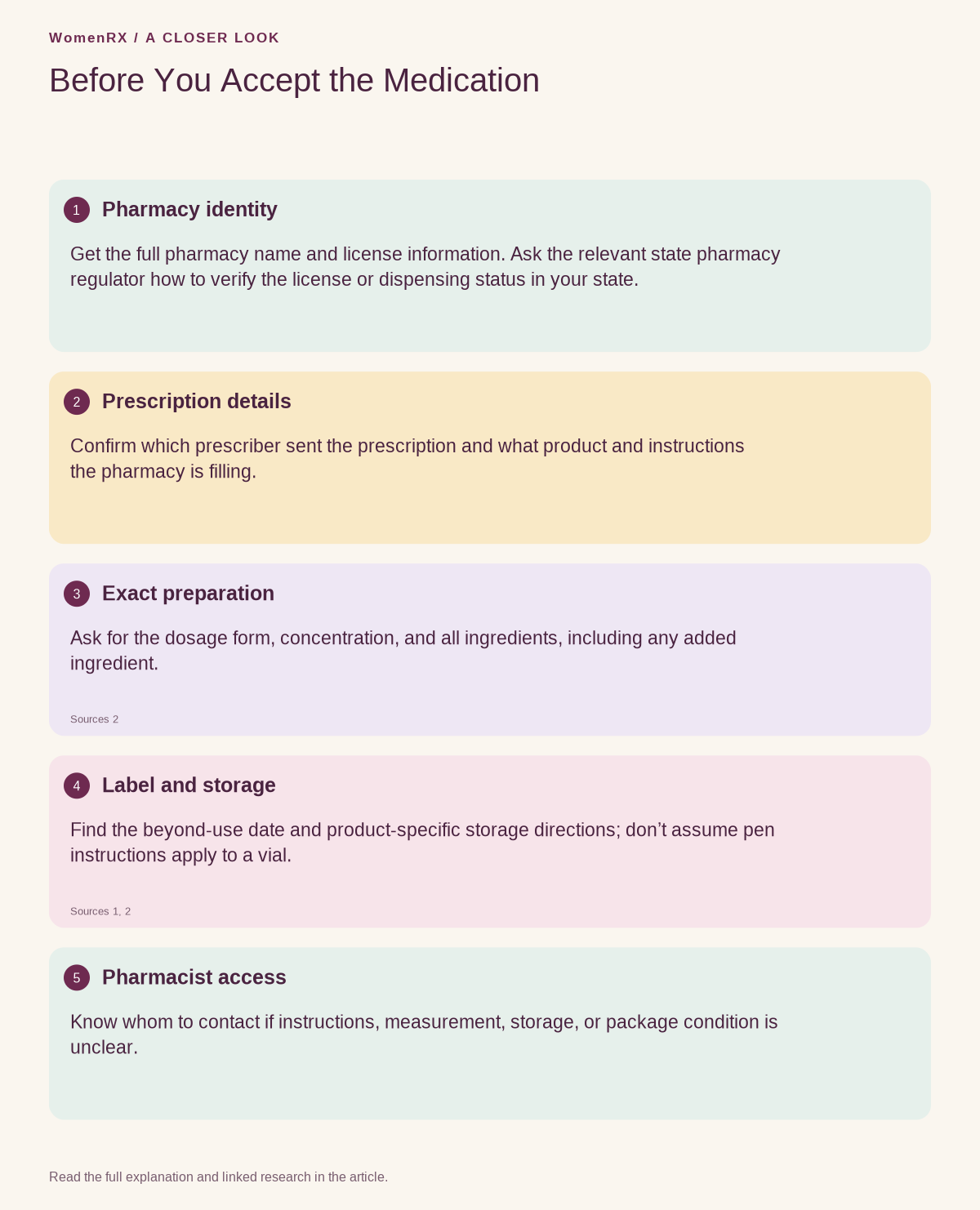
Before You Accept the Medication
Pharmacy identity: Get the full pharmacy name and license information. Ask the relevant state pharmacy regulator how to verify the license or dispensing status in your state.
Prescription details: Confirm which prescriber sent the prescription and what product and instructions the pharmacy is filling.
Exact preparation: Ask for the dosage form, concentration, and all ingredients, including any added ingredient.2
Label and storage: Find the beyond-use date and product-specific storage directions; don’t assume pen instructions apply to a vial.12
Pharmacist access: Know whom to contact if instructions, measurement, storage, or package condition is unclear.
Read the figure as text
Check the pharmacy, prescription, preparation, label, and support plan separately. None of these checks alone certifies product quality.- Pharmacy identity: Get the full pharmacy name and license information. Ask the relevant state pharmacy regulator how to verify the license or dispensing status in your state.
- Prescription details: Confirm which prescriber sent the prescription and what product and instructions the pharmacy is filling.
- Exact preparation: Ask for the dosage form, concentration, and all ingredients, including any added ingredient.2
- Label and storage: Find the beyond-use date and product-specific storage directions; don’t assume pen instructions apply to a vial.12
- Pharmacist access: Know whom to contact if instructions, measurement, storage, or package condition is unclear.
More questions, answered
Can I use the storage directions for a Zepbound pen?
Not automatically. Zepbound’s storage instructions apply to its labeled pen. Ask the dispensing pharmacist for the storage directions and beyond-use date for your specific compounded preparation. 1 2
Does a pharmacy license prove the medication is high quality?
No. A license helps you identify and verify the pharmacy, but it doesn’t independently confirm the quality of an individual preparation. Ask for the product details and make sure the pharmacist can explain them.
Sources you can check
- ZEPBOUND (TIRZEPATIDE) INJECTION, SOLUTION ZEPBOUND (TIRZEPATIDE) INJECTION, SOLUTION ZEPBOUND KWIKPEN (TIRZEPATIDE) INJECTION, SOLUTION [ELI LILLY AND COMPANY] | US prescribing information and patient instructionsAccessed 2026-09-25Return to first citation
- Compounded Semaglutide and Tirzepatide Products Use Unique Formulations but Efficacy and Safety Largely Unknown.Belcourt J, Sapowadia A, White CM. · The Annals of pharmacotherapy · 2026Return to first citation
- Safety analysis of compounded GLP-1 receptor agonists: a pharmacovigilance study using the FDA adverse event reporting system.McCall KL, Mastro Dwyer KA, Casey RT, Samana TN, Sulicz EK, Tso SY, Yalanzhi ER, Piper BJ. · Expert opinion on drug safety · 2026Return to first citation