Plan Before Stopping a GLP-1 Medicine
Weight regain is common after stopping GLP-1 treatment, so it helps to plan the reason for the change, what comes next, and how you’ll follow your health.
In studies, stopping a GLP-1 medicine was followed by weight regain on average, though the amount varied and isn’t a prediction for you. If you’re considering a pause or stop, discuss why, whether another treatment or ongoing support makes sense, and what health changes to follow. Don’t make a medication change without your prescriber’s plan. 3 4
What research suggests after stopping
Weight regain after GLP-1 receptor agonist treatment is common, but study averages can’t tell you exactly what will happen to you. In a meta-analysis of randomized trials, participants with obesity gained an average of 5.63 kg after stopping; in trials involving people with type 2 diabetes, the average gain was 2.03 kg. These figures compare weight at the end of treatment with weight at a later follow-up, and follow-up varied across studies. They aren’t a forecast for one person or a fixed outcome at a particular number of months. 4
The results also differed considerably between studies. For participants with obesity, the meta-analysis reported very high variation in weight outcomes, and longer follow-up was associated with more regain. That makes the overall average useful for understanding the direction of risk, but less useful for predicting an individual’s course. The reported results don’t provide a separate estimate for women. 4
For people taking treatment for type 2 diabetes, stopping may affect more than weight. The same analysis found that HbA1c rose by an average of 0.65 percentage points in the type 2 diabetes studies after treatment ended. The size of that change varied substantially between studies. If blood sugar management is one reason you take the medicine, include it in the transition plan. 4
Why the transition deserves its own plan
Liraglutide can reduce calorie intake while someone is taking it. 2 After GLP-1 treatment stops, appetite may return, which is one possible contributor to weight regain. A review describes this as a likely part of a broader mix of biological changes, while also noting that the mechanisms aren’t fully established. 3
The review describes regain as potentially concentrated in the earlier period after stopping. That makes planned follow-up sensible, but it doesn’t establish a standard schedule or prove that a particular taper prevents regain. Evidence on how best to withdraw treatment or reliably avoid regain is still limited. 3
Lifestyle support can be part of a maintenance plan, but the studies summarized above don’t establish that it will prevent regain after stopping. Nor do they identify one best replacement treatment. Instead, the useful question is what approach fits the reason you’re stopping, your health needs, and your preferences.
Build the conversation around your reason
Before a change, write down what’s driving it. For example, the issue might be side effects, cost, access, pregnancy planning, breastfeeding, a health change, or feeling ready to try a different approach. Those reasons can point to different conversations. If pregnancy is possible or you’re planning pregnancy or breastfeeding, bring that up before medication changes so your clinician can review a plan for your circumstances.
Ask what the proposed change means for the condition the medicine is treating. If you take it for weight management, discuss whether continued treatment, another treatment, or stopping with planned support is being considered. If you take it for type 2 diabetes, ask how glucose management and follow-up will be handled. The evidence doesn’t establish a universal transition strategy, so ask why a particular plan is being recommended for you. 3 4
A focused list of questions can help:
- What is the main reason for changing treatment, and are there other options to consider?
- If I stop or switch, what changes should prompt me to check in sooner?
- What follow-up do you recommend for my weight and, if relevant, blood sugar?
- What support would be available if appetite or weight changes become difficult to manage?
- How should pregnancy planning or breastfeeding affect the discussion, if relevant?
Make follow-up about health, not only the scale
Weight is one useful measure, but it doesn’t describe every part of health. Consider asking which changes matter most for you, such as appetite, day-to-day wellbeing, or blood sugar if you have diabetes. MedlinePlus also notes that body weight includes muscle, bone, fat, and water, and that the number alone can’t tell the whole story. 1
The aim of planning isn’t to guarantee that weight won’t change. It’s to avoid treating stopping as a single event with no next step: agree on the reason, the medication plan, and how you’ll review what happens afterward.
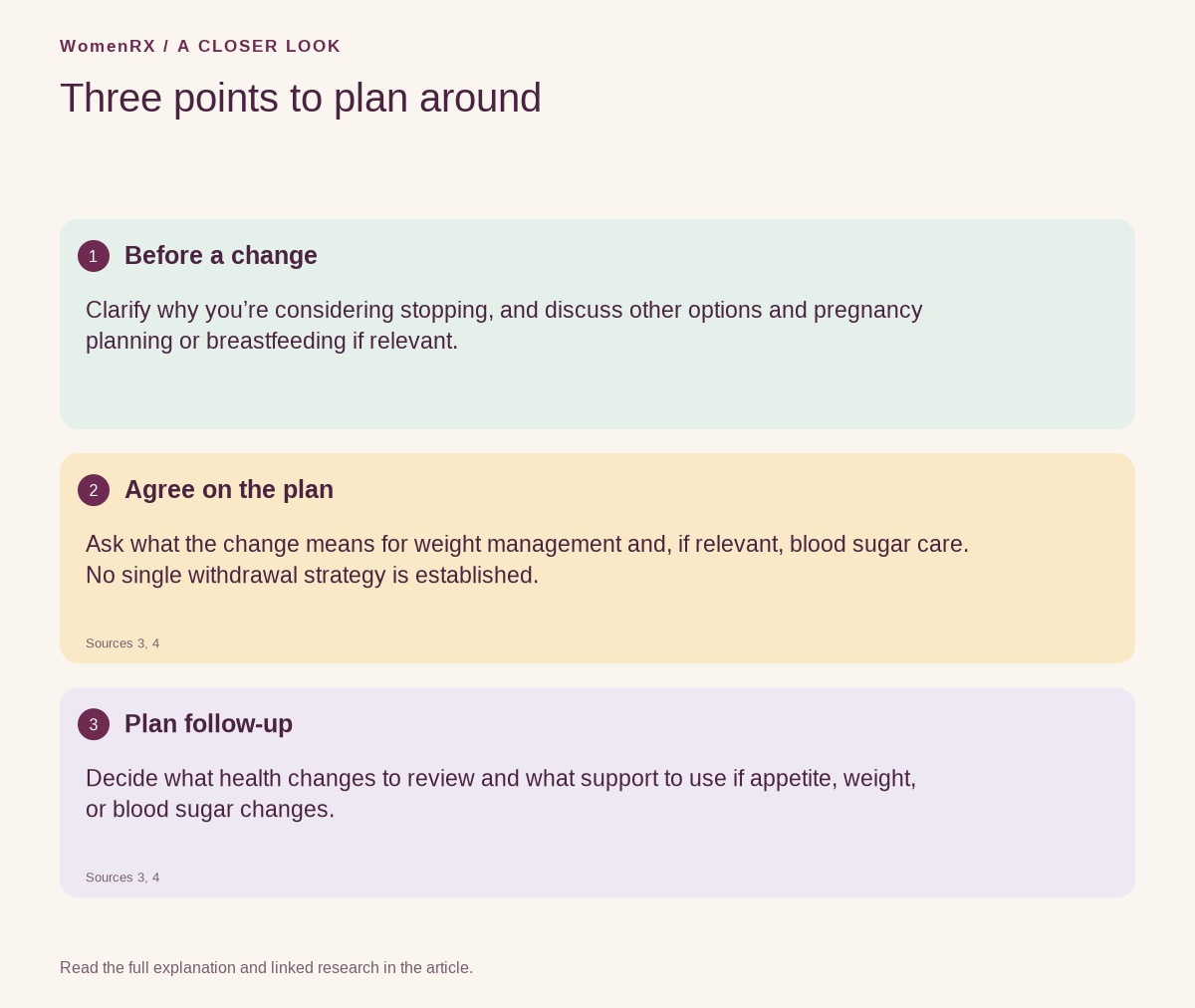
Three points to plan around
Before a change: Clarify why you’re considering stopping, and discuss other options and pregnancy planning or breastfeeding if relevant.
Agree on the plan: Ask what the change means for weight management and, if relevant, blood sugar care. No single withdrawal strategy is established.34
Plan follow-up: Decide what health changes to review and what support to use if appetite, weight, or blood sugar changes.34
Read the figure as text
A conversation guide for a possible treatment change. The stages show decision points, not a standard medication schedule or a promised outcome.- Before a change: Clarify why you’re considering stopping, and discuss other options and pregnancy planning or breastfeeding if relevant.
- Agree on the plan: Ask what the change means for weight management and, if relevant, blood sugar care. No single withdrawal strategy is established.34
- Plan follow-up: Decide what health changes to review and what support to use if appetite, weight, or blood sugar changes.34
More questions, answered
Does everyone regain all the weight they lost?
No. The research reports average changes across groups, not a guaranteed outcome for each person. It doesn’t show that everyone regains all the weight they lost. 4
Sources you can check
- Body Weight: MedlinePlusAccessed 2026-09-25Return to first citation
- SAXENDA (LIRAGLUTIDE) INJECTION, SOLUTION [NOVO NORDISK PHARMACEUTICAL INDUSTRIES, LP] | US prescribing information and patient instructionsAccessed 2026-09-25Return to first citation
- Early Weight Regain After GLP-1 Receptor Agonist Discontinuation: Mechanisms and Implications for Treatment De-Escalation Strategies.Damhof MA, van Bruggen FH, van Roon EN. · Diabetes, obesity & metabolism · 2026Return to first citation
- Metabolic rebound after GLP-1 receptor agonist discontinuation: a systematic review and meta-analysis.Tzang CC, Wu PH, Luo CA, Chen ZT, Lee YT, Huang ES, Kang YF, Lin WC, Tzang BS, Hsu TC. · EClinicalMedicine · 2025Return to first citation