Do You Need Supplements While Taking a GLP-1 Medicine?
A smaller appetite is a reason to check what you’re eating, not a reason to buy a standard supplement bundle.
Not automatically. GLP-1-based medicines can reduce food intake, and digestive symptoms may make eating harder. Whether a supplement makes sense depends on what you can eat consistently, not the medicine’s name alone. If meals have become very limited or symptoms keep interfering with eating or drinking, discuss the pattern with your care team so any nutrition support, testing, or supplement has a clear purpose. 2 3 5
A GLP-1 medicine may make a smaller meal feel like enough. That can be helpful, but it also changes the practical question: are the foods you are eating still meeting your needs? Liraglutide reduces calorie intake, and reviews of GLP-1-based treatments describe appetite changes and digestive symptoms that can affect meals. Neither change, by itself, tells you that you have a vitamin deficiency. 2 4 5
Smaller portions and a narrow diet are different problems
Think about an ordinary stretch of meals, not one day when you felt especially hungry or unwell. If portions are smaller but you’re still eating a range of foods, including foods that provide protein, the first step may be to make those smaller meals count. An eating pattern needs to provide energy, protein, other nutrients, and water while fitting your preferences and budget. Nutrition reviews of GLP-1 treatment emphasize nutrient-dense, protein-rich food choices rather than assuming a supplement can make up for inadequate meals. 1 7
A different concern is a diet that stays narrow. For example, if you’ve stopped eating many of your usual foods because they no longer appeal to you, or only a few foods feel tolerable, look at what has dropped out of your routine. That gives a clinician or registered dietitian something specific to assess. A supplement might address a particular nutrient gap, but it won’t replace enough food or fluids. Reviews recommend individualized nutrition assessment while noting that long-term evidence on micronutrient status during these treatments remains limited. 1 5
When symptoms change the next step
If nausea or other digestive symptoms repeatedly keep you from eating or drinking, raise that with the team managing your medicine rather than trying to solve it with vitamins. Gastrointestinal adverse effects are recognized with liraglutide, and nutrition reviews describe how such symptoms can affect dietary tolerance. The immediate question is what’s making intake difficult, not which supplement to add. 3 5
Persistent or severe abdominal pain, sometimes spreading to the back and occurring with or without vomiting, calls for prompt medical assessment. It is a warning symptom described in liraglutide prescribing information, not a sign to interpret as a nutrient shortfall. 2 3
Give a supplement a specific job
There’s a useful order to the decision. First, identify whether the issue is smaller but varied meals, a consistently restricted range of foods, or symptoms that are preventing intake. Then consider whether food changes are workable and whether an individual assessment points to a reason for testing or a particular supplement. Research raises concerns about inadequate nutrient intake in some people using GLP-1-based treatment, but it hasn’t established one deficiency or supplement routine that applies to everyone. 5 7
A preliminary study illustrates why a personal review matters more than a blanket rule. It reconstructed intake from two-day food diaries submitted by 387 adults recruited through Polish online support groups. The reported diets raised nutrition concerns, but that short, self-reported snapshot cannot show what every GLP-1 user eats or establish that the medicines caused a deficiency. 6
If you’re planning pregnancy or have questions about contraception, bring up the exact medicine you take during your medication review. That conversation is separate from deciding whether your current meals point to a supplement need.
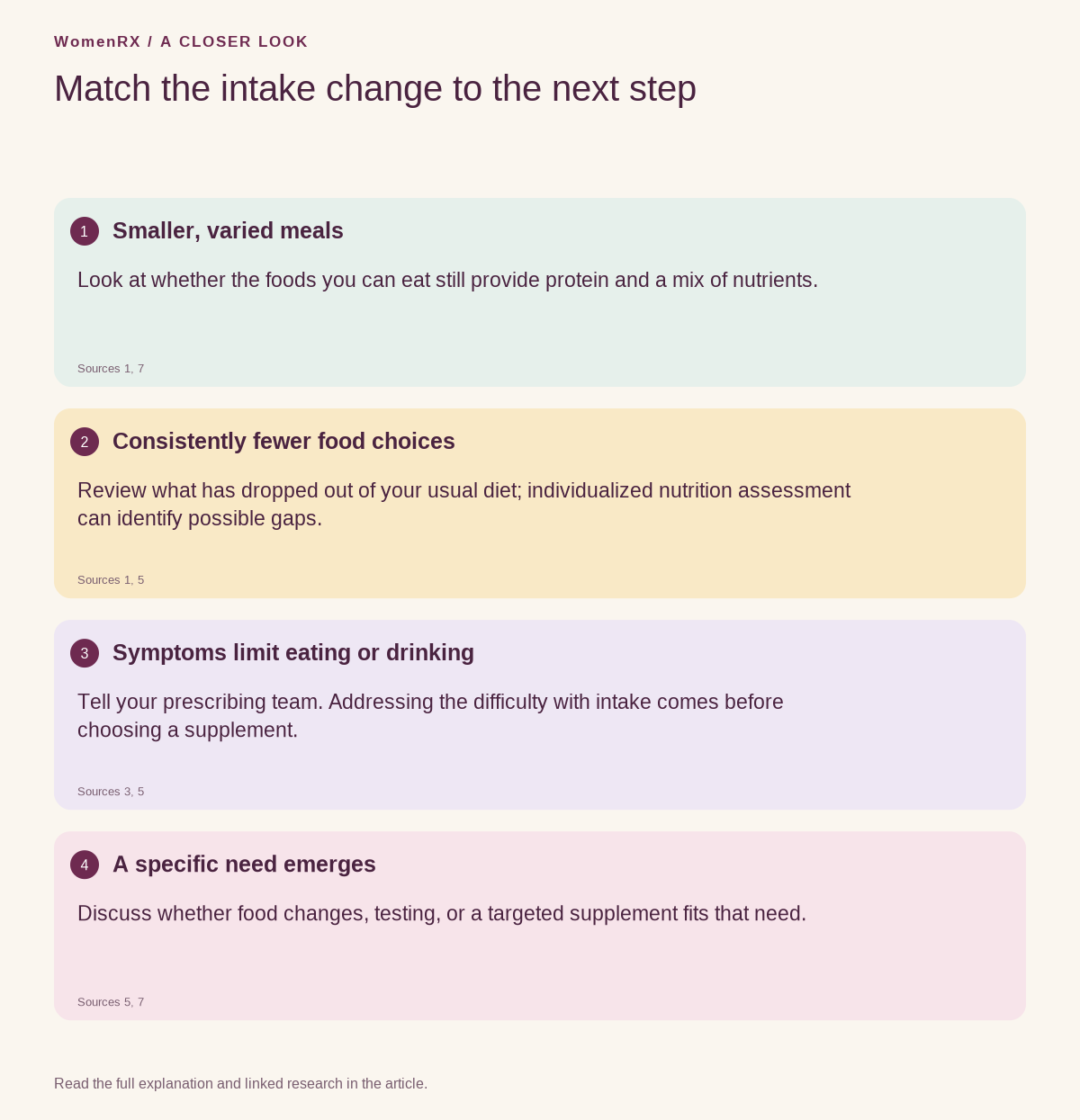
Match the intake change to the next step
Smaller, varied meals: Look at whether the foods you can eat still provide protein and a mix of nutrients.17
Consistently fewer food choices: Review what has dropped out of your usual diet; individualized nutrition assessment can identify possible gaps.15
Symptoms limit eating or drinking: Tell your prescribing team. Addressing the difficulty with intake comes before choosing a supplement.35
A specific need emerges: Discuss whether food changes, testing, or a targeted supplement fits that need.57
Read the figure as text
Start with what has changed about your meals; different patterns call for different questions.- Smaller, varied meals: Look at whether the foods you can eat still provide protein and a mix of nutrients.17
- Consistently fewer food choices: Review what has dropped out of your usual diet; individualized nutrition assessment can identify possible gaps.15
- Symptoms limit eating or drinking: Tell your prescribing team. Addressing the difficulty with intake comes before choosing a supplement.35
- A specific need emerges: Discuss whether food changes, testing, or a targeted supplement fits that need.57
More questions, answered
Does everyone taking a GLP-1 medicine need a multivitamin?
No routine multivitamin plan has been established for everyone taking these medicines. Start with what you regularly eat and what, if anything, an individual assessment identifies as missing. 5 7
Can a supplement prevent muscle loss during weight loss?
A supplement isn’t a substitute for eating enough overall or getting protein from the foods you can manage. Reviews raise concerns about lean tissue loss during GLP-1-based treatment, but they don’t establish that a particular supplement prevents it. Reviewing your full eating pattern is the more useful starting point. 4 5 7
Sources you can check
- Nutrition: MedlinePlusAccessed 2026-09-25Return to first citation
- SAXENDA (LIRAGLUTIDE) INJECTION, SOLUTION [NOVO NORDISK PHARMACEUTICAL INDUSTRIES, LP] | US prescribing information and patient instructionsAccessed 2026-09-25Return to first citation
- VICTOZA (LIRAGLUTIDE) INJECTION [NOVO NORDISK] | US prescribing information and patient instructionsAccessed 2026-09-25Return to first citation
- Effect of GLP-1 receptor agonist on nutrient intake: A narrative review.Fujioka K. · Nutrition in clinical practice : official publication of the American Society for Parenteral and Enteral Nutrition · 2026Return to first citation
- Nutritional Care for Adults With Obesity Treated With Glucagon-Like Peptide (GLP)-1 and Dual Glucose-Dependent Insulinotropic Polypeptide (GIP)/GLP-1 Receptor Agonists: A Review of Evidence, Gaps, and Clinical Implications.McGuane C, Farhadhar N, Sharieff KA, Petrosky SN, Alabasi K. · Cureus · 2026Return to first citation
- Dietary intake patterns and nutritional adequacy among adults with overweight or obesity treated with GLP-1 or dual GIP/GLP-1 receptor agonists- preliminary study.Korus S, Cembrowska-Lech D, Kłoda K, Stachowska E. · Journal of translational medicine · 2026Return to first citation
- GLP-1 Receptor Agonists - Good for Body Weight, Bad for Micronutrient Status?Kerlikowsky F, Krämer K, Eggersdorfer M, Hahn A. · Current developments in nutrition · 2025Return to first citation