Starting Strength Training While Taking a GLP-1 Medicine
Start with movements you can repeat comfortably, then build a routine around your strength, appetite, and health needs.
You don’t need to wait until weight loss is over to begin strength training. Start with manageable movements, notice how you feel, and build gradually rather than trying to meet a full exercise target at once. Resistance training is recommended alongside GLP-1 treatment to support muscle during weight loss, but no workout can guarantee that you’ll preserve all your muscle. Your current fitness, food intake, symptoms, and bone or joint health should shape the plan.12
Make the first session a starting point, not a test
Strength training means asking your muscles to work against resistance. That could be your body weight, a resistance band, a machine, or a weight. If you’re new to it, a few familiar movements are a more useful starting point than an ambitious workout you dread repeating. For example, you might try rising from a sturdy chair, pushing against a wall, and pulling a light band. These are examples of movement patterns, not a tested GLP-1 workout or a requirement to do all three.
Notice what each movement tells you. Can you do it with control? Does a joint hurt? Do you feel steady? Choose a version you can manage now, including a seated or supported version if that’s what works for you. As the movements become familiar, you can discuss adding resistance or more training with a qualified strength trainer or exercise physiologist. The four-society advisory on nutrition and GLP-1 therapy recommends a structured program tailored to fitness and physical capacity, and notes that this kind of support may help people establish a routine and assess strength over time.1
The advisory’s longer-term aim is regular strength training at least three times a week, alongside aerobic activity. That’s a goal to adapt to your capacity, not a pass-or-fail starting line. General exercise guidance also supports beginning slowly.12
Why strength matters during weight loss
Weight loss can include lean tissue as well as fat. Resistance training gives your muscles a reason to keep working while your body weight changes. A research review describes gains in strength and lean mass from supervised resistance training in men and women, but those results do not establish that the same gains will occur for someone starting a particular workout during GLP-1 treatment.4
There’s a useful distinction here: evidence for resistance training during weight loss is stronger than evidence for any one GLP-1-specific lifting plan. The four-society advisory recommends structured resistance or mixed resistance-and-aerobic exercise to help preserve lean mass. It also cautions that eating more protein alone is unlikely to do the job without strength training. Neither step guarantees complete muscle preservation.1
Think beyond the number on the scale. Being able to rise from a chair or climb stairs can tell you something about how your strength serves daily life. The advisory identifies sit-to-stand and stair-climb measures as potentially useful in older adults, while noting they may be less sensitive to change in younger people.1
Let your appetite and symptoms shape the day
Gastrointestinal symptoms can make an exercise plan harder to carry out. The advisory recommends regular meals, adequate fluids, and an eating pattern that meets individual nutrition needs; its protein targets are not universal prescriptions.1 For example, if you’ve barely eaten and feel unwell, a demanding session needn’t be the day’s priority. Adjusting the session is different from giving up on strength training.
If symptoms repeatedly keep you from eating, drinking, or training comfortably, bring that up with the clinician managing your medication rather than trying to push through every workout. Severe gastrointestinal reactions are documented for liraglutide, one GLP-1 medicine.3 Persistent or severe abdominal pain, sometimes spreading to the back and occurring with or without vomiting, needs prompt medical assessment rather than a workout; it is a listed warning sign of pancreatitis for liraglutide.3
Account for the body you have now
Your starting point matters more than a generic plan. If you already lift, the question may be how to keep training manageable while your weight and appetite change. If you’ve been inactive, the question may be which movements feel stable enough to repeat. Arthritis, balance concerns, or another condition affecting activity may call for different exercise choices; physical activity can still support function in people with chronic conditions.2
If you’re in perimenopause or postmenopause, or have been told you have low bone density, ask whether your exercise choices need adapting. That’s an assessment question, not an assumption that the medication has harmed your bones. Exercise can help slow age-related bone-density loss, and the GLP-1 advisory discusses bone health as one reason to tailor activity during weight reduction.21
A useful next move is to choose one manageable way to practice strength, then see whether you can repeat it while feeling adequately fueled and steady. If bone health, joint symptoms, or a health condition makes that choice uncertain, ask what kind of resistance exercise fits your situation. You’re building a practice you can adjust, not trying to prove yourself in the first week.1
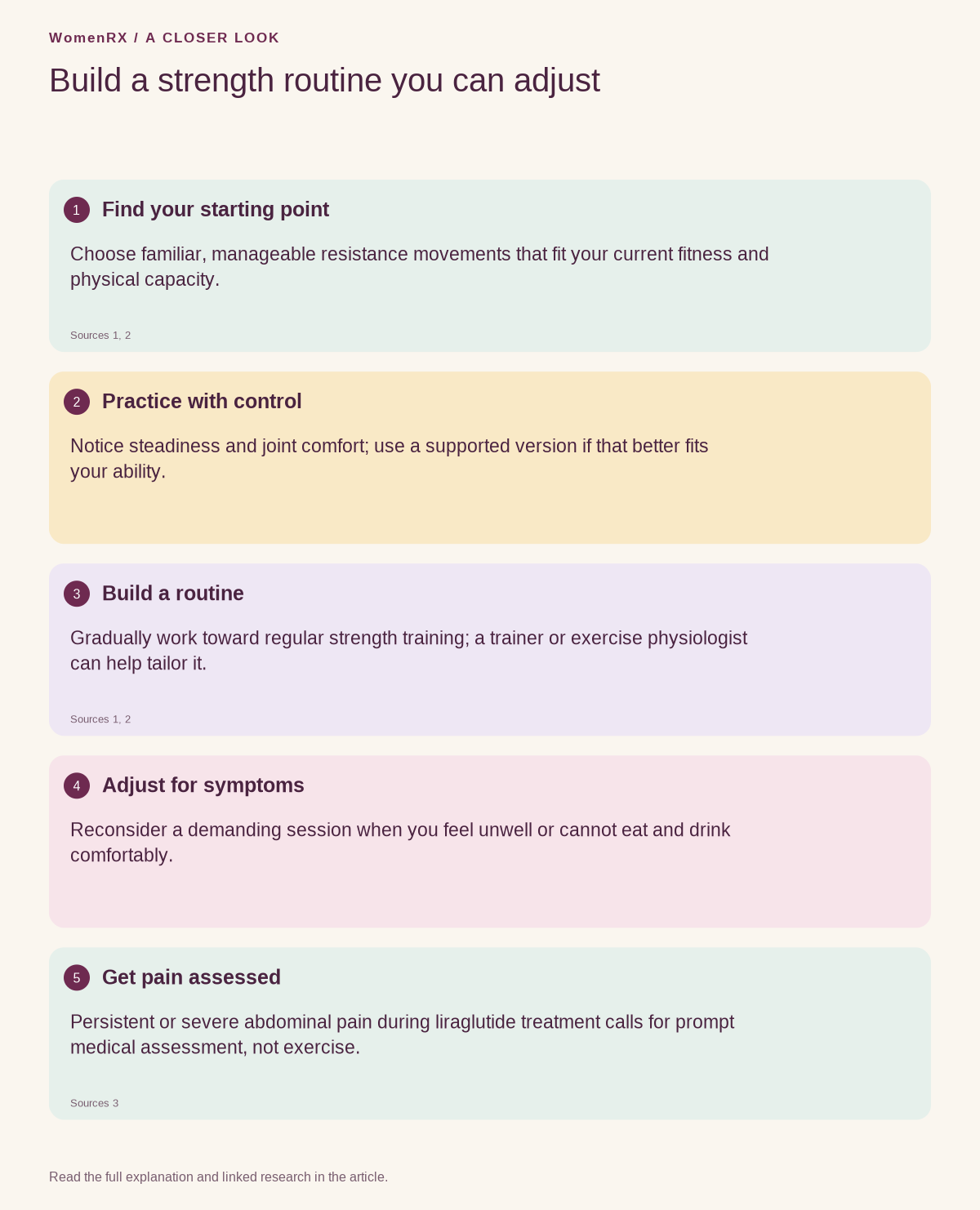
Build a strength routine you can adjust
Find your starting point: Choose familiar, manageable resistance movements that fit your current fitness and physical capacity.12
Practice with control: Notice steadiness and joint comfort; use a supported version if that better fits your ability.
Build a routine: Gradually work toward regular strength training; a trainer or exercise physiologist can help tailor it.12
Adjust for symptoms: Reconsider a demanding session when you feel unwell or cannot eat and drink comfortably.
Get pain assessed: Persistent or severe abdominal pain during liraglutide treatment calls for prompt medical assessment, not exercise.3
Read the figure as text
Use these decision points to shape a beginning, rather than following a fixed workout timetable.- Find your starting point: Choose familiar, manageable resistance movements that fit your current fitness and physical capacity.12
- Practice with control: Notice steadiness and joint comfort; use a supported version if that better fits your ability.
- Build a routine: Gradually work toward regular strength training; a trainer or exercise physiologist can help tailor it.12
- Adjust for symptoms: Reconsider a demanding session when you feel unwell or cannot eat and drink comfortably.
- Get pain assessed: Persistent or severe abdominal pain during liraglutide treatment calls for prompt medical assessment, not exercise.3
More questions, answered
Does walking count as strength training?
Walking is useful physical activity, but it doesn’t replace a structured resistance program for preserving lean mass during weight reduction. The GLP-1 advisory recommends both strength work and aerobic activity, with a plan matched to your capacity.1
Sources you can check
- Nutritional priorities to support GLP-1 therapy for obesity: four-society joint advisory2025Return to first citation
- Benefits of Exercise: MedlinePlusAccessed 2026-09-25Return to first citation
- SAXENDA (LIRAGLUTIDE) INJECTION, SOLUTION [NOVO NORDISK PHARMACEUTICAL INDUSTRIES, LP] | US prescribing information and patient instructionsAccessed 2026-09-25Return to first citation
- Incretin-Based Weight Loss Pharmacotherapy: Can Resistance Exercise Optimize Changes in Body Composition?Locatelli JC, Costa JG, Haynes A, Naylor LH, Fegan PG, Yeap BB, Green DJ. · Diabetes care · 2024Return to first citation