Should You Fast While Taking a GLP-1 Medicine?
If your medicine already makes eating difficult, a shorter eating window may leave too little room for the food and fluids you need.
The four-society nutrition advisory does not establish that adding intermittent fasting improves GLP-1 treatment. It favors regular, smaller meals, adequate fluids, and enough protein during weight loss.1 If you’re struggling to eat, take insulin or certain other diabetes medicines, or are pregnant or breastfeeding, get individualized advice before adding a food restriction.148
Start with what’s happening when you eat
A GLP-1 medicine can make you feel full sooner and less interested in food. Liraglutide, for example, reduces calorie intake and delays stomach emptying. Nausea and other digestive symptoms can also occur with GLP-1 receptor agonists.57 That can make time-restricted eating feel easy, but easy to skip meals isn’t the same as easy to nourish yourself.
A four-society advisory on nutrition during GLP-1 therapy encourages regular, small meals, adequate fluids, and a range of nutrient-rich foods. It advises against going so long without a meal that you become overly hungry, or compensating with a large meal.1 This is expert guidance, not a trial proving that one eating schedule is best. It gives you a practical way to judge whether a fasting window fits your current appetite.
Ask whether the window helps you eat well
Suppose you’re comfortable without a late-night snack, then eat satisfying meals through the day. That’s different from missing breakfast because you feel nauseated, eating little at lunch, and trying to fit most of your food into one large dinner. The second pattern works against the advisory’s emphasis on smaller meals and nutrient adequacy.1
When appetite is low, think about what you can actually manage rather than aiming for the narrowest window. For example, yogurt with fruit, tofu with vegetables and a whole grain, or fish with vegetables are ways to include protein and varied foods across meals. They’re examples, not a tested GLP-1 menu or a required set of meals. Protein can come from animal foods or from foods such as tofu, beans, and lentils.123
Protein matters during weight loss, but there’s no single protein target that fits everyone taking a GLP-1 medicine. The advisory also notes that protein alone is unlikely to preserve muscle without strength training.1 If a fasting plan repeatedly crowds out meals, fluids, or foods you can tolerate, making the window stricter is unlikely to solve that problem.
Diabetes medicines change the safety question
If you also use insulin or a medicine that prompts your pancreas to release insulin, going longer without food can raise a different concern: low blood glucose. Low glucose may come on quickly, and people taking these medicines may need changes to their food or medication plan if lows recur.4 Ask the clinician who manages your diabetes how an eating-window change would affect glucose monitoring and your treatment plan.
For someone taking a GLP-1 medicine without those additional glucose-lowering medicines, that particular risk is different. It doesn’t settle the nutrition question, though. Whether you’re eating enough still matters.14
When to set the fasting plan aside
If nausea or vomiting means you’re struggling to keep up with food or fluids, focus on addressing that problem rather than extending a fast. As a practical next step, tell your prescriber what’s making eating difficult; a registered dietitian can help you find a workable eating pattern.1 Persistent or severe abdominal pain, sometimes reaching the back and possibly accompanied by vomiting, needs prompt medical assessment because it can be a sign of pancreatitis during GLP-1 treatment.6
Pregnancy plans, pregnancy, and breastfeeding call for a separate discussion about the medicine itself, not just the meal schedule. Major GLP-1 trials excluded people who were pregnant, breastfeeding, or planning pregnancy, and evidence in these periods remains limited.8 If you’re postpartum, your needs and treatment choices may also differ depending on whether you’re breastfeeding; studies of GLP-1 treatment after gestational diabetes have not settled long-term benefits or lactation safety.7
If your periods change while you’re eating much less, bring up both changes rather than assuming the medicine or fasting explains them. And if rigid eating windows bring back restrictive or binge-eating patterns, say so plainly when discussing your plan. Neither situation is a universal verdict about fasting, but both are reasons to make the decision around your health rather than a clock.
The useful question for your prescriber or dietitian isn’t simply, “Can I fast?” It’s: “Given what I can eat now, my other medicines, and my health circumstances, would an eating window help me maintain a nourishing routine or make that harder?” A registered dietitian can help shape a pattern around your needs and preferences while you’re on GLP-1 therapy.1
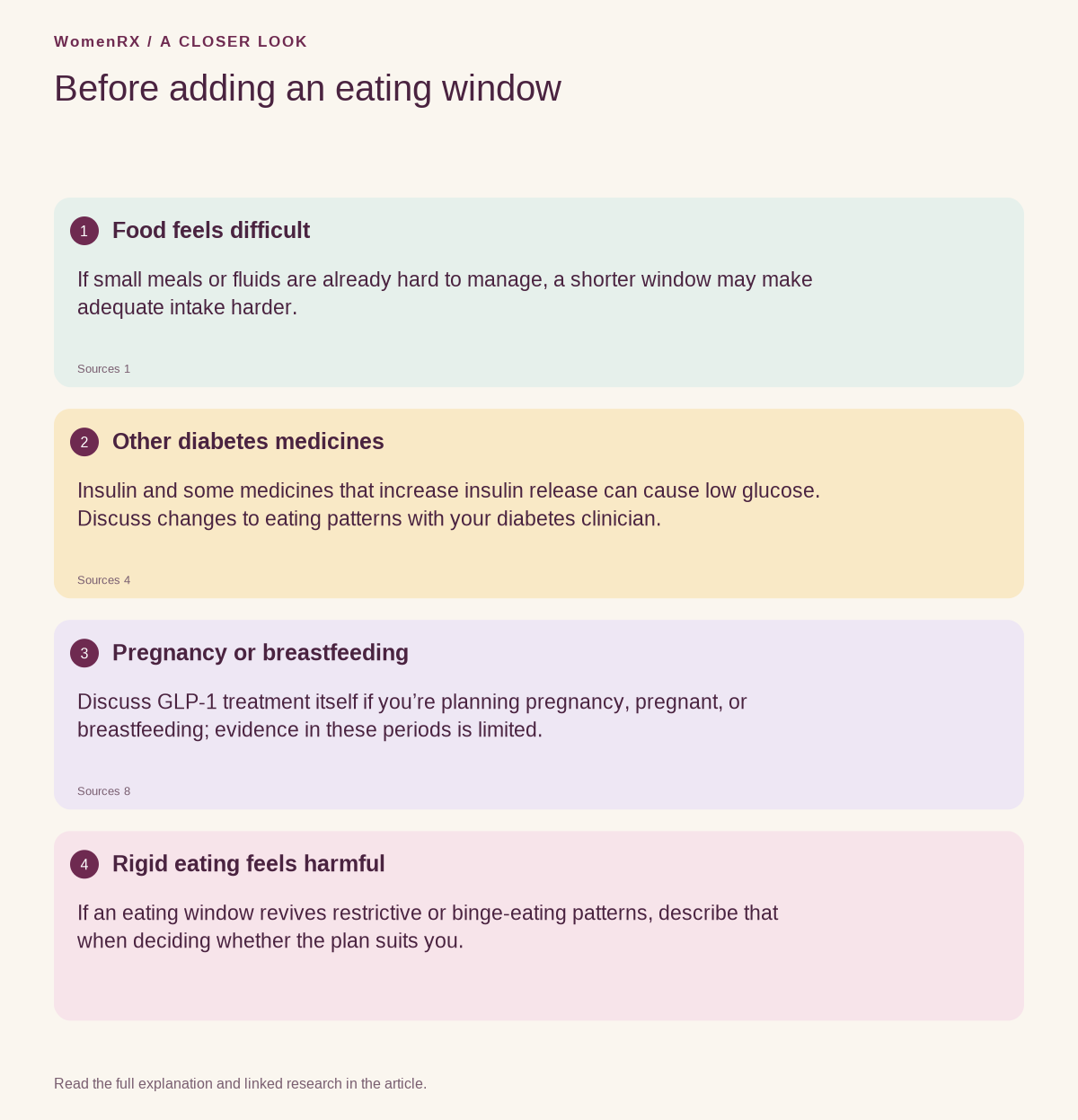
Before adding an eating window
Food feels difficult: If small meals or fluids are already hard to manage, a shorter window may make adequate intake harder.1
Other diabetes medicines: Insulin and some medicines that increase insulin release can cause low glucose. Discuss changes to eating patterns with your diabetes clinician.4
Pregnancy or breastfeeding: Discuss GLP-1 treatment itself if you’re planning pregnancy, pregnant, or breastfeeding; evidence in these periods is limited.8
Rigid eating feels harmful: If an eating window revives restrictive or binge-eating patterns, describe that when deciding whether the plan suits you.
Read the figure as text
These are reasons to pause and make a plan that fits your treatment, not a score or a list of automatic fasting bans.- Food feels difficult: If small meals or fluids are already hard to manage, a shorter window may make adequate intake harder.1
- Other diabetes medicines: Insulin and some medicines that increase insulin release can cause low glucose. Discuss changes to eating patterns with your diabetes clinician.4
- Pregnancy or breastfeeding: Discuss GLP-1 treatment itself if you’re planning pregnancy, pregnant, or breastfeeding; evidence in these periods is limited.8
- Rigid eating feels harmful: If an eating window revives restrictive or binge-eating patterns, describe that when deciding whether the plan suits you.
More questions, answered
Does fasting make a GLP-1 medicine more effective?
The four-society advisory does not test whether adding intermittent fasting makes GLP-1 treatment more effective. It focuses instead on whether your eating pattern supports adequate intake, tolerable meals, and muscle preservation during weight loss.1
Does a fasting window change when I should take my GLP-1 medicine?
Ask your prescriber or pharmacist about the instructions for your specific medicine. If you also take insulin or a medicine that increases insulin release, ask how a change in meals affects your diabetes plan.4
Sources you can check
- Nutritional priorities to support GLP-1 therapy for obesity: four-society joint advisory2025Return to first citation
- MedlinePlus: Protein in diet, including tofu and other plant sourcesAccessed 2026-09-25Return to first citation
- MedlinePlus: Managing weight with healthy eatingAccessed 2026-09-25Return to first citation
- Hypoglycemia: MedlinePlusAccessed 2026-09-25Return to first citation
- SAXENDA (LIRAGLUTIDE) INJECTION, SOLUTION [NOVO NORDISK PHARMACEUTICAL INDUSTRIES, LP] | US prescribing information and patient instructionsAccessed 2026-09-25Return to first citation
- VICTOZA (LIRAGLUTIDE) INJECTION [NOVO NORDISK] | US prescribing information and patient instructionsAccessed 2026-09-25Return to first citation
- Postpartum GLP-1 receptor agonists and SGLT-2 therapies in women with prior gestational diabetes: current evidence and uncertainties.Vanlaer Y, Van de Cauter E, Embo N, Benhalima K. · BMC medicine · 2026Return to first citation
- Maternal cardiometabolic health and the role of GLP-1 receptor agonists from preconception to postpartum: A review of evidence and opportunities.Vardhan S, Arnott C, Chen AX, Frolova A, Meka R, Raghuraman N, Vijay A, Yoo SG, Mahmoud Z. · American journal of preventive cardiology · 2026Return to first citation