Starting a GLP-1 After 60: What to Review
Before starting, look at more than the scale: the treatment’s purpose, your medicines, digestive tolerance, nutrition, hydration, and day-to-day strength all deserve a place in the conversation.
Being over 60 is a reason to make the plan fit your health and daily life, not to assume a GLP-1 medicine is automatically unsuitable. Review why the specific medicine is being considered, your full medication list, eating and drinking, and how you’ll keep track of strength and function. Digestive symptoms can make hydration and adequate nutrition harder, so agree on what to watch for and when to check in.
Start with the reason for treatment
Be clear about the goal: is the medicine being considered for type 2 diabetes, weight management, or another reason? Ask which specific medicine is proposed and what outcome would make it worthwhile for you. This is a practical starting point, not a test of whether you qualify. A review of phase 4 trials in adults 65 and older covered people with diabetes; its findings shouldn’t automatically be applied to every medicine or treatment purpose. 5
Age alone doesn’t tell the whole story. Your other health conditions, appetite, mobility, and the number of medicines you already take may matter more to how manageable treatment feels.
Bring the full medication picture
Bring a current list of prescriptions, nonprescription medicines, and supplements, including how you take them. Ask whether any part of your existing regimen needs closer monitoring if your appetite, food intake, or blood sugar changes. Don’t rely on a general list of “safe” combinations in place of a review of your actual medicines.
It can also help to discuss who will follow up with you and how to reach them if symptoms interfere with eating or drinking. That matters especially when several treatments or health conditions need attention at once.
Make room for eating and drinking
Digestive intolerance was reported in the phase 4 trial review of GLP-1 medicines in older adults with diabetes, though the review does not provide a sex-specific breakdown in its reported findings. 5 If symptoms make meals or fluids difficult, that can become more consequential with age: older adults still need enough nutrients even when their calorie needs may be lower, and some may need more protein. 1
Ask how you’ll recognize a pattern of eating or drinking less than usual, and what the next step should be if that happens. A nutrition advisory on GLP-1 treatment says preserving muscle and bone during weight loss matters, particularly at older ages. It also cautions that protein intake alone may not preserve muscle without structured strength training. Protein needs are individual, so use the conversation to find an approach that fits your health and abilities rather than adopting a one-size-fits-all target. 3
Include strength and everyday function
Think about what you want to be able to keep doing: walking, getting up from a chair, carrying groceries, or managing stairs. Mention any recent change in strength, balance, or ability to do usual activities. These details can help make the treatment discussion about function as well as weight.
The GLP-1 nutrition advisory describes muscle and bone preservation as connected priorities during weight reduction, and notes that strength or mixed resistance-and-aerobic training can help preserve lean mass. 3 Ask what activity is appropriate for your current abilities, and how you and your care team will notice if your function changes.
Know when symptoms need attention
If nausea, vomiting, or diarrhea occurs, pay attention to whether you can keep up with fluids. Dry mouth, urinating less often, or dark urine can be signs of dehydration. 2 Dehydration can be more serious in older adults. 4 For adults, MedlinePlus advises contacting a health care provider for diarrhea lasting more than two days, or sooner if there are signs of dehydration. 4
Before treatment begins, agree on whom to contact if symptoms make it hard to eat or drink, and what follow-up will look like. That gives you a plan based on your health and routine, not just a prescription.
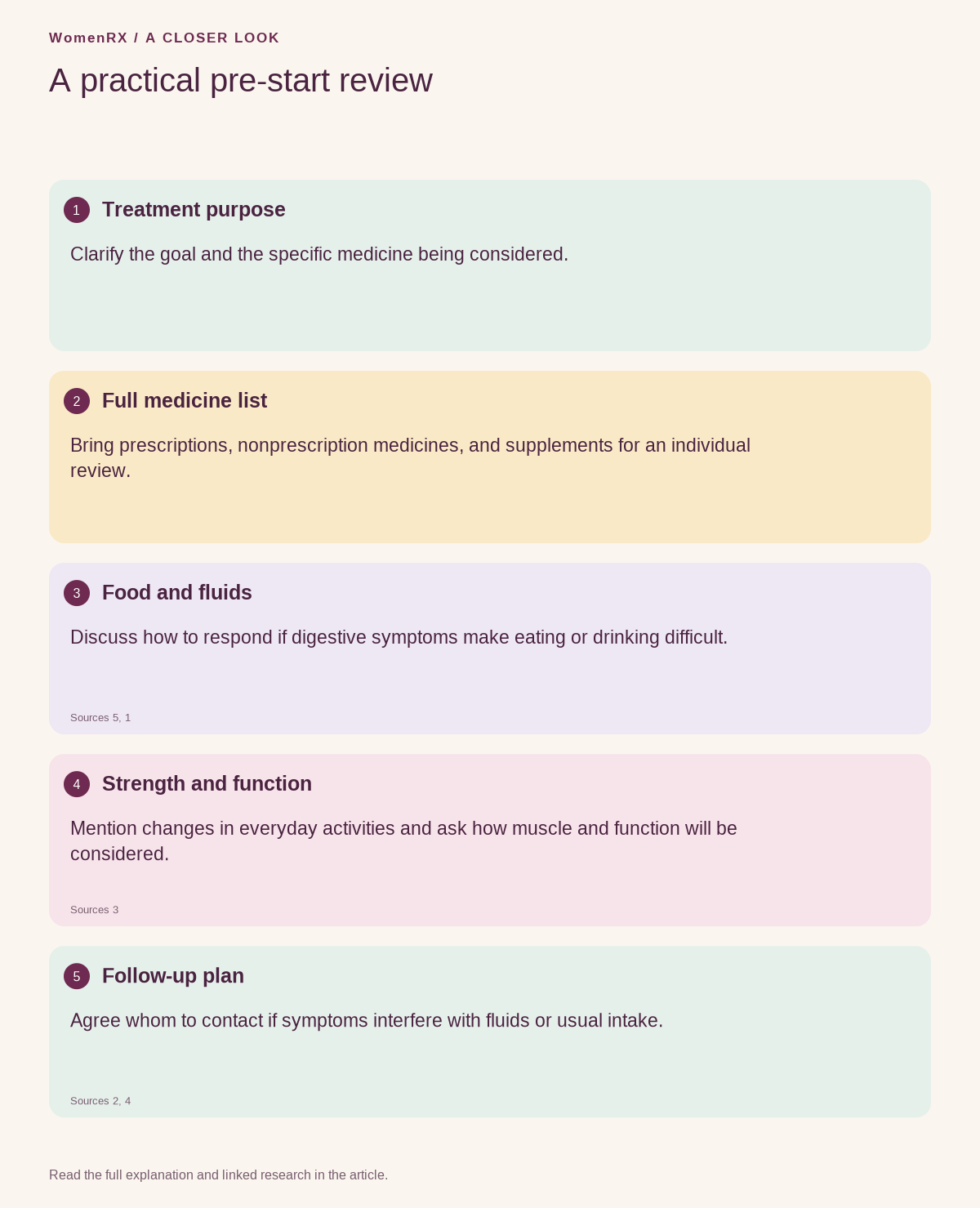
A practical pre-start review
Treatment purpose: Clarify the goal and the specific medicine being considered.
Full medicine list: Bring prescriptions, nonprescription medicines, and supplements for an individual review.
Food and fluids: Discuss how to respond if digestive symptoms make eating or drinking difficult.51
Strength and function: Mention changes in everyday activities and ask how muscle and function will be considered.3
Follow-up plan: Agree whom to contact if symptoms interfere with fluids or usual intake.24
Read the figure as text
Use these prompts to make the treatment discussion specific to your health, medicines, intake, and everyday function.- Treatment purpose: Clarify the goal and the specific medicine being considered.
- Full medicine list: Bring prescriptions, nonprescription medicines, and supplements for an individual review.
- Food and fluids: Discuss how to respond if digestive symptoms make eating or drinking difficult.51
- Strength and function: Mention changes in everyday activities and ask how muscle and function will be considered.3
- Follow-up plan: Agree whom to contact if symptoms interfere with fluids or usual intake.24
More questions, answered
Do studies in older adults tell us specifically about older women?
A review of phase 4 trials covered adults 65 and older with diabetes. Its reported findings do not provide a sex-specific breakdown, so they cannot answer whether outcomes differ for older women. 5
What should I do if diarrhea starts?
Watch for signs of dehydration, including dry mouth, urinating less often, or dark urine. For adults, MedlinePlus advises contacting a health care provider if diarrhea lasts more than two days, or sooner if dehydration signs appear. 24
Sources you can check
- Nutrition for Older Adults: MedlinePlusAccessed 2026-09-25Return to first citation
- Nausea | Vomiting | MedlinePlusAccessed 2026-09-25Return to first citation
- Nutritional priorities to support GLP-1 therapy for obesity: four-society joint advisory2025Return to first citation
- Diarrhea | MedlinePlusAccessed 2026-09-25Return to first citation
- GLP-1 Receptor Agonist Therapy in Older Adults with Diabetes: A Qualitative Analysis of Phase 4 ClinicalTrials.gov Studies.Alourfi NM, Alorfi NM. · Diabetes, metabolic syndrome and obesity : targets and therapy · 2026Return to first citation