GLP-1 Treatment in Your 30s: What Actually Matters
Your age alone doesn’t settle the decision; your health goals, pregnancy plans, and the particular medicine matter more.
Being in your 30s doesn’t, by itself, make a GLP-1-based medicine right or wrong for you. The more useful questions are whether you have a medical reason for treatment, what you hope it will do, and whether pregnancy is possible or planned. Contraception needs particular attention with tirzepatide if you use an oral hormonal method.25
Start with the reason for treatment, not your birthday
A conversation about weight-management medication starts with your health picture, not a decade on the calendar. For example, a major tirzepatide weight-management trial enrolled adults with a BMI of 30 or higher, or a BMI of 27 to under 30 plus a weight-related condition such as high blood pressure or sleep apnea. Those are the trial’s entry criteria, not a complete test of whether a medicine is appropriate for you.1 BMI is useful context, but it doesn’t distinguish body fat from muscle or tell the whole story about health risk.3
It also matters what you want to treat. Weight management and blood-sugar treatment aren’t interchangeable goals, even when medicines share an ingredient. The tirzepatide trials described in Zepbound’s prescribing information included one study that excluded people with type 2 diabetes and another that enrolled people with it.1 Bring your weight history, relevant conditions, and treatment goal into the same conversation rather than asking only, “Am I old enough for a GLP-1?”
Make pregnancy plans part of the decision now
You might be hoping to conceive soon, years from now, or not at all. None of those plans should be assumed from your age. If pregnancy is possible, though, it’s worth discussing before starting treatment. GLP-1 receptor agonists aren’t recommended during pregnancy, and human evidence is too limited to predict the effects of exposure around conception with confidence.57 If you’re planning a pregnancy, ask how the proposed medicine fits that timeline and what the plan would be for stopping it. Don’t substitute a single class-wide stopping interval: these medicines differ, and the preconception evidence remains limited.6
Contraception is a separate, practical question. Tirzepatide delays stomach emptying and may make oral hormonal contraceptives less effective. Mounjaro’s US prescribing information advises people using oral hormonal contraception to switch to a non-oral method or add a barrier method for four weeks after starting tirzepatide and for four weeks after each dose increase. It says hormonal methods that aren’t taken by mouth should not be affected by this interaction.2 If you rely on a pill, say so when discussing tirzepatide; this is more specific than a general reminder to “use contraception.”
If you have polycystic ovary syndrome (PCOS) and irregular periods, ask whether a change in your cycle could affect your pregnancy plans or contraception. Some small studies have reported improved menstrual regularity with semaglutide, but the evidence is not strong enough to promise improved ovulation or fertility for an individual woman.4 That uncertainty makes an explicit pregnancy-prevention or pregnancy-planning conversation more useful, not less.
Know what the evidence can tell you about your 30s
Adults in their 30s were eligible for the tirzepatide trials described above: reported participant ages spanned 18 to 84 in one study and 18 to 85 in the other. The reported age ranges and female proportions alone don’t tell us how women aged 30 to 39 responded, or predict how treatment would work for you.1
PCOS research adds a different piece of the picture, not a shortcut around it. A 2026 scoping review found promising weight and metabolic findings for semaglutide in women with PCOS, but the evidence was largely observational or from small studies. Its findings on menstrual regularity were less secure, and it called for larger trials of reproductive outcomes.4 Having PCOS may shape your treatment goals; it doesn’t establish that a medicine will improve fertility.
Plan for treatment beyond the first prescription
Ask what benefit you’re aiming for and how you’ll decide whether treatment is helping. Also ask what follow-up will cover: tolerability, your other health conditions, and any change in pregnancy plans. Digestive side effects are commonly reported in the PCOS semaglutide research, while tirzepatide prescribing information identifies consequential concerns including pancreatitis, gallbladder disease, and kidney injury related to dehydration.24 These are reasons to have a clear way to report symptoms during treatment, not reasons to assume you’ll experience them.
Finally, ask what the plan looks like if you want to stop, including for pregnancy. A weight-management trial lasting 72 weeks tells us something about treatment over that study period, but it doesn’t by itself tell you what will happen to your weight, health goals, or fertility plans after stopping.1 The best decision is one that fits your health now and the changes you can reasonably see coming.
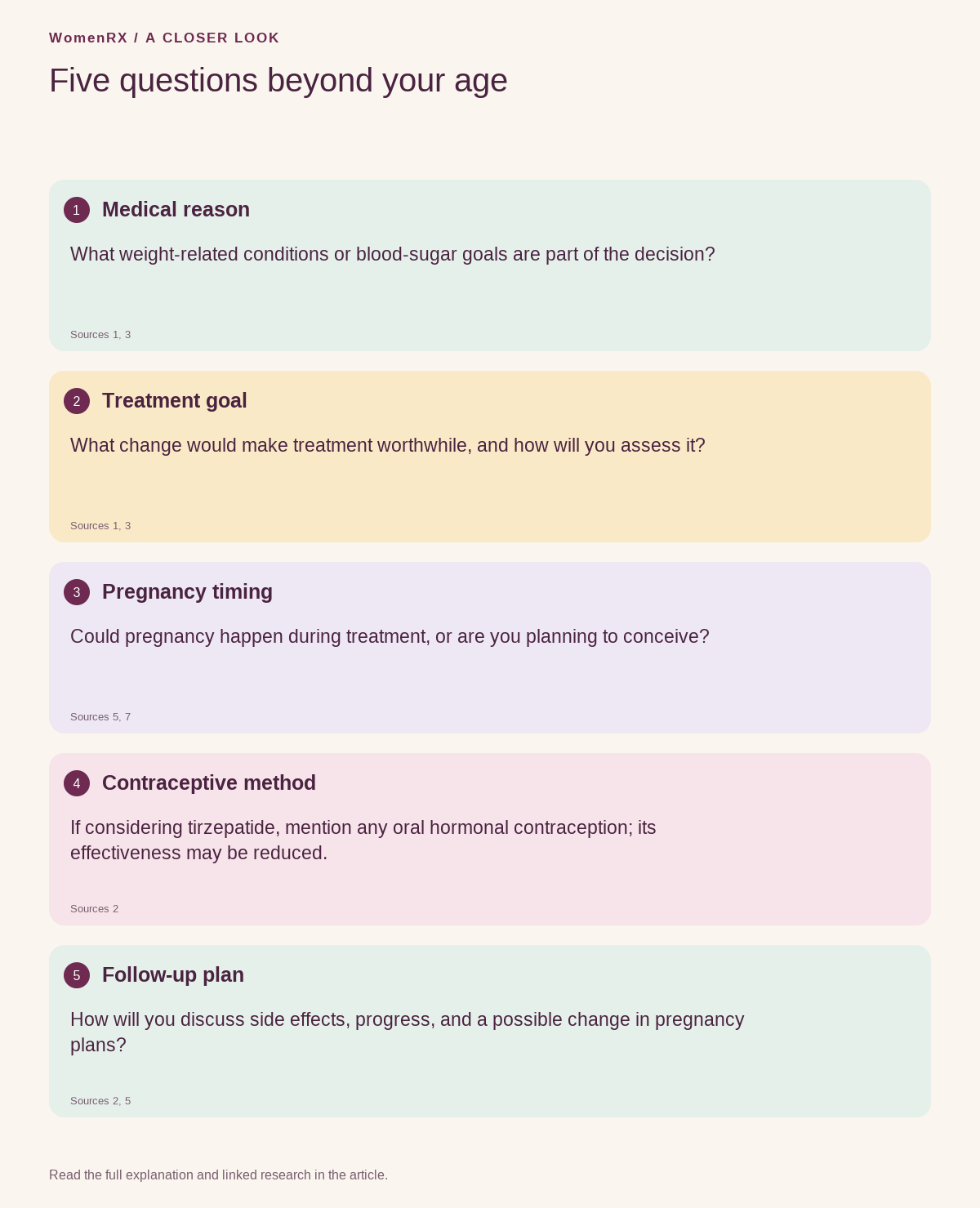
Five questions beyond your age
Medical reason: What weight-related conditions or blood-sugar goals are part of the decision?13
Treatment goal: What change would make treatment worthwhile, and how will you assess it?13
Pregnancy timing: Could pregnancy happen during treatment, or are you planning to conceive?57
Contraceptive method: If considering tirzepatide, mention any oral hormonal contraception; its effectiveness may be reduced.2
Follow-up plan: How will you discuss side effects, progress, and a possible change in pregnancy plans?25
Read the figure as text
Use these questions to separate treatment fit from reproductive and follow-up planning; they are discussion prompts, not an eligibility score.- Medical reason: What weight-related conditions or blood-sugar goals are part of the decision?13
- Treatment goal: What change would make treatment worthwhile, and how will you assess it?13
- Pregnancy timing: Could pregnancy happen during treatment, or are you planning to conceive?57
- Contraceptive method: If considering tirzepatide, mention any oral hormonal contraception; its effectiveness may be reduced.2
- Follow-up plan: How will you discuss side effects, progress, and a possible change in pregnancy plans?25
More questions, answered
Does an unexpected pregnancy exposure mean harm is certain?
No. Reports of human exposures haven’t established a clear pattern of birth defects, but the data are too limited to rule out harm or predict other pregnancy outcomes. If you become pregnant while taking one of these medicines, discuss the exposure and next steps with a clinician.5
Sources you can check
- ZEPBOUND (TIRZEPATIDE) INJECTION, SOLUTION ZEPBOUND (TIRZEPATIDE) INJECTION, SOLUTION ZEPBOUND KWIKPEN (TIRZEPATIDE) INJECTION, SOLUTION [ELI LILLY AND COMPANY] | US prescribing information and patient instructionsAccessed 2026-09-25Return to first citation
- MOUNJARO (TIRZEPATIDE) INJECTION, SOLUTION MOUNJARO KWIKPEN (TIRZEPATIDE) INJECTION, SOLUTION [ELI LILLY AND COMPANY] | US prescribing information and patient instructionsAccessed 2026-09-25Return to first citation
- Obesity: MedlinePlusAccessed 2026-09-25Return to first citation
- Efficacy and Safety of Semaglutide in Patients with Polycystic Ovary Syndrome: A Scoping Review.La Vignera S, Condorelli RA. · Biomedicines · 2026Return to first citation
- Glucagon-like peptide-1 receptor agonist use in pregnancy: a review.Drummond RF, Seif KE, Reece EA. · American journal of obstetrics and gynecology · 2025Return to first citation
- GLP-1 receptor agonists and preconception planning: bridging the gap between obesity treatment and reproductive safety, a narrative review.Saad Alfaiz A. · Annals of medicine and surgery (2012) · 2025Return to first citation
- GLP-1 Receptor Agonist Use Across Preconception, Pregnancy, and the Postpartum Periods.Porterfield F, Ogunwole SM, Maya J, Stanford FC. · Paediatric drugs · 2026Return to first citation