Where GLP-1 Medicines Fit With Menopause Weight Changes
GLP-1 medicines can help treat obesity during and after menopause, but the best plan depends on health risks, strength, and what you want treatment to change.
Menopause alone doesn’t determine whether a weight-management medicine is appropriate. The decision starts with your weight-related health and goals, then weighs medication alongside eating and activity support. GLP-1 treatment can help with weight loss, but evidence specific to perimenopause and postmenopause is still limited. If you’re considering it, look beyond the scale to waist size, muscle strength, and how treatment fits your life. 597
A familiar change is that your clothes fit differently around your waist even when the scale hasn’t moved much. Weight and waist size answer different questions: the scale includes muscle, bone, fat, and water, while more fat carried around the waist is associated with greater weight-related health risk. BMI is useful in obesity care, but it cannot distinguish fat from muscle. 31
Is the concern weight, health risk, or both?
Perimenopause and postmenopause can bring changes in body composition and fat distribution. That doesn’t mean every change calls for weight-loss treatment, or that a medicine would reverse the effects of menopause. It means a useful goal might be broader than a target weight: reducing a weight-related health risk, addressing an increasing waist size, or maintaining the strength you rely on day to day. A Spanish Menopause Society position statement recommends considering body fat distribution, cardiometabolic risk, and muscle health together when weighing incretin-based treatment. Its authors also found that direct menopause-specific evidence remains limited, particularly for tirzepatide. 9
There’s another reason not to assume menopause explains every change. Medicines and medical conditions can affect weight, and an unexpected weight change without an apparent reason is worth discussing rather than automatically attributing to this life stage. 13
What does adding medication change?
An eating and activity program is a treatment approach in its own right. Prescription weight-management medicines are considered when those changes haven’t been enough to achieve or maintain weight loss, and they’re used with lifestyle support, not instead of it. In studies summarized by the National Institute of Diabetes and Digestive and Kidney Diseases, adults taking various prescription weight-management medicines as part of a lifestyle program lost, on average, an additional 3% to 12% of their starting body weight after one year compared with adults in a lifestyle program without medication. That range covers multiple medicines and is not a predicted result for any one GLP-1 medicine or for a woman in menopause. 5
For example, a woman whose main concern is a new waistline change, but who has no established weight-related health problem, may have a different treatment discussion from someone whose weight and blood pressure have both risen. US guidance says a clinician may prescribe a weight-management medicine for an adult with a BMI of 27 or higher and a weight-related health problem such as high blood pressure or type 2 diabetes. It also says a high BMI does not mean medication is right for everyone. Menopause status is not presented as a stand-alone eligibility criterion. 5
Semaglutide, liraglutide, and tirzepatide are among the medicines used for long-term weight management. They shouldn’t be treated as interchangeable, though: this evidence does not establish a head-to-head ranking for women in perimenopause or postmenopause. Nor does a trial combining a medicine with lifestyle support tell us what would happen if the medicine replaced that support. 59
What have studies found in postmenopausal women?
In one four-month study, postmenopausal women taking semaglutide had weight and fat-mass losses that were statistically similar to those of premenopausal women taking it. This is useful evidence that postmenopausal participants lost weight during treatment. It is not a comparison with lifestyle care alone, and it cannot tell you how much of the change was caused by semaglutide in this group or what happens over years of treatment. 4
A separate retrospective study followed postmenopausal women treated with semaglutide for overweight or obesity. The 16 women also using menopause hormone therapy had greater average weight loss at 12 months than the 90 women not using hormone therapy. Because treatment was not randomly assigned, that association does not show that hormone therapy boosted semaglutide’s effect. The Spanish Menopause Society cautions against starting hormone therapy solely to increase weight loss. 109
These distinctions matter if someone promises a medicine will specifically remove “menopause belly” or restore your premenopausal body composition. The stronger case for medication is treatment of overweight or obesity and related health risks; the menopause-specific evidence is much thinner. 59
Protect what the scale cannot show
Weight loss can include changes in lean mass, but a lean-mass measurement does not, by itself, tell you whether your muscle function has worsened. A review focused on postmenopausal women identifies that functional question as an important gap. If maintaining strength matters to you, ask how you’ll support it during treatment rather than judging progress by pounds alone. 8
A four-society clinical advisory recommends structured resistance or mixed resistance-and-aerobic training to help preserve lean mass during weight reduction; it says protein intake alone is unlikely to do the job without strength training. The advisory also recommends reassessing food intake and hydration during GLP-1 treatment so nutrition support can be adjusted to the person’s needs. That makes strength and adequate nourishment part of the plan, not an afterthought once weight has changed. 7
Medication also has burdens worth weighing against its possible benefit. In one tirzepatide trial, participants first completed an intensive lifestyle program, and only those who had already lost at least 5% of their weight entered the randomized treatment phase. During that phase, 10% of those assigned tirzepatide and 2% assigned placebo stopped the assigned drug because of adverse reactions. Those figures describe a selected trial group, not everyone considering treatment, but they show why tolerability belongs in the decision. 6
The most useful treatment conversation starts with the outcome you care about. If it’s a weight-related condition, ask what improvement treatment is meant to support. If it’s an expanding waistline, ask how that will be assessed alongside other health measures. If it’s staying strong while losing weight, ask what eating and strength-training support you can realistically sustain. Those answers make it easier to judge whether medication adds enough value for you, rather than treating menopause itself as the reason to take it. 179
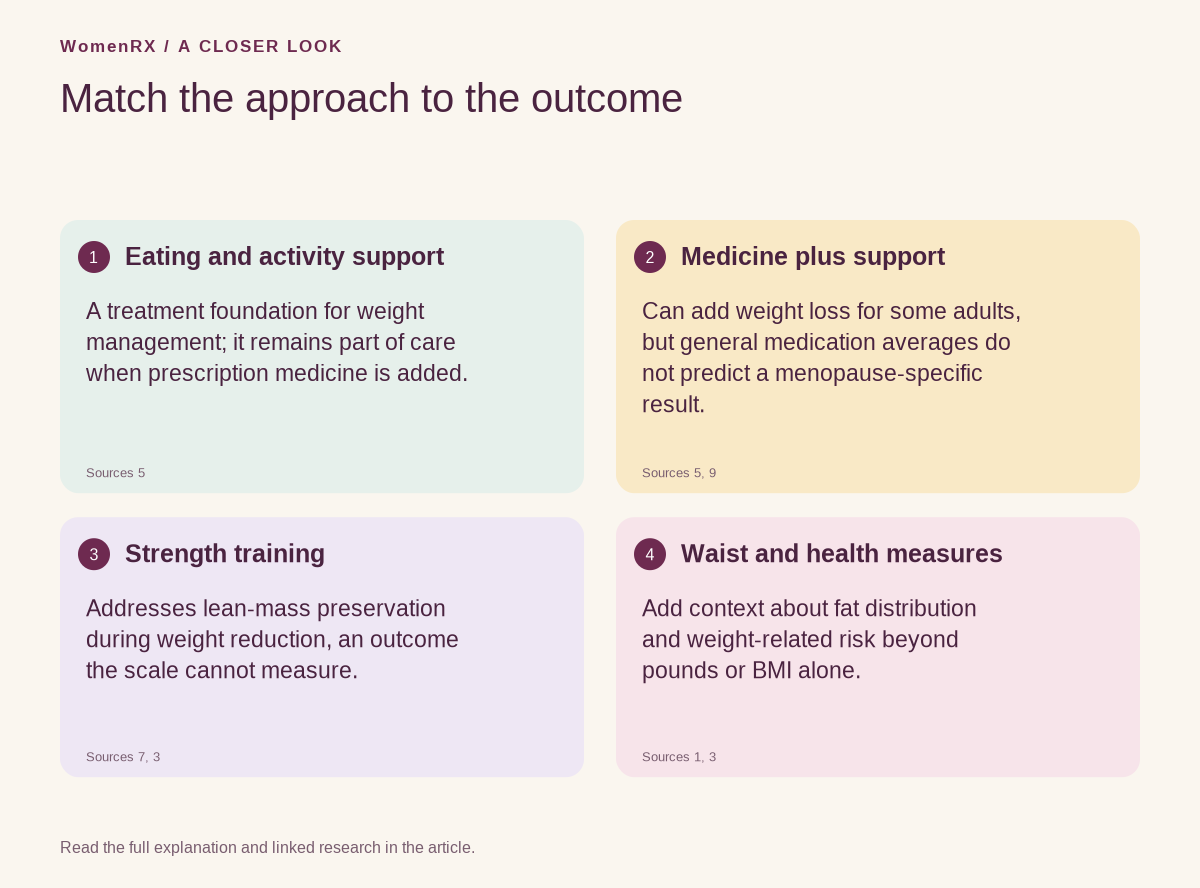
Match the approach to the outcome
Eating and activity support: A treatment foundation for weight management; it remains part of care when prescription medicine is added.5
Medicine plus support: Can add weight loss for some adults, but general medication averages do not predict a menopause-specific result.59
Strength training: Addresses lean-mass preservation during weight reduction, an outcome the scale cannot measure.73
Waist and health measures: Add context about fat distribution and weight-related risk beyond pounds or BMI alone.13
Read the figure as text
These approaches answer related but different questions about menopause-era weight changes.- Eating and activity support: A treatment foundation for weight management; it remains part of care when prescription medicine is added.5
- Medicine plus support: Can add weight loss for some adults, but general medication averages do not predict a menopause-specific result.59
- Strength training: Addresses lean-mass preservation during weight reduction, an outcome the scale cannot measure.73
- Waist and health measures: Add context about fat distribution and weight-related risk beyond pounds or BMI alone.13
More questions, answered
Would a weight-loss supplement be a simpler alternative?
Don’t assume a product marketed for weight loss offers comparable evidence. An NIH review finds that effects vary by ingredient, many studies are small or poor quality, and some supplements have safety concerns. That’s a different evidence base from prescription obesity treatment used alongside lifestyle support. 25
Sources you can check
- Obesity: MedlinePlusAccessed 2026-09-25Return to first citation
- Dietary Supplements for Weight Loss - Health Professional Fact SheetAccessed 2026-09-25Return to first citation
- Body Weight: MedlinePlusAccessed 2026-09-25Return to first citation
- Effectiveness of Low Doses of Semaglutide on Weight Loss and Body Composition Among Women in Their Menopause.Nicolau J, Blanco-Anesto J, Bonet A, Félix-Jaume JJ, Gil-Palmer A. · Metabolic syndrome and related disorders · 2025Return to first citation
- Prescription Medications to Treat Overweight & Obesity - NIDDKAccessed 2026-09-25Return to first citation
- ZEPBOUND (TIRZEPATIDE) INJECTION, SOLUTION ZEPBOUND (TIRZEPATIDE) INJECTION, SOLUTION ZEPBOUND KWIKPEN (TIRZEPATIDE) INJECTION, SOLUTION [ELI LILLY AND COMPANY] | US prescribing information and patient instructionsAccessed 2026-09-25Return to first citation
- Nutritional priorities to support GLP-1 therapy for obesity: four-society joint advisory2025Return to first citation
- Semaglutide in postmenopausal women: Clinical implications for weight loss, muscle health, and sleep-disordered breathing.Pereira NRM, Ishikura IA, Tufik S, Hachul H. · Maturitas · 2026Return to first citation
- Incretin-based therapies in peri- and postmenopausal women with obesity: an expert position statement from the Spanish Menopause Society.Sánchez-Prieto M, Romero-Domínguez M, Orozco R, Lilue M, Lubián-López DM, González SP, Nieto A, Coronado P, Sánchez-Borrego R, Cano A, Castelo-Branco C, Palacios S, Young Investiga... · Maturitas · 2026Return to first citation
- Weight loss response to semaglutide in postmenopausal women with and without hormone therapy use.Hurtado MD, Tama E, Fansa S, Ghusn W, Anazco D, Acosta A, Faubion SS, Shufelt CL. · Menopause (New York, N.Y.) · 2024Return to first citation