GLP-1 Medicines and Fertility Treatment: What Changes the Plan?
The key question isn’t whether a GLP-1 medicine improves fertility, but how your exact medicine fits with treatment and a possible pregnancy.
GLP-1 medicines aren’t established fertility treatments. Early findings in women with PCOS don’t tell us whether taking one through an IVF cycle improves live births, and pregnancy-exposure studies don’t answer when to stop before treatment. Bring your exact medicine, why you take it, and your treatment dates to both your prescriber and fertility team so they can make one coordinated plan. 3467
Fertility results and pregnancy exposure are different questions
If you’re taking a GLP-1 medicine and planning ovulation induction or IVF, it’s reasonable to ask two things: Could the medicine help treatment work? And could it still be present when pregnancy begins? Evidence for one question can’t answer the other.
A review of weight-loss medicines and natural female fertility found seven small trials involving 575 women. Only one assessed a GLP-1 medicine: semaglutide combined with metformin. That trial reported more pregnancies than metformin alone, but the review found no studies reporting live-birth rates. Those findings don’t establish a benefit from semaglutide alone or predict IVF results. 3
A separate review describes preliminary IVF pregnancy findings with liraglutide combined with metformin in women with PCOS. That’s a specific group and a combination treatment, not evidence that GLP-1 medicines improve IVF outcomes for everyone. The review calls for better human research on treatment timing and outcomes, particularly outside PCOS. 6
Pregnancy-exposure research asks a different question. A systematic review of mostly retrospective studies found no significant difference in major congenital malformations between pregnancies with and without GLP-1 exposure around conception or in pregnancy. Because these were observational data, that result isn’t proof that planned exposure is safe. A semaglutide-specific review likewise found no consistent birth-defect signal but judged the studies too varied and limited for firm conclusions. Neither review establishes a medication schedule for fertility treatment. 45
Make the plan before the cycle moves forward
Start by giving both teams the product name, the reason you take it, and your planned treatment steps. A fertility evaluation ordinarily includes current medicines and the status of conditions such as endocrine disease. That matters if the medicine is part of diabetes treatment: poorly controlled diabetes carries pregnancy risks, so a plan to change treatment also needs a plan for glucose care. 72
Then separate the decisions that can otherwise get bundled together:
- Before ovarian stimulation or ovulation induction: Ask whether the fertility team has a protocol concerning your medicine during treatment, and who will coordinate any change with its prescriber. Preliminary fertility findings do not establish that continuing a GLP-1 medicine through either process helps. 36
- Before embryo transfer or attempts to conceive: Ask which pregnancy guidance applies to your exact product and how the teams want to handle the transition. Embryo transfer and attempts to conceive are distinct treatment situations; neither the fertility reviews nor the pregnancy-exposure studies provide a universal stop date for them. 346
- If pregnancy is recognized: Contact the team managing the medicine promptly for product-specific advice, particularly if it treats diabetes. Saxenda’s U.S. prescribing information says to discontinue that liraglutide product when pregnancy is recognized. Victoza, another liraglutide product used for diabetes, says use during pregnancy only if the potential benefit justifies the potential fetal risk. Those are not interchangeable instructions for every GLP-1 product. 12
The distinction between those two liraglutide labels is a useful reminder: even products containing the same active ingredient can have different indications and pregnancy wording. Their instructions should not be used as a stand-in for semaglutide or tirzepatide guidance. Rather than guessing a washout interval from an IVF date or a pregnancy study, ask your teams to check the current guidance for the product you actually use and agree on what happens to the condition it treats if therapy changes. 124
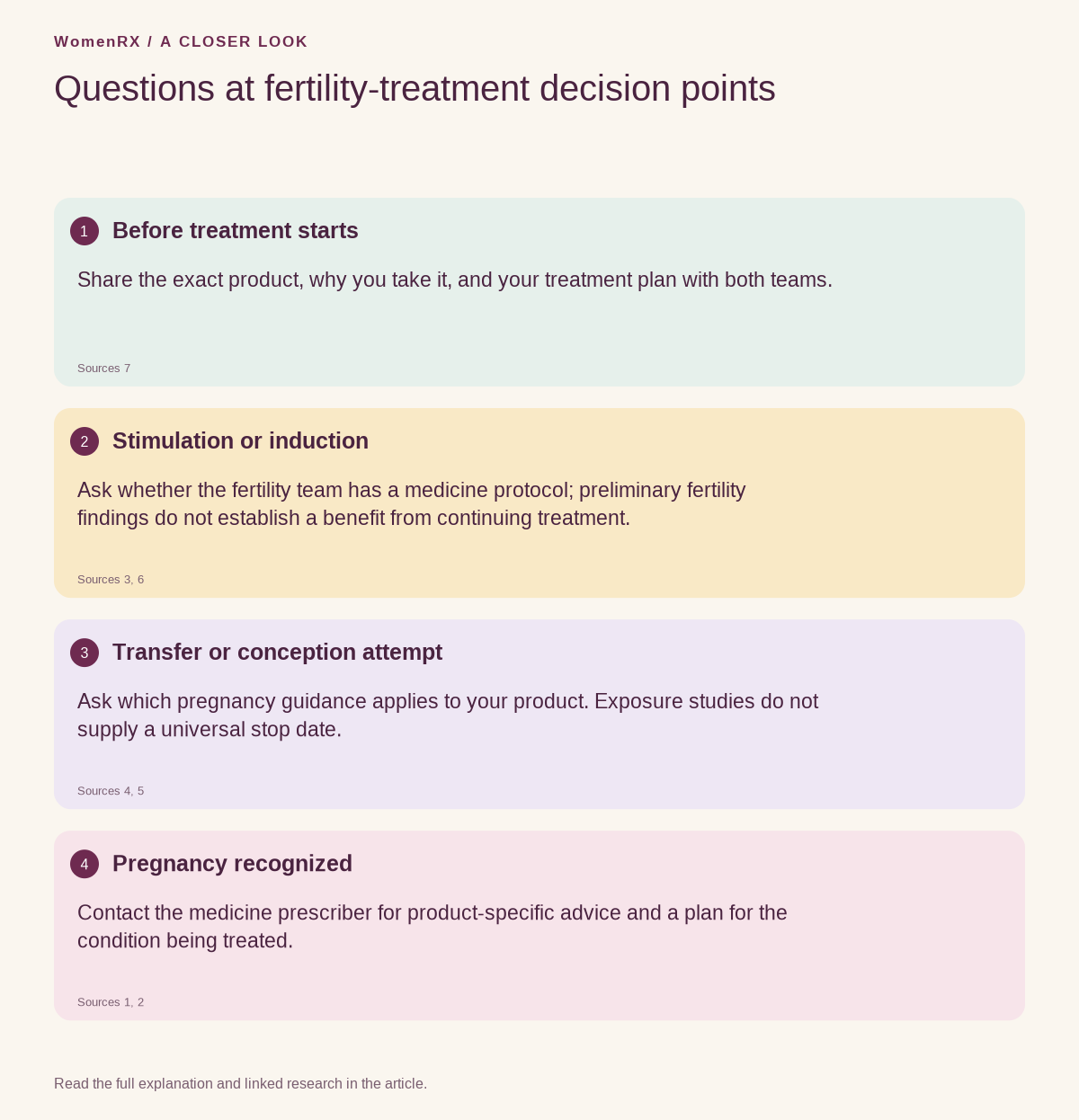
Questions at fertility-treatment decision points
Before treatment starts: Share the exact product, why you take it, and your treatment plan with both teams.7
Stimulation or induction: Ask whether the fertility team has a medicine protocol; preliminary fertility findings do not establish a benefit from continuing treatment.36
Transfer or conception attempt: Ask which pregnancy guidance applies to your product. Exposure studies do not supply a universal stop date.45
Pregnancy recognized: Contact the medicine prescriber for product-specific advice and a plan for the condition being treated.12
Read the figure as text
These are conversation points, not a medication schedule. The order depends on the treatment you’re having.- Before treatment starts: Share the exact product, why you take it, and your treatment plan with both teams.7
- Stimulation or induction: Ask whether the fertility team has a medicine protocol; preliminary fertility findings do not establish a benefit from continuing treatment.36
- Transfer or conception attempt: Ask which pregnancy guidance applies to your product. Exposure studies do not supply a universal stop date.45
- Pregnancy recognized: Contact the medicine prescriber for product-specific advice and a plan for the condition being treated.12
More questions, answered
Does a better ovulation rate mean a better chance of a live birth?
Not necessarily. Ovulation, pregnancy, and live birth are different outcomes. In a systematic review of weight-loss medicines and natural fertility, pregnancy was reported less often than ovulation, and none of the included trials reported live-birth rates. The review also cannot establish IVF outcomes. 3
What if I became pregnant while taking a GLP-1 medicine?
Tell the clinician managing the medicine which product you took and when, especially if you use it for diabetes. Human observational studies have not shown a clear increase in major congenital malformations with exposure around conception, but they cannot prove safety for an individual pregnancy. The next medication decision depends on your product and why you take it. 4512
Sources you can check
- SAXENDA (LIRAGLUTIDE) INJECTION, SOLUTION [NOVO NORDISK PHARMACEUTICAL INDUSTRIES, LP] | US prescribing information and patient instructionsAccessed 2026-09-25Return to first citation
- VICTOZA (LIRAGLUTIDE) INJECTION [NOVO NORDISK] | US prescribing information and patient instructionsAccessed 2026-09-25Return to first citation
- Weight-Lowering Drugs and Natural Female Fertility-A Systematic Review and Meta-Analysis.Alnaimi SJ, Alsugeir DM, Wei L, Harvey K, Brauer R. · Clinical obesity · 2026Return to first citation
- Periconceptional use of GLP-1 receptor agonists and the risk of major congenital malformations: a systematic review and meta-analysis.Liu X, Xiong B, Yang R, Wang H, Liu Y. · Endocrine connections · 2026Return to first citation
- Impact of semaglutide exposure on fetal and neonatal outcomes in pregnant women: a systematic review.Mandal L, Andersen LU, Luef BM, Tanvig MH, Vinter CA. · European journal of obstetrics, gynecology, and reproductive biology · 2026Return to first citation
- A Systematic Review on GLP-1 Receptor Agonists in Reproductive Health: Integrating IVF Data, Ovarian Physiology and Molecular Mechanisms.Voros C, Chatzinikolaou F, Papapanagiotou I, Polykalas S, Mavrogianni D, Koulakmanidis AM, Athanasiou D, Kanaka V, Bananis K, Athanasiou A, Athanasiou A, Papadimas G, Tsimpoukelis ... · International journal of molecular sciences · 2026Return to first citation
- Fertility evaluation of infertile women: a committee opinion (2021) | American Society for Reproductive Medicine | ASRMAccessed 2026-09-25Return to first citation