How to Plan Meals When a GLP-1 Changes Your Appetite
Build meals around foods you can comfortably manage, then adjust the portion to your appetite rather than forcing a planned serving.
When appetite or portion tolerance changes, keep the plan flexible: choose a protein-containing food, add other foods you enjoy, and pause or save the rest if you feel full. GLP-1 medicines can reduce how much people eat, though standardized meal tests don’t describe anyone’s full day of eating. If difficulty eating persists, contact your prescriber; persistent or severe abdominal pain calls for prompt medical attention. 32
Start with a flexible meal, not a fixed portion
A useful meal plan on a GLP-1 medicine is a set of options, not a rule that you must finish a certain amount. Appetite and portion tolerance can change, so begin with an amount that feels manageable. You can pause, eat more if you want, or save the rest. The goal is to make room for nourishing foods without turning every meal into a test of willpower.
One simple starting point is to choose a protein-containing food, then add another food you enjoy and tolerate. Protein is found in meat, dairy, nuts, beans and some grains. If you rely on plant proteins, varying the sources across your day can help provide the amino acids your body needs. How much protein is right for you depends on factors including health and activity, so this framework deliberately avoids a universal target. 1
For example, you might pair yogurt with berries and nuts, beans with a grain and vegetables, or meat with a grain and vegetables. Start with whichever parts sound manageable and save the rest if you get full. These are flexible meal ideas, not recipes shown to prevent side effects. They also give you options beyond eating protein alone when you have room for more variety.
One day of protein-forward meals you can scale to your appetite
Here’s a concrete day to borrow from, not a set of portions you must finish. You could start with the yogurt bowl below, have soybeans and cheddar with a grain and vegetables for lunch, and choose lean fish with a grain and vegetables for dinner. Cottage cheese with fruit is an optional snack if you’re hungry later. The protein estimates come from the VA’s general food-serving guide; they describe the listed protein-containing food, not the full meal. 5
Breakfast recipe: yogurt, berry and almond bowl. For one bowl, use 6 ounces of Greek-style yogurt, ½ cup of berries and 1 ounce of almonds. Spoon the yogurt into a bowl, add the berries and sprinkle the almonds on top. Yield: one bowl; serving: the bowl, or whatever portion feels comfortable now with the rest saved for later. The VA estimates 14-18 grams of protein in 6 ounces of Greek-style yogurt and 6 grams in 1 ounce of almonds. Together, those two ingredients contribute an estimated 20-24 grams of protein. That isn’t a tested nutrition total for the finished bowl, and changing the ingredients changes the estimate. 5
Lunch: Try ½ cup of cooked soybeans and 1 ounce of cheddar with a grain and vegetables you like. The VA estimates 11 grams of protein in that amount of soybeans and 7 grams in the cheddar, or 18 grams from those two foods. Make a bowl or keep the components separate if that sounds better. The estimate is for the specified foods, not the whole meal. 5
Dinner: Try fish with a grain and vegetables. The VA estimates 21 grams of protein in 3 ounces of lean fish; you can serve what feels manageable and save what you don’t eat. 5
Optional snack: If you’re hungry later, try ½ cup of cottage cheese with fruit. That amount of cottage cheese contributes an estimated 14 grams of protein. 5
Swap the protein foods between meals if that suits your day. These serving estimates make the options easier to compare; they aren’t a daily protein target or a reason to eat past comfortable fullness.
Let appetite guide the next step
Research supports the idea that these medicines can affect how much people eat, but the evidence needs careful interpretation. A meta-analysis pooled controlled meal tests from three trials, involving 209 participants, and found lower intake at a standardized lunch among people using GLP-1 or dual GIP/GLP-1 medicines than among comparison groups. A test meal is not the same as measuring what someone eats day to day, and the review found that real-world habitual intake remains underreported. 3
That distinction matters for planning: a meal that looks balanced on paper may not feel manageable at a particular moment. Use a flexible first portion and treat it as a starting point, not a target you have to meet. If you are hungry later, you can have more; if you feel full, you can stop and keep what remains for another time.
Keep variety in the options you rotate
When your appetite is lower, a short list of meals you can manage may be more practical than an elaborate meal plan. You could rotate between yogurt with fruit and nuts, soybeans and cheddar with a grain and vegetables, and a meat-based meal with vegetables. Swap ingredients to suit what appeals to you rather than forcing a particular combination. The sample day is an option, not a required menu. A small observational study following 28 adults taking semaglutide or tirzepatide found that reported energy and several nutrient intakes fell over 24 weeks. Higher reported protein intake was associated with better preservation of estimated skeletal muscle mass, but the study was small and cannot show that protein caused that difference. 4
This is a reason to pay attention to whether your usual variety is shrinking, not a reason to chase a specific protein number or buy a supplement.
Know when meal adjustments aren’t enough
If you keep having trouble eating or tolerating meals, contact your prescriber rather than relying on smaller portions indefinitely. GLP-1 medicines can cause gastrointestinal problems, sometimes severe, and a small study found that nutrient intake fell alongside food intake during treatment. Your prescriber can help assess what’s happening without you having to change the medicine yourself. 24
Some symptoms call for more immediate medical attention rather than another recipe. The Saxenda prescribing information reports severe gastrointestinal adverse reactions. It also identifies persistent or severe abdominal pain, sometimes radiating to the back and with or without nausea or vomiting, as a possible sign of acute pancreatitis. Seek prompt medical attention for that pain. 2
If you’re planning a pregnancy, could be pregnant, or are breastfeeding, ask about guidance for your specific medicine. Don’t assume that advice for liraglutide, semaglutide and tirzepatide is interchangeable.
A quick meal-planning path
On a day when eating feels manageable, choose a protein option and add another food you enjoy. When appetite is low, make the first portion smaller and leave room to stop or save it. If difficulty eating or tolerating meals continues, contact your prescriber instead of repeatedly trying to adjust portions. 24 If you have persistent or severe abdominal pain, don’t try another meal adjustment: seek prompt medical attention. 2 A flexible plan supports choice; it does not guarantee weight loss or prevent medication side effects.
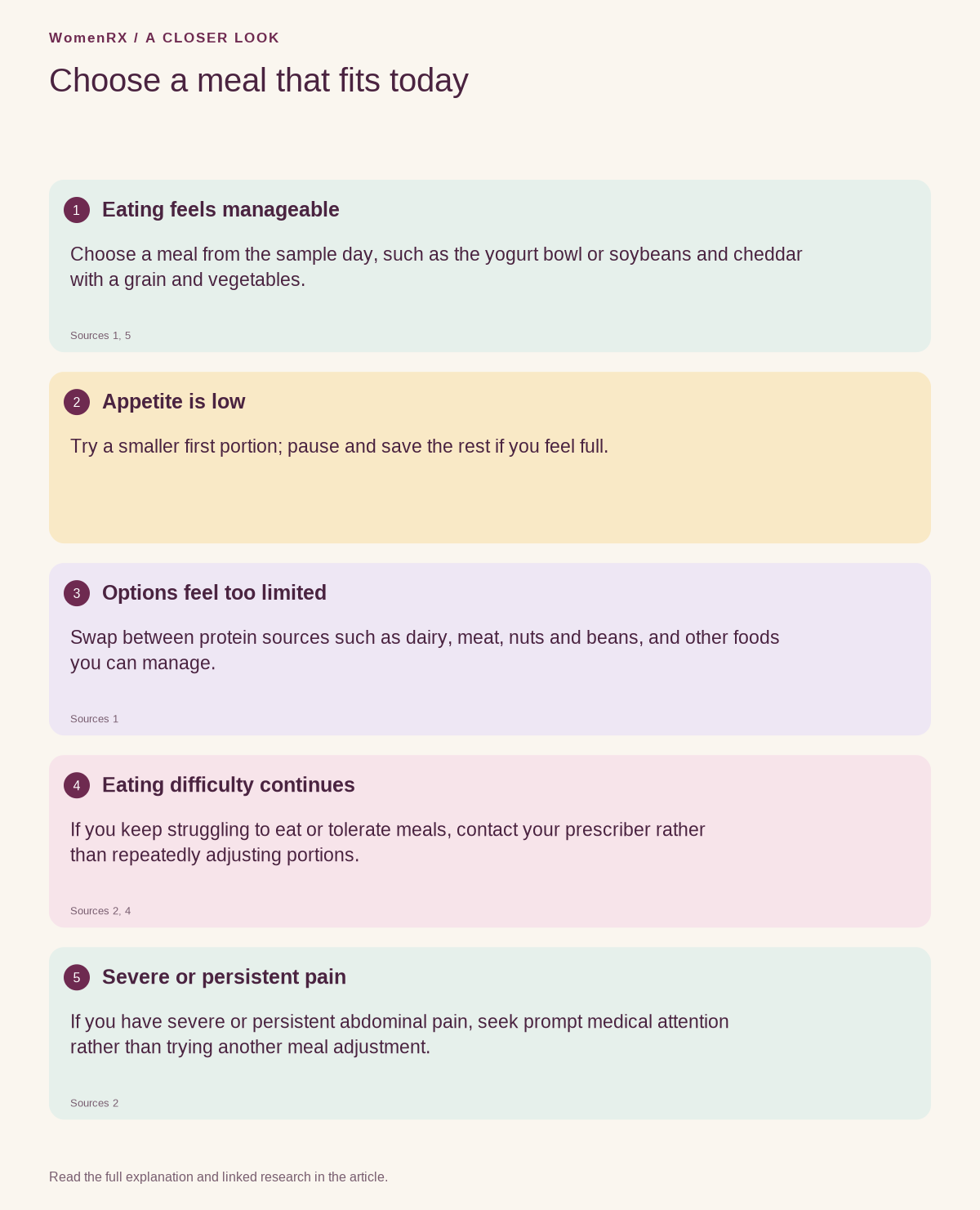
Choose a meal that fits today
Eating feels manageable: Choose a meal from the sample day, such as the yogurt bowl or soybeans and cheddar with a grain and vegetables.15
Appetite is low: Try a smaller first portion; pause and save the rest if you feel full.
Options feel too limited: Swap between protein sources such as dairy, meat, nuts and beans, and other foods you can manage.1
Eating difficulty continues: If you keep struggling to eat or tolerate meals, contact your prescriber rather than repeatedly adjusting portions.24
Severe or persistent pain: If you have severe or persistent abdominal pain, seek prompt medical attention rather than trying another meal adjustment.2
Read the figure as text
A flexible path from appetite and tolerance to a practical next step.- Eating feels manageable: Choose a meal from the sample day, such as the yogurt bowl or soybeans and cheddar with a grain and vegetables.15
- Appetite is low: Try a smaller first portion; pause and save the rest if you feel full.
- Options feel too limited: Swap between protein sources such as dairy, meat, nuts and beans, and other foods you can manage.1
- Eating difficulty continues: If you keep struggling to eat or tolerate meals, contact your prescriber rather than repeatedly adjusting portions.24
- Severe or persistent pain: If you have severe or persistent abdominal pain, seek prompt medical attention rather than trying another meal adjustment.2
More questions, answered
Should I follow a specific protein target?
Not from a general meal-planning article. Protein needs vary with health, age and activity. Ask your care team whether an individualized target makes sense for you. 1
Are pregnancy and breastfeeding questions the same for every GLP-1 medicine?
Don’t assume so. Ask the prescriber about the guidance for your specific medicine if you’re planning a pregnancy, could be pregnant, or are breastfeeding.
Sources you can check
- Dietary Proteins: MedlinePlusAccessed 2026-09-25Return to first citation
- SAXENDA (LIRAGLUTIDE) INJECTION, SOLUTION [NOVO NORDISK PHARMACEUTICAL INDUSTRIES, LP] | US prescribing information and patient instructionsAccessed 2026-09-25Return to first citation
- Nutritional intake changes during GLP-1 receptor agonist therapy: A systematic review and meta-analysis.Quan AT, Nguyen HL, Nguyen TMT. · Diabetes & metabolic syndrome · 2026Return to first citation
- Changes in food cravings, dietary quality, body composition, and dietary intake during GLP-1 receptor agonist therapy: The CRAVE study.Babazadeh D, Therrien S, Fitch AK, Steinberg FM. · Obesity pillars · 2026Return to first citation
- Healthy Ways to Add Protein, VA Nutrition and Food ServicesAccessed 2026-09-25Return to first citation