How to Build Vegetarian Meals with Enough Protein
Start with a protein food you enjoy, check how much is in the portion you eat, and give iron its own attention.
Build meals around beans, lentils, tofu, or tempeh, adding eggs or dairy if you eat them. Choose different protein foods across the day; you don’t need to pair particular plant proteins at every meal. Check serving sizes to see how much protein your meals provide. Vegetarian eating can meet nutritional needs, while iron deserves particular attention if you menstruate or are pregnant. 178
Start with the part that makes it a meal
A bowl of rice and vegetables can become a more substantial vegetarian meal with lentils stirred in. A quick lunch might be tofu with vegetables and a grain you like. If you eat eggs or dairy, they’re options too, not requirements. Beans, lentils, tofu, tempeh, eggs, and dairy are all protein foods you can use as starting points. These are meal-building examples, not menus that meet everyone’s needs. 17
Choose among those protein foods based on your budget, preferences, and how much time you have. If the tofu meal doesn’t fit this week, for example, you could make a bean or lentil meal instead. A useful eating plan has to work for your circumstances, not just look good on paper. 4
The useful question is less “Does this one ingredient have protein?” and more “What protein foods am I eating across the day?” Your body needs essential amino acids from food, and eating different types of plant protein over the day helps provide them. You don’t have to match beans with a particular grain at every sitting. How much protein you need depends in part on your age, health, and activity level. 37
For example, you might have eggs at breakfast, a lentil dish at lunch, and tofu at dinner. If you don’t eat eggs, you could use another plant protein instead. The point is variety, not following that exact sequence. An observational review of generally healthy adults found that grains, nuts and seeds, soy foods, and beans, peas, and lentils all contributed protein across different plant-based eating patterns. It describes what people ate, not a prescription for how to divide protein among meals. 5
Put amounts to the example
Suppose breakfast is a 150-gram cup of plain skyr, lunch includes 1 cup of cooked lentils, and dinner includes ½ cup of tofu. One skyr product lists 16 grams of protein per cup. MedlinePlus gives approximate equivalents of 7 grams for ½ cup of cooked lentils and 7 grams for ¼ cup of tofu. Doubling those portions puts the three protein foods at about 44 grams combined, before counting protein in the rest of the meals. The skyr figure belongs to that specific product, and the tofu amount is an estimate, so check the packages you buy. 79
That total tells you what those portions contribute, not whether 44 grams is enough for your whole day. Protein needs vary with age, health, activity, and overall calorie needs. MedlinePlus gives a broad healthy-adult range of 10% to 35% of daily calories from protein, not a single target for every woman. To see where your meals stand, add the protein from the portions you actually eat across the day, then compare that total with a protein goal that fits your circumstances. 37
Read a label when the choice isn’t obvious
Two packages of tofu may not provide the same amount of protein in the serving you’ll actually eat. Check the protein amount and serving size on the package when comparing them. This is more useful than assuming every tofu product is interchangeable. 7
The label can help with iron, too: US food labels list iron, usually as a percentage of Daily Value. That percentage is a comparison tool, not a personal iron target. Iron needs change with life stage, and iron from plants is less readily absorbed than iron from meat. 8
Give iron a place in the meal, not just the shopping list
Spinach contains iron, but some of its iron is hard to absorb. That makes it a useful addition rather than a food to rely on alone. For example, you could add spinach to a lentil meal and include a source of vitamin C alongside it. The spinach contributes plant iron; vitamin C and citric acid can help with absorption of nonheme iron, the form found in plant foods. That pairing is a practical option, not a guarantee that one meal covers your iron needs. 68
Whether you have regular menstrual cycles matters when thinking about iron. In one observational study, researchers accounted for factors that can raise ferritin, a marker used when assessing iron stores. After excluding people with signs of inflammation, iron deficiency was not more common among vegetarians overall, except among women with regular menstrual cycles. That finding doesn’t mean a vegetarian diet causes deficiency, or that someone who doesn’t menstruate can ignore iron. Pregnancy also changes iron needs. 68
Protein and iron aren’t the entire nutrition picture. Vegetarian diets can provide the nutrients you need, but calcium, zinc, and vitamin B12 also merit attention. Whether you include dairy and eggs matters when thinking through your choices; a vegan pattern excludes both. 1
If you’re frequently tired, dizzy, or short of breath, don’t assume the answer is simply to eat more spinach or take iron. Anemia has several possible causes, including blood loss and inadequate iron or vitamin B12. Blood tests are used to diagnose anemia, and treatment depends on its type. That’s a different task from everyday meal planning. 2
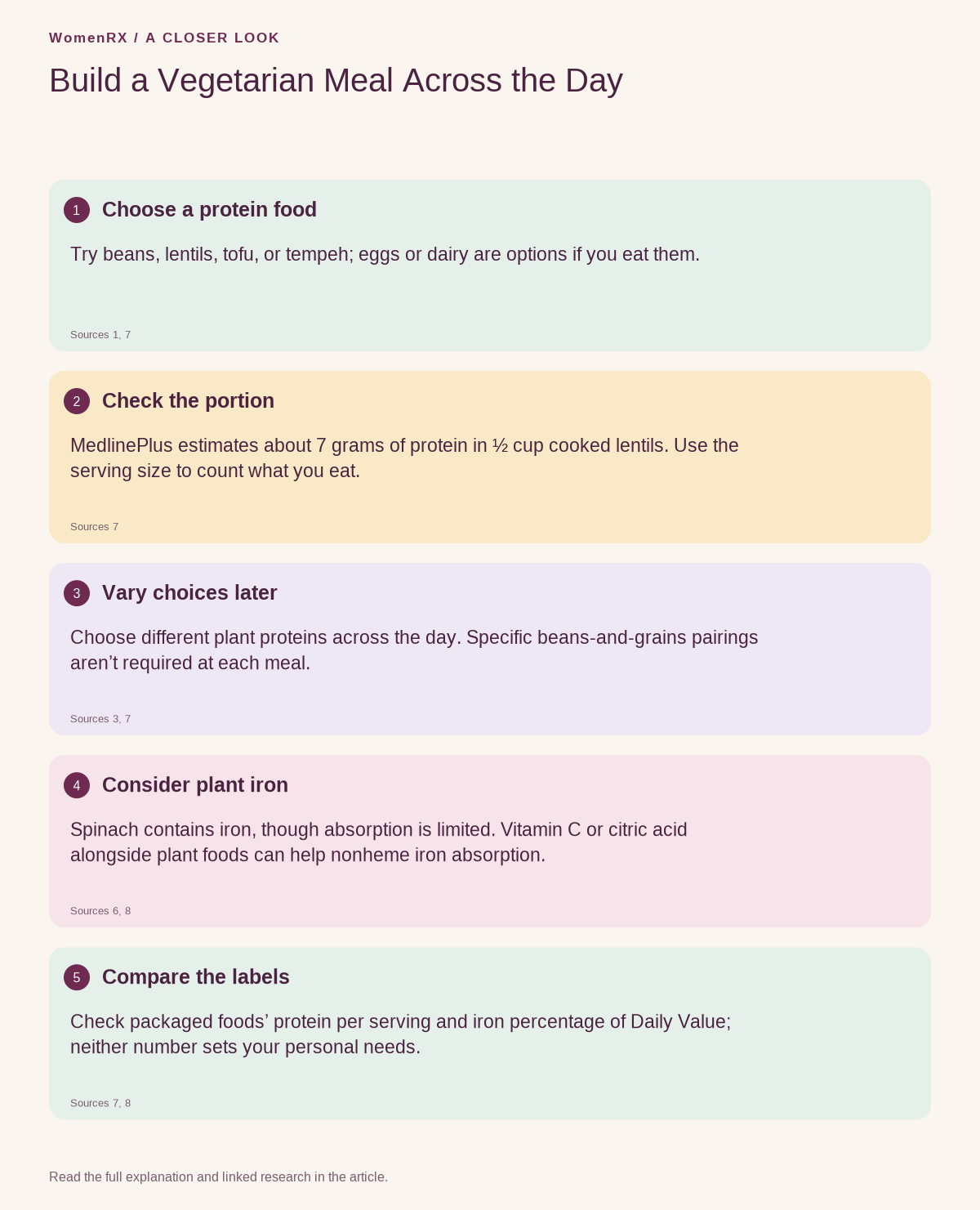
Build a Vegetarian Meal Across the Day
Choose a protein food: Try beans, lentils, tofu, or tempeh; eggs or dairy are options if you eat them.17
Check the portion: MedlinePlus estimates about 7 grams of protein in ½ cup cooked lentils. Use the serving size to count what you eat.7
Vary choices later: Choose different plant proteins across the day. Specific beans-and-grains pairings aren’t required at each meal.37
Consider plant iron: Spinach contains iron, though absorption is limited. Vitamin C or citric acid alongside plant foods can help nonheme iron absorption.68
Compare the labels: Check packaged foods’ protein per serving and iron percentage of Daily Value; neither number sets your personal needs.78
Read the figure as text
Use these prompts to check portions, vary protein foods, and give iron its own look. This is a planning aid, not a nutrient score.- Choose a protein food: Try beans, lentils, tofu, or tempeh; eggs or dairy are options if you eat them.17
- Check the portion: MedlinePlus estimates about 7 grams of protein in ½ cup cooked lentils. Use the serving size to count what you eat.7
- Vary choices later: Choose different plant proteins across the day. Specific beans-and-grains pairings aren’t required at each meal.37
- Consider plant iron: Spinach contains iron, though absorption is limited. Vitamin C or citric acid alongside plant foods can help nonheme iron absorption.68
- Compare the labels: Check packaged foods’ protein per serving and iron percentage of Daily Value; neither number sets your personal needs.78
More questions, answered
Do I need to combine beans and grains at every meal?
No. Aim for different plant protein foods across the day rather than a particular pairing at each meal. 37
Does the iron percentage on a food label tell me how much I need?
No. The percentage of Daily Value helps you compare foods, but your iron needs can differ by life stage. 8
Sources you can check
- Vegetarian Diet: MedlinePlusAccessed 2026-09-25Return to first citation
- Anemia | MedlinePlusAccessed 2026-09-25Return to first citation
- Dietary Proteins: MedlinePlusAccessed 2026-09-25Return to first citation
- Nutrition: MedlinePlusAccessed 2026-09-25Return to first citation
- Protein Adequacy, Plant Protein Proportion, and Main Plant Protein Sources Consumed Across Vegan, Vegetarian, Pescovegetarian, and Semivegetarian Diets: A Systematic Review.Rolands MR, Hackl LS, Bochud M, Lê KA. · The Journal of nutrition · 2025Return to first citation
- Iron Deficiency in Vegetarian and Omnivorous Individuals: Analysis of 1340 Individuals.Slywitch E, Savalli C, Duarte ACG, Escrivão MAMS. · Nutrients · 2021Return to first citation
- MedlinePlus: Protein in diet, including tofu and other plant sourcesAccessed 2026-09-25Return to first citation
- Iron - Health Professional Fact SheetAccessed 2026-09-25Return to first citation
- Plain Nonfat Skyr Yogurt 5.3oz - High Protein - siggi'sAccessed 2026-09-25Return to first citation