Tempeh vs. Tofu: Protein, Fermentation, and What to Check
Tempeh is a fermented soy food that can anchor a plant-based meal, but its protein and ingredients depend on the product you buy.
Tempeh is made by fermenting soybeans, while tofu is made by coagulating soy milk. Both can provide protein; a USDA reference lists 19.9 grams in 100 grams of cooked tempeh, but your package may differ. 638 Compare protein for the amount you’ll eat, check ingredients if you have a food allergy, and use the package’s preparation directions. 21
What fermentation changes, and what it doesn’t prove
Tempeh starts with soybeans and a fermentation process involving fungi from the Rhizopus genus. The beans become a food you can slice or crumble. Tofu takes a different route: soy is processed into soy milk, which is then coagulated. That difference gives you two useful cooking options, not a reason to assume one is always more nutritious. 63
Fermentation can change a food’s composition. In a laboratory study of soybeans and other legumes, fermented products had less phytate, a compound that can limit mineral availability. Digested fermented samples also produced more of a marker related to iron uptake in a cell model than tofu samples did. Those results are promising, but they don’t show that eating tempeh prevents iron deficiency or delivers more usable iron to a woman than eating tofu. 3
The same distinction applies to soy isoflavones, compounds often brought up in conversations about hormones. Processing changes how much remains in a soy food: a study comparing traditional homemade preparations with commercial products found differences in isoflavone content, including for tempeh. You can’t infer a particular package’s isoflavone content from the word “fermented,” and isoflavone measurements alone don’t establish a health effect. 7
Compare what you’ll actually put on the plate
As a reference point, USDA data for 100 grams of cooked tempeh list 19.9 grams of protein and 195 calories. That’s a weighed amount of cooked food, not a universal serving size or a measurement of the block in your refrigerator. 8
For example, if you’re choosing between a seasoned tempeh and a plain tofu for dinner, compare the Nutrition Facts protein amounts using the labeled serving sizes. Check how many servings you expect to use. Then read the ingredient lists: a flavored tempeh may contain ingredients beyond soy, while different tofu products can have different protein amounts. The label is more useful than a blanket claim that tempeh is “higher protein.” 2
Let the recipe help you choose, too. Tempeh can be sliced for a sandwich or crumbled into a skillet dish. Tofu can be cut or broken up according to its firmness and what you’re making. Those are cooking choices, not evidence that either food is the better choice for every meal.
If you have a known food allergy, check the ingredients every time you buy a product, including sauces or seasoning that come with it. Don’t eat a food containing an ingredient you’re allergic to. 1 For storage and preparation, follow the directions on the package you bought rather than assuming all tempeh products are sold in the same form.
What the soy research means for women
Tempeh can be a protein food during cycling years, perimenopause, and postmenopause without needing a special hormone claim attached to it. Soy research is broader than tempeh research, and findings about soy foods shouldn’t automatically be credited to this one food. A review of prospective studies found an association between soy-food intake and lower fracture risk among Asian women, with some findings involving fermented soy foods. Because these were observational studies, they can’t establish that adding tempeh prevents fractures; the authors also called for research in other populations. 24
Research in postmenopausal women has also examined soy and blood markers of inflammation. A meta-analysis of randomized trials found a small reduction in C-reactive protein with soy supplementation overall, but not in two other measured inflammatory markers. A change in a blood marker isn’t evidence that tempeh relieves hot flashes or other menopause symptoms. 5
For pregnancy and postpartum, the useful distinction is simpler: tempeh contributes to a menu as a soy protein food, but this evidence doesn’t establish a tempeh-specific benefit for either life stage. If you’re choosing it, choose it for the meal it helps you make, then use the product label to judge what that meal contains. 2
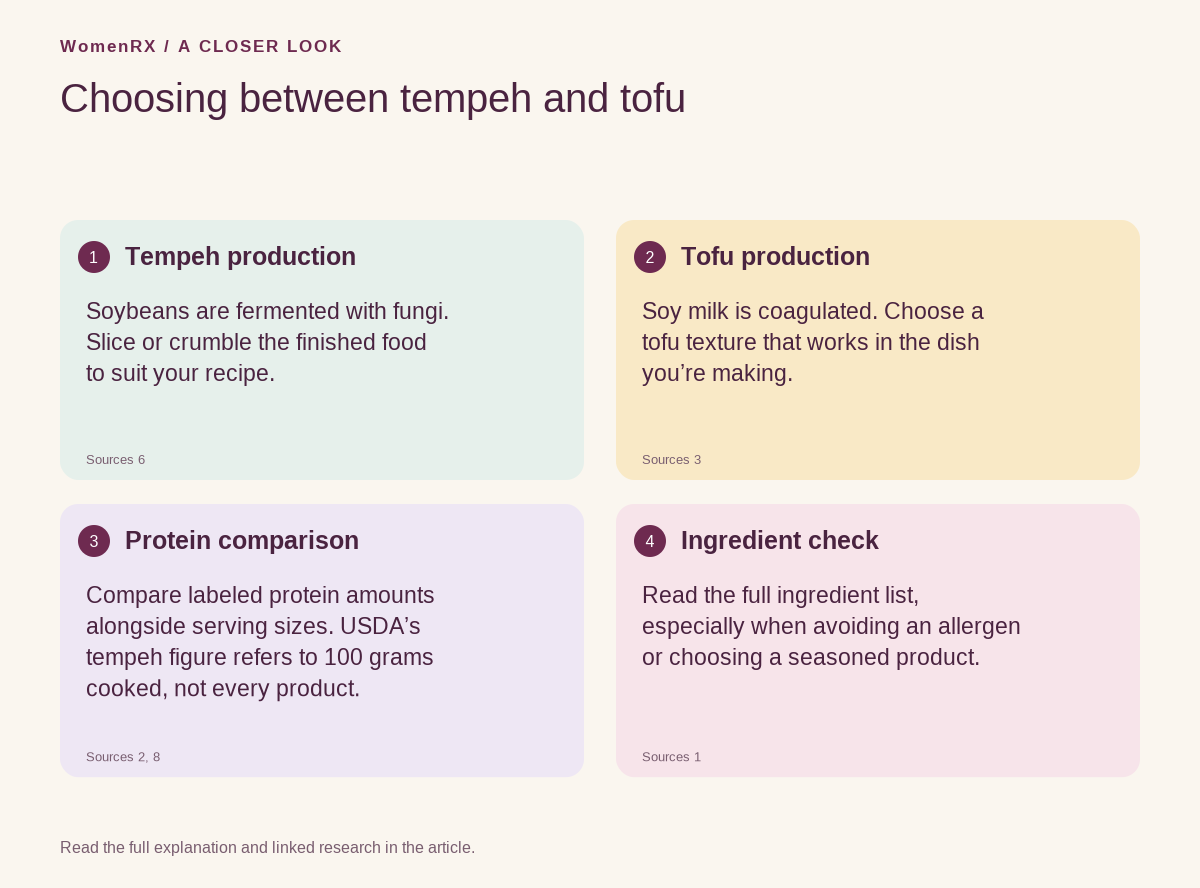
Choosing between tempeh and tofu
Tempeh production: Soybeans are fermented with fungi. Slice or crumble the finished food to suit your recipe.6
Tofu production: Soy milk is coagulated. Choose a tofu texture that works in the dish you’re making.3
Protein comparison: Compare labeled protein amounts alongside serving sizes. USDA’s tempeh figure refers to 100 grams cooked, not every product.28
Ingredient check: Read the full ingredient list, especially when avoiding an allergen or choosing a seasoned product.1
Read the figure as text
The production difference explains why they offer different cooking options; the package tells you more about the food you’re buying.- Tempeh production: Soybeans are fermented with fungi. Slice or crumble the finished food to suit your recipe.6
- Tofu production: Soy milk is coagulated. Choose a tofu texture that works in the dish you’re making.3
- Protein comparison: Compare labeled protein amounts alongside serving sizes. USDA’s tempeh figure refers to 100 grams cooked, not every product.28
- Ingredient check: Read the full ingredient list, especially when avoiding an allergen or choosing a seasoned product.1
More questions, answered
Does fermented tempeh contain less isoflavone than tofu?
There isn’t one reliable answer for every package. Processing can substantially change isoflavone content in both foods, and a comparison of homemade and commercial soy foods found that preparation methods mattered. A product’s fermentation status alone won’t tell you its isoflavone content. 7
Sources you can check
- Food allergy - NHSAccessed 2026-09-25Return to first citation
- MedlinePlus: Protein in diet, including tofu and other plant sourcesAccessed 2026-09-25Return to first citation
- Effect of processing on the protein digestibility and mineral bioavailability of legumes.Auer J, Duivenvoorde L, van der Zande M, Alminger M, Castaneda LAF, Lu J, Tizzanini G, Zamaratskaia G, Högberg A, Langton M. · Food research international (Ottawa, Ont.) · 2026Return to first citation
- Soy Foods and the Risk of Fracture: A Systematic Review of Prospective Cohort Studies.Akhavan Zanjani M, Rahmani S, Mehranfar S, Zarrin M, Bazyar H, Moradi Poodeh B, Zare Javid A, Hosseini SA, Sadeghian M. · Complementary medicine research · 2022Return to first citation
- A Meta-Analysis of Randomized Controlled Trials of the Effects of Soy Intake on Inflammatory Markers in Postmenopausal Women.Bajerska J, Łagowska K, Mori M, Mori M, Reguła J, Skoczek-Rubińska A, Toda T, Mizuno N, Yamori Y. · The Journal of nutrition · 2022Return to first citation
- Microbial Intervention in the Soaking Step during Tempeh Preparation to Modulate B Vitamin Contents: A Metabolomics Approach.Riyanto RA, Fukusaki E, Putri SP. · Preventive nutrition and food science · 2025Return to first citation
- Traditional and Domestic Cooking Dramatically Reduce Estrogenic Isoflavones in Soy Foods.Bensaada S, Peruzzi G, Cubizolles L, Denayrolles M, Bennetau-Pelissero C. · Foods (Basel, Switzerland) · 2024Return to first citation
- USDA SR Legacy: Tempeh, cooked (FDC 172467)Accessed 2026-09-25Return to first citation