How Tofu Can Fit Into a Weight-Conscious Meal
Tofu can be a useful meal protein; its portion, cooking oil and sauce all matter when you compare finished dishes.
Yes, tofu can fit into a meal while you’re managing your weight. As a concrete reference, ½ cup (126 g) of raw firm tofu made with calcium sulfate has about 181 calories and 22 g of protein. Your product may differ, so check its label for the portion you’ll eat. Cooking oil and sauce add to the finished meal. 65
Start with the protein, then look at the whole plate
Tofu gives you another way to put protein in a meal, alongside choices such as eggs, fish, yogurt, beans, lentils and meat. You don’t need to treat it as a special weight-loss food. Its practical advantage is flexibility: you can use it as the main protein in a bowl, add it to vegetables, or serve it with a grain you enjoy. You can include it as one of a variety of protein foods. 12
The useful comparison isn’t tofu versus no tofu. It’s one version of a meal versus another: the same portion of tofu, vegetables and rice might be baked with no added oil, cooked with oil, or finished with a sauce. The tofu contributes the same labeled calories in each version; the additions change what else is in the meal. MedlinePlus recommends baked, steamed, grilled, stewed or broiled foods instead of fried options when trying to reduce calories and saturated fat. 25
Make the package serving size work for you
There isn’t one reliable calorie or protein figure for every block of tofu. Products differ, so use the Nutrition Facts label on the one you bought. Find its serving size, calories and protein, then check how many servings are in the package. The labeled serving is a reference for reading the numbers, not a rule about how much you must eat. 15
For a concrete reference, USDA food-composition data lists about 181 calories and 22 g of protein in ½ cup (126 g) of raw firm tofu made with calcium sulfate. That figure describes this particular type of raw tofu, not every brand or a prepared tofu dish. 6
Here’s a way to compare portions without guessing at the numbers: if a package says it contains two servings, eating half the package gives you one labeled serving of tofu; eating the whole package gives you twice the listed calories and protein. If you share a dish, count the tofu portion that ends up on your plate rather than the amount that went into the pan. The same approach helps when comparing two tofu products with different serving sizes: first work out how much of each you’d actually eat. 5
That calculation covers the tofu, not the finished dish. A plain-tofu label won’t tell you the calories in the rice, vegetables, cooking oil or sauce served with it. Compare the portion on your plate as well as the preparation. 25
Compare two versions of the same meal
Picture your usual tofu, vegetable and rice bowl. To see what preparation changes, keep the tofu portion and sides the same in both versions. In one, bake the tofu without added oil and add it to the bowl. In the other, cook that same tofu portion with oil and add a sauce. Start with the same tofu-label figure for both. For the second bowl, check the oil and sauce labels and account for the amounts that went into the portion you ate. If you make several servings at once, the amount used for the whole pan isn’t necessarily the amount on your plate. Food labels give calories per serving, so the amount actually used matters. 5
This comparison doesn’t mean every baked dish has less energy than every fried dish. Baked tofu can also be coated in oil or sauce, and a sauce’s contribution depends on the product and amount. If you prefer fried tofu, you don’t have to rule it out; just don’t count a fried, sauced serving as though it were plain tofu. Choosing a non-fried method is one option MedlinePlus suggests for reducing calories and saturated fat. 25
When ordering out, descriptions can help you ask a more useful question than “Is it tofu?” Is it fried or steamed? Does it come with sauce? You may not know the dish’s exact calories, but those details tell you more about the meal than the protein name alone. 2
What does the weight-loss research say?
Research on soy doesn’t establish that tofu has a unique fat-loss effect. In one 16-week randomized trial, 43 women with obesity followed highly structured, energy-restricted diets using either soy or casein meal-replacement shakes. Both groups lost weight, but their weight-loss and body-composition changes did not differ significantly. That’s a comparison of shakes within an intensive program, not a test of tofu dinners. 3
A large observational study of US men and women found that increases in a combined tofu/soy food category were associated with less weight gain across four-year periods. Because the category grouped foods together and the study observed eating patterns rather than assigning meals, it cannot tell us that tofu itself caused the difference. It also isn’t a women-only result. 4
The useful takeaway is simpler: choose tofu when it suits the meal you want, check the protein and calories for your portion, and pay attention to preparation. Those decisions give you more to work with than a claim that soy alone will change your weight. 1235
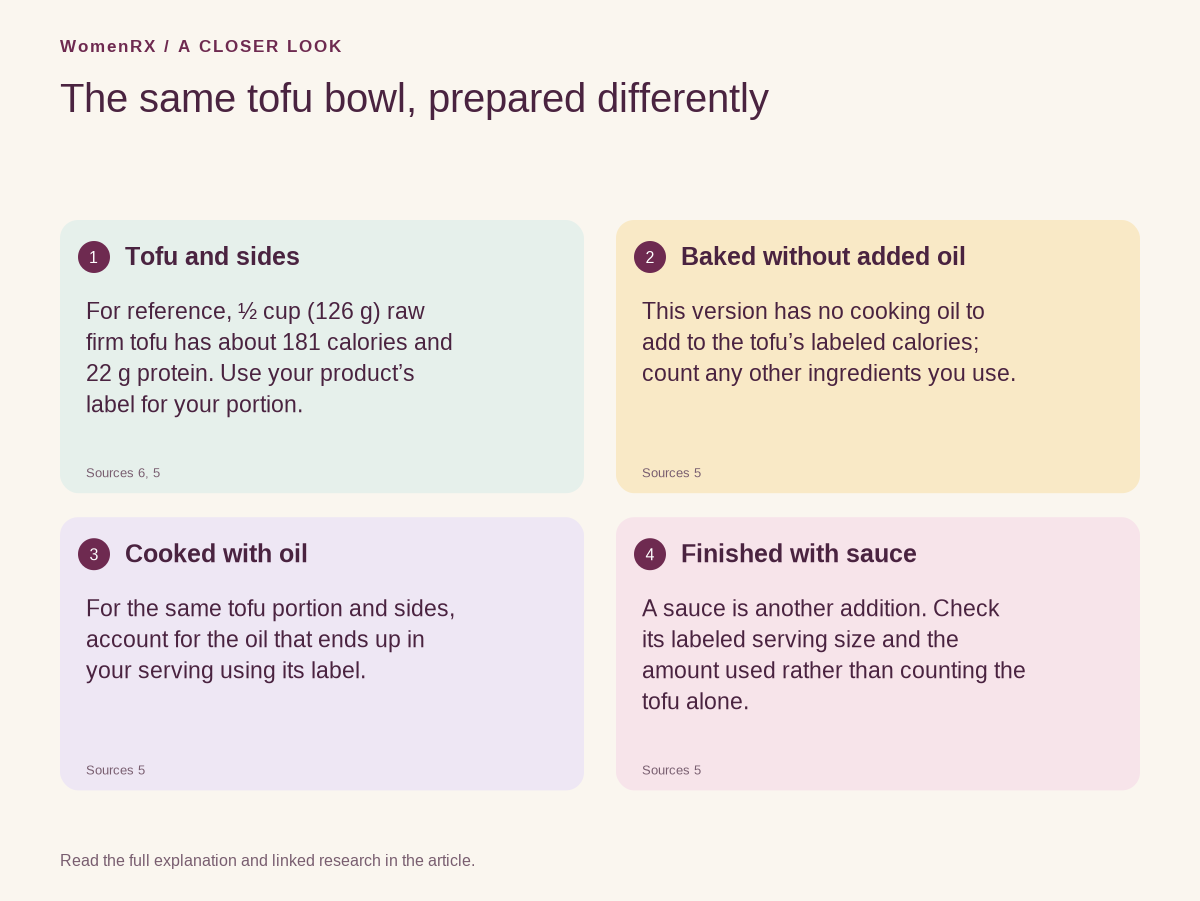
The same tofu bowl, prepared differently
Tofu and sides: For reference, ½ cup (126 g) raw firm tofu has about 181 calories and 22 g protein. Use your product’s label for your portion.65
Baked without added oil: This version has no cooking oil to add to the tofu’s labeled calories; count any other ingredients you use.5
Cooked with oil: For the same tofu portion and sides, account for the oil that ends up in your serving using its label.5
Finished with sauce: A sauce is another addition. Check its labeled serving size and the amount used rather than counting the tofu alone.5
Read the figure as text
Keep the tofu portion, vegetables and rice the same. Compare what each preparation adds to that meal.- Tofu and sides: For reference, ½ cup (126 g) raw firm tofu has about 181 calories and 22 g protein. Use your product’s label for your portion.65
- Baked without added oil: This version has no cooking oil to add to the tofu’s labeled calories; count any other ingredients you use.5
- Cooked with oil: For the same tofu portion and sides, account for the oil that ends up in your serving using its label.5
- Finished with sauce: A sauce is another addition. Check its labeled serving size and the amount used rather than counting the tofu alone.5
Sources you can check
- MedlinePlus: Protein in diet, including tofu and other plant sourcesAccessed 2026-09-25Return to first citation
- MedlinePlus: Managing weight with healthy eatingAccessed 2026-09-25Return to first citation
- Soy compared to casein meal replacement shakes with energy-restricted diets for obese women: randomized controlled trial.Anderson JW, Fuller J, Patterson K, Blair R, Tabor A. · Metabolism: clinical and experimental · 2007Return to first citation
- Changes in Intake of Fruits and Vegetables and Weight Change in United States Men and Women Followed for Up to 24 Years: Analysis from Three Prospective Cohort Studies.Bertoia ML, Mukamal KJ, Cahill LE, Hou T, Ludwig DS, Mozaffarian D, Willett WC, Hu FB, Rimm EB. · PLoS medicine · 2015Return to first citation
- Food Labeling: MedlinePlusAccessed 2026-09-25Return to first citation
- USDA SR Legacy: Tofu, raw, firm, prepared with calcium sulfate (FDC 172475)Accessed 2026-09-25Return to first citation