How Eggs Fit Into a Protein-Rich Meal
One large hard-boiled egg provides about 6 grams of protein, while the foods beside it can add the fiber it lacks.
One large hard-boiled egg provides about 6.3 grams of protein and no fiber. Two would provide about 12.6 grams of protein, before you count anything else on the plate. Pair eggs with vegetables, fruit, or whole grains to add fiber. If you’re using whites instead, don’t apply the whole-egg protein number to them; check the serving information for the whites you’re using. 82
Start with what one egg provides
A large hard-boiled egg is a useful protein component, but it doesn’t have to carry the whole meal. USDA reference data put one large hard-boiled egg at 6.3 grams of protein, 77.5 calories, 5.3 grams of fat, 0.6 grams of carbohydrate, and zero fiber. Two of those eggs provide about 12.6 grams of protein. These are estimates for hard-boiled eggs, not measurements of every egg dish or packaged product. 8
That gives you a simple way to build breakfast or lunch: count the eggs toward protein, then look at what else the meal needs. For example, eggs with whole-grain toast and fruit bring together the eggs’ protein and plant foods that supply fiber. Eggs with vegetables and beans offer another combination; beans contribute protein as well as being a plant food. These are meal ideas, not claims that a particular combination has a proven weight-loss effect. 29
Whole eggs and whites aren’t interchangeable servings
The 6.3-gram figure describes a whole hard-boiled egg. It doesn’t tell you how much protein is in one egg white or in a serving of carton whites. If you’re choosing whites to build a meal, use the protein amount on the product label for the quantity you’ll eat rather than counting each white as a whole egg. 8
Egg yolks are a source of dietary cholesterol. A white-only serving leaves out the yolk. Whole eggs are among the dietary sources of choline, a nutrient that deserves particular attention during pregnancy. The available whole-egg protein figure doesn’t tell you how much choline you’d get from a white-only meal. 13
Put the cholesterol question in context
An egg’s dietary cholesterol isn’t the same thing as your blood cholesterol level. In a meta-analysis of 28 randomized trials, people assigned to eat eggs had modestly higher LDL and HDL cholesterol, on average, than people in lower-egg control groups. The trials measured blood lipids, not whether participants later had heart attacks. A larger, later meta-analysis of randomized trials also found increases in several blood-lipid measures with egg consumption. Neither result makes a universal daily egg limit out of a single serving number. 47
Other research asks different questions and doesn’t yield a single verdict. A review of six randomized trials in people with type 2 diabetes or at risk for it found no adverse change in several measured cardiovascular risk factors when participants ate 6 to 12 eggs a week within diets consistent with heart-health guidance, but the authors said differences among the trials prevented firm conclusions. A meta-analysis of prospective cohorts found no association between each additional egg per day and cardiovascular mortality; observational findings can’t establish what caused an outcome. These findings do not establish a women-specific heart-health conclusion. 56
For the meal in front of you, pay attention to the whole pattern rather than treating the egg as either a heart-health shortcut or a food to fear. Saturated fat from foods across the diet can raise LDL cholesterol, while whole grains, fruit, and vegetables are sources of fiber. That makes the sides and the foods you eat regularly relevant to the choice. 12
If you’re pregnant, the considerations shift
Eggs can be one food source of choline. The recommended adequate intake rises to 450 milligrams a day during pregnancy, and many pregnant women in the United States don’t reach it. That’s a reason to consider choline across your diet, not to assume eggs alone meet the need. 3
Preparation matters, too. If you’re pregnant, cook eggs until both the yolk and white are firm. For a food that won’t be thoroughly cooked, such as a homemade dressing made with egg, use pasteurized eggs rather than raw eggs. 1011
Build a Meal Around Whole Eggs
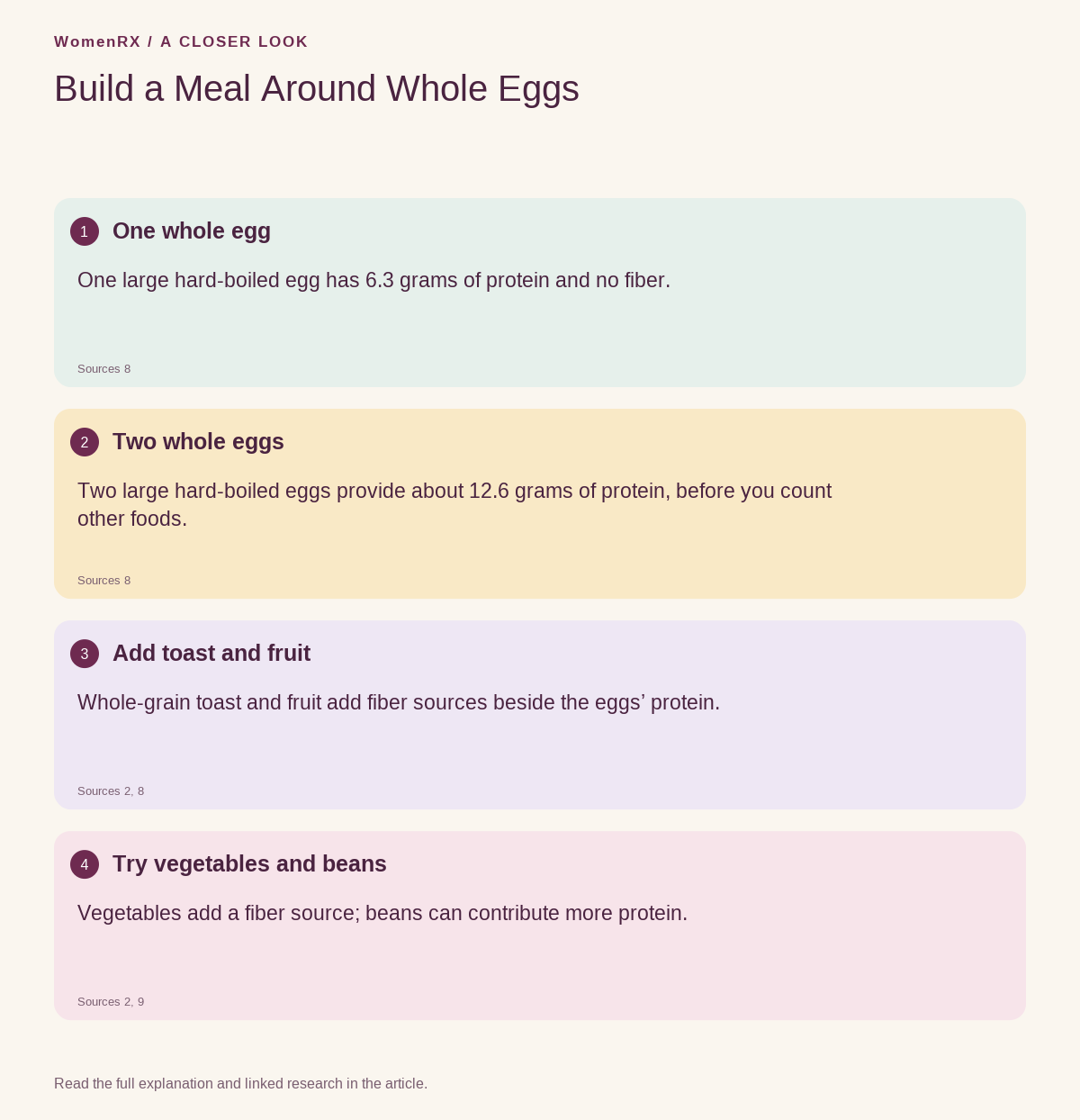
One whole egg: One large hard-boiled egg has 6.3 grams of protein and no fiber.8
Two whole eggs: Two large hard-boiled eggs provide about 12.6 grams of protein, before you count other foods.8
Add toast and fruit: Whole-grain toast and fruit add fiber sources beside the eggs’ protein.28
Try vegetables and beans: Vegetables add a fiber source; beans can contribute more protein.29
Read the figure as text
Use the whole-egg protein estimate, then choose foods that add fiber. Egg whites need a separate protein count.- One whole egg: One large hard-boiled egg has 6.3 grams of protein and no fiber.8
- Two whole eggs: Two large hard-boiled eggs provide about 12.6 grams of protein, before you count other foods.8
- Add toast and fruit: Whole-grain toast and fruit add fiber sources beside the eggs’ protein.28
- Try vegetables and beans: Vegetables add a fiber source; beans can contribute more protein.29
More questions, answered
Do eggs add fiber to a meal?
A large hard-boiled egg has zero fiber. Add a fiber-containing plant food, such as fruit, vegetables, or whole grains, if fiber is what the meal is missing. 82
Sources you can check
- Cholesterol | MedlinePlusAccessed 2026-09-25Return to first citation
- Dietary Fiber: MedlinePlusAccessed 2026-09-25Return to first citation
- Dietary Supplements and Life Stages: Pregnancy - Health Professional Fact SheetAccessed 2026-09-25Return to first citation
- Effects of Egg Consumption on Blood Lipids: A Systematic Review and Meta-Analysis of Randomized Clinical Trials.Rouhani MH, Rashidi-Pourfard N, Salehi-Abargouei A, Karimi M, Haghighatdoost F. · Journal of the American College of Nutrition · 2018Return to first citation
- Impact of Egg Consumption on Cardiovascular Risk Factors in Individuals with Type 2 Diabetes and at Risk for Developing Diabetes: A Systematic Review of Randomized Nutritional Intervention Studies.Richard C, Cristall L, Fleming E, Lewis ED, Ricupero M, Jacobs RL, Field CJ. · Canadian journal of diabetes · 2017Return to first citation
- Egg and Dietary Cholesterol Intake and Risk of All-Cause, Cardiovascular, and Cancer Mortality: A Systematic Review and Dose-Response Meta-Analysis of Prospective Cohort Studies.Darooghegi Mofrad M, Naghshi S, Lotfi K, Beyene J, Hypponen E, Pirouzi A, Sadeghi O. · Frontiers in nutrition · 2022Return to first citation
- The responses of different dosages of egg consumption on blood lipid profile: An updated systematic review and meta-analysis of randomized clinical trials.Khalighi Sikaroudi M, Soltani S, Kolahdouz-Mohammadi R, Kolahdouz-Mohammadi R, Clayton ZS, Fernandez ML, Varse F, Shidfar F. · Journal of food biochemistry · 2020Return to first citation
- USDA SR Legacy: Egg, whole, cooked, hard-boiled (FDC 173424)Accessed 2026-09-25Return to first citation
- MedlinePlus: Protein in diet, including tofu and other plant sourcesAccessed 2026-09-25Return to first citation
- Dairy and Eggs (Food Safety for Moms-to-Be) | FDAAccessed 2026-09-25Return to first citation
- Safer Food Choices for Pregnant Women | Food Safety | CDCAccessed 2026-09-25Return to first citation