Constipation on GLP-1 Medicines: A Stepwise Plan
Check for urgent symptoms first. Then note whether stools are hard or difficult to pass, review everyday habits, and discuss medication timing with your prescriber.
Constipation can happen with GLP-1 medicines, and gastrointestinal side effects may be more common at higher doses, but symptoms can have other causes too. Track how often you go, what your stools are like, when symptoms began, and any recent dose changes. Review fluids, fiber-rich foods, movement, and whether you’re holding back the urge to go. If symptoms persist or worsen, contact your prescriber; ask before using a laxative. 2 5
First, check for urgent symptoms
Get urgent medical assessment if you suddenly develop sharp abdominal pain, your abdomen is hard and tender, or you can’t move your bowels, especially if you’re also vomiting. 1
Then, check what “constipation” means for you
It isn’t only about how many times you go. Hard or dry stools, straining, feeling that you haven’t emptied fully, or a sense that stool is blocked can matter too. You don’t have to have a bowel movement every day for your pattern to be normal; a noticeable change from your usual pattern is more useful to track. 2 4
GLP-1 medicines can be one possible contributor. A review of randomized trials in adults receiving GLP-1 or related medicines found gastrointestinal symptoms, including constipation, were more common in treatment groups than in placebo groups; the review also described some symptoms as dose-related. That doesn’t establish that a medicine is the only cause of your constipation, or that a particular prevention plan will work for everyone. 5
Step 1: Distinguish stool changes from trouble emptying
For several days, note when you have a bowel movement and whether stools are hard or difficult to pass. Also note straining, a persistent blocked feeling, or feeling incompletely emptied. Those emptying symptoms are worth describing to your prescriber, even if bowel movements have not become much less frequent. Record when symptoms began and any changes in fluid intake, eating, activity, or other medicines. 2 4
Step 2: Review everyday factors
If symptoms are mild and you’re otherwise well, check whether you’ve been getting less fiber-rich food or fluid than usual, moving less, or postponing the urge to go. General constipation guidance includes fruits, vegetables, and grains; plenty of fluids; regular activity; and making time to use the bathroom when you feel the urge. These are general measures, not a guarantee that constipation will be prevented or resolved. 2
Don’t suddenly treat fiber as the whole answer. If symptoms include a feeling of blockage or repeated difficulty emptying, mention that detail: constipation can involve problems with evacuation as well as infrequent or hard stools. 4
Step 3: Compare symptoms with medication timing
Tell your prescriber when the change began and whether it followed starting or increasing a medicine such as semaglutide, liraglutide, dulaglutide, or tirzepatide. Also mention other medicines you take, since medicines beyond GLP-1 treatments can contribute to constipation. If symptoms persist or worsen, discuss your symptoms and treatment with the prescriber. General constipation guidance advises using laxatives only with a provider’s direction. 2 5
Evidence for an optimal diet during GLP-1 treatment remains limited. Your prescriber can consider your symptoms and other possible causes rather than treating every bowel change as a medication side effect. 5
Pregnancy, postpartum, and pelvic-floor context
Constipation is common during pregnancy and after giving birth, so those changes may also be relevant if they apply to you. Pelvic-floor or evacuation problems are another possible contributor for some people; they aren’t something to assume from constipation alone. Mention a persistent blocked feeling or difficulty emptying, especially if ordinary measures haven’t helped. 3 4
The GLP-1 trial findings cited here describe gastrointestinal side effects but don’t provide a basis for comparing constipation rates by sex. 5 6
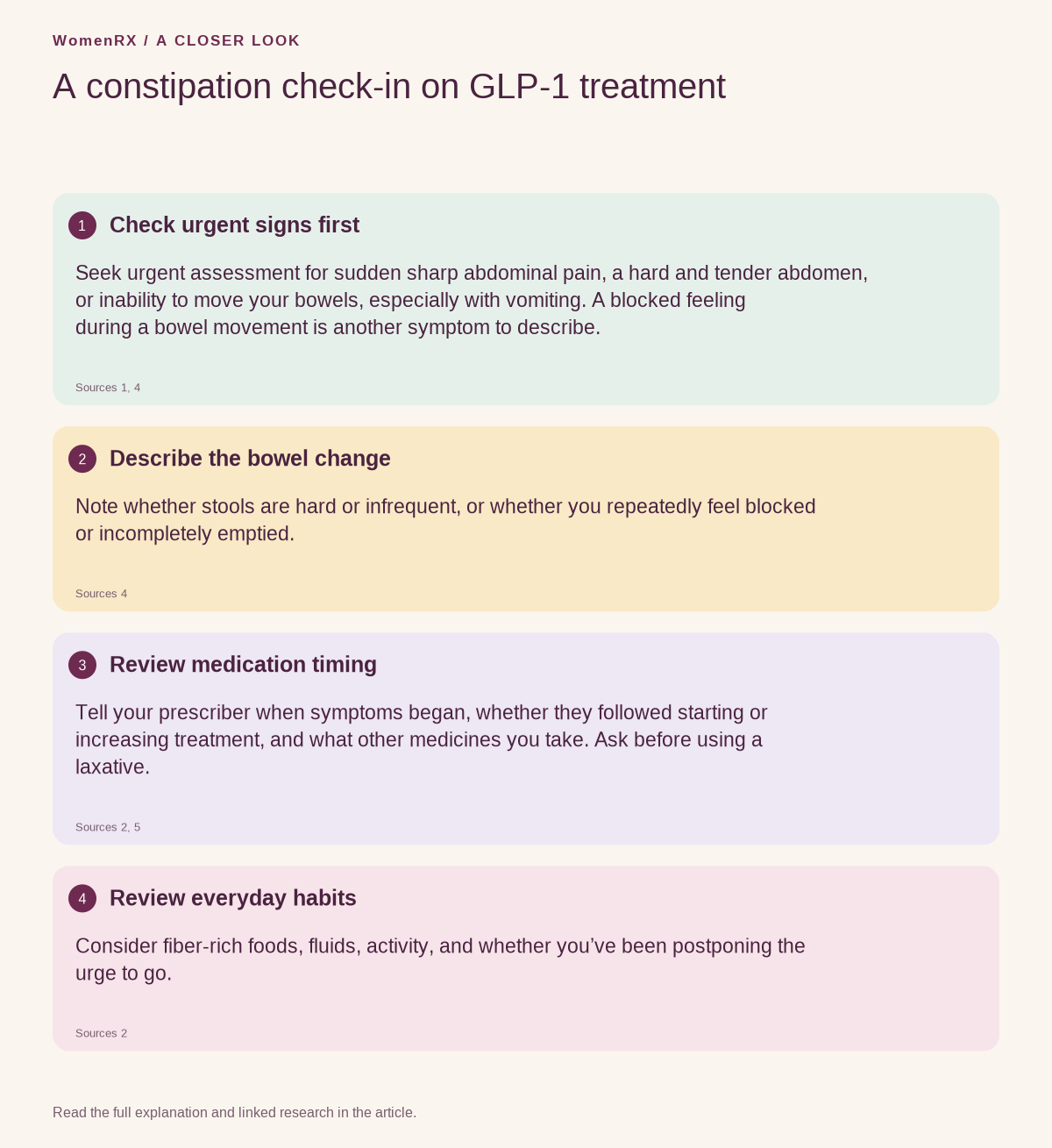
A constipation check-in on GLP-1 treatment
Check urgent signs first: Seek urgent assessment for sudden sharp abdominal pain, a hard and tender abdomen, or inability to move your bowels, especially with vomiting. A blocked feeling during a bowel movement is another symptom to describe.14
Describe the bowel change: Note whether stools are hard or infrequent, or whether you repeatedly feel blocked or incompletely emptied.4
Review medication timing: Tell your prescriber when symptoms began, whether they followed starting or increasing treatment, and what other medicines you take. Ask before using a laxative.25
Review everyday habits: Consider fiber-rich foods, fluids, activity, and whether you’ve been postponing the urge to go.2
Read the figure as text
Check urgent signs first. Then distinguish stool changes from trouble emptying, review medication timing, and consider general habits.- Check urgent signs first: Seek urgent assessment for sudden sharp abdominal pain, a hard and tender abdomen, or inability to move your bowels, especially with vomiting. A blocked feeling during a bowel movement is another symptom to describe.14
- Describe the bowel change: Note whether stools are hard or infrequent, or whether you repeatedly feel blocked or incompletely emptied.4
- Review medication timing: Tell your prescriber when symptoms began, whether they followed starting or increasing treatment, and what other medicines you take. Ask before using a laxative.25
- Review everyday habits: Consider fiber-rich foods, fluids, activity, and whether you’ve been postponing the urge to go.2
More questions, answered
Do I need to have a bowel movement every day?
No. General constipation guidance says daily bowel movements aren’t required; pay attention to a change from your usual pattern and to hard stools, straining, or difficulty emptying. 2 4
Sources you can check
- Abdominal Pain | MedlinePlusAccessed 2026-09-25Return to first citation
- Constipation | MedlinePlusAccessed 2026-09-25Return to first citation
- Constipation - NHSAccessed 2026-09-25Return to first citation
- [Seoul Consensus on Clinical Practice Guidelines for Functional Constipation].Song KH, Cho YS, Shin JE, Jung HK, Park SY, Kang SJ, Kim JW, Lee YJ, Lim HC, Park HS, Kim SJ, Cha RR, Bang KB, Bang CS, Yim SK, Ryoo SB, Kye BH, Ji WB, Choi M, Sung IK, Choi SC. · The Korean journal of gastroenterology = Taehan Sohwagi Hakhoe chi · 2025Return to first citation
- Dietary Strategies and Nutritional Management in Patients Receiving GLP-1 and Dual GIP/GLP-1 Receptor Agonists as Adjuncts to Lifestyle Interventions: A Systematic Review of Randomised Clinical Trials.de Paulo RS, Bonifácio DB, de Carvalho MHL, Bressan J. · Diabetes, obesity & metabolism · 2026Return to first citation
- Efficacy and Safety of Glucagon-Like Peptide-1 Receptor Agonists for Weight Loss Among Adults Without Diabetes : A Systematic Review of Randomized Controlled Trials.Moiz A, Filion KB, Toutounchi H, Tsoukas MA, Yu OHY, Peters TM, Eisenberg MJ. · Annals of internal medicine · 2025Return to first citation