Gallbladder Symptoms on GLP-1 Medicines: When to Get Help
New upper-abdominal pain during treatment deserves attention, but symptoms alone can’t confirm a gallbladder problem.
Gallstones can cause upper-abdominal pain with nausea or vomiting, but other conditions can cause similar pain. Contact your prescriber promptly if you suspect a gallbladder problem. Seek urgent assessment for severe or persistent pain, yellow skin or eyes, dark urine, or unusually pale stools. Share your medication, symptom timeline, and recent weight changes to help the clinician assess the cause. 123
Start with the symptoms, not an assumption
Gallstones often cause no symptoms. When a stone blocks a bile duct, it can cause abdominal pain and nausea or vomiting. Pain in the upper-right abdomen can raise suspicion, but it doesn’t establish the cause: other problems involving the liver, pancreas, stomach, or nearby tissues can feel similar. 13
Call your prescriber or another clinician promptly if you’re having pain that makes you suspect gallbladder trouble. Seek urgent medical assessment if your skin or the whites of your eyes turn yellow, or if you notice dark urine or unusually pale stools. These changes can signal a blockage and need assessment rather than watchful waiting. 12
Severe, persistent abdominal pain also needs urgent attention. It can have causes other than gallbladder disease, including pancreatitis; a product label for liraglutide identifies persistent or severe abdominal pain, sometimes with nausea or vomiting, as a reason to assess for pancreatitis. Don’t assume pain is “just a side effect” or diagnose yourself from where it hurts. 23
Why treatment and weight change both matter
There’s evidence of an association between GLP-1 receptor agonist treatment and gallbladder or bile-duct problems, but an individual episode of pain can’t tell you whether the medicine caused it. A meta-analysis of 76 randomized trials, involving 103,371 adults (40.5% women), found a higher relative risk of gallbladder or biliary disease among people assigned a GLP-1 receptor agonist than among comparison-group participants. The association was stronger in trials for weight loss and in trials with higher doses or longer treatment. These are relative comparisons across trials, not a prediction of your personal likelihood of developing a problem. The analysis did not report a women-only result. 5
Weight loss itself can also raise gallstone risk, particularly when it is substantial or rapid. Liraglutide’s US prescribing information notes that gallbladder events occurred more often in its weight-loss trials than with placebo, even after accounting for the degree of weight loss. That supports taking symptoms seriously without assuming every case is caused directly by the medicine. 12
For context, in adult trials of the weight-management product Saxenda (liraglutide), reported gallstones occurred in 2.2% of treated participants and 0.8% of placebo participants; gallbladder inflammation occurred in 0.8% and 0.4%, respectively. These figures are specific to those trials and that product, not a rate for every GLP-1 medicine or every person taking one. 2
What an assessment can clarify
A clinician will use your symptoms and history to decide whether gallstones or another cause is more likely. When acute gallbladder inflammation is suspected in someone with upper-right abdominal pain, ultrasound is usually the first imaging test; further imaging may be considered when the initial findings don’t settle the question. 4
A useful account is concrete, not perfect. Be ready to describe where the pain is, when it started, whether it has returned, and whether nausea or vomiting comes with it. Bring the medication name and indication, when you started it, any recent dose changes, and the pattern of your weight change. Mention previous gallstones or gallbladder procedures, and any other relevant health conditions or medicines. If you’re pregnant or have recently given birth, share that too as part of your health history, not as proof that the medicine caused the pain. This helps the clinician consider medication exposure alongside other possible explanations. 23
Don’t change or stop a medicine on your own based only on a suspicion of gallstones. Contact the prescriber for specific advice; suspected gallbladder disease warrants clinical follow-up, and severe persistent pain needs prompt assessment. 2
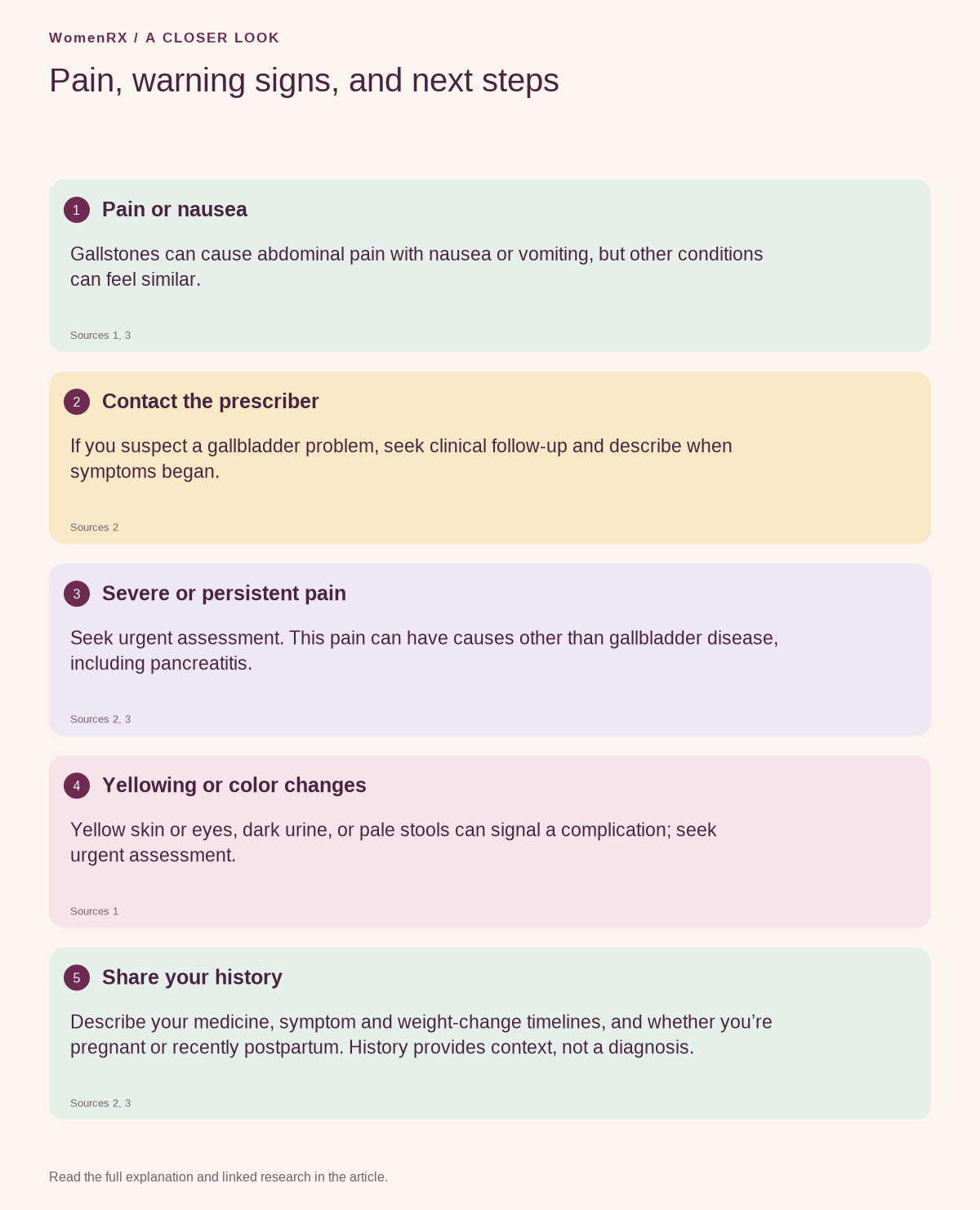
Pain, warning signs, and next steps
Pain or nausea: Gallstones can cause abdominal pain with nausea or vomiting, but other conditions can feel similar.13
Contact the prescriber: If you suspect a gallbladder problem, seek clinical follow-up and describe when symptoms began.2
Severe or persistent pain: Seek urgent assessment. This pain can have causes other than gallbladder disease, including pancreatitis.23
Yellowing or color changes: Yellow skin or eyes, dark urine, or pale stools can signal a complication; seek urgent assessment.1
Share your history: Describe your medicine, symptom and weight-change timelines, and whether you’re pregnant or recently postpartum. History provides context, not a diagnosis.23
Read the figure as text
A symptom-based route from noticing pain to seeking assessment. It does not diagnose gallstones.- Pain or nausea: Gallstones can cause abdominal pain with nausea or vomiting, but other conditions can feel similar.13
- Contact the prescriber: If you suspect a gallbladder problem, seek clinical follow-up and describe when symptoms began.2
- Severe or persistent pain: Seek urgent assessment. This pain can have causes other than gallbladder disease, including pancreatitis.23
- Yellowing or color changes: Yellow skin or eyes, dark urine, or pale stools can signal a complication; seek urgent assessment.1
- Share your history: Describe your medicine, symptom and weight-change timelines, and whether you’re pregnant or recently postpartum. History provides context, not a diagnosis.23
More questions, answered
Does pain mean I have gallstones?
No. Gallstones can cause pain, nausea, or vomiting, but several other conditions can cause upper-abdominal pain too. Symptoms raise a question; assessment and, when appropriate, imaging help clarify the cause. 134
Does this evidence show the same risk for every GLP-1 medicine?
No. The meta-analysis assessed GLP-1 receptor agonists as a group, while the specific percentages quoted here come from liraglutide weight-loss trials. Those figures shouldn’t be applied to every medicine in the broader GLP-1 treatment landscape. 25
Sources you can check
- Gallstones - NHSAccessed 2026-09-25Return to first citation
- SAXENDA (LIRAGLUTIDE) INJECTION, SOLUTION [NOVO NORDISK PHARMACEUTICAL INDUSTRIES, LP] | US prescribing information and patient instructionsAccessed 2026-09-25Return to first citation
- ACR Appropriateness Criteria® Right Upper Quadrant Pain: 2022 Update.Expert Panel on Gastrointestinal Imaging, Russo GK, Zaheer A, Kamel IR, Porter KK, Archer-Arroyo K, Bashir MR, Cash BD, Fung A, McCrary M, McGuire BM, Shih RD, Stowers J, Thakrar K... · Journal of the American College of Radiology : JACR · 2023Return to first citation
- ACR appropriateness criteria right upper quadrant pain.Yarmish GM, Smith MP, Rosen MP, Baker ME, Blake MA, Cash BD, Hindman NM, Kamel IR, Kaur H, Nelson RC, Piorkowski RJ, Qayyum A, Tulchinsky M. · Journal of the American College of Radiology : JACR · 2014Return to first citation
- Association of Glucagon-Like Peptide-1 Receptor Agonist Use With Risk of Gallbladder and Biliary Diseases: A Systematic Review and Meta-analysis of Randomized Clinical Trials.He L, Wang J, Ping F, Yang N, Huang J, Li Y, Xu L, Li W, Zhang H. · JAMA internal medicine · 2022Return to first citation