Gallbladder Symptoms on a GLP-1: When to Act
New upper abdominal pain deserves attention during GLP-1 treatment, especially if it comes with fever, vomiting, or yellowing of the eyes.
GLP-1 receptor agonists are linked to a higher risk of gallstones and other gallbladder or bile-duct problems, but symptoms alone can’t tell you whether the medicine is responsible. If upper abdominal pain is severe or comes with fever or jaundice, seek urgent medical assessment. If pain recurs, contact a clinician promptly rather than treating it as routine nausea. 614
The risk signal isn’t a diagnosis
In a review of 76 randomized trials involving 103,371 adults, people assigned to a GLP-1 receptor agonist had a higher relative risk of gallbladder or bile-duct disease than people assigned to placebo or another medication. The relative risk was 1.37 for the combined outcome and 1.27 for gallstones specifically. Those figures describe groups of people, not the chance that your particular pain is a gallstone or that your medication caused it. 6
Gallstones are common and often cause no symptoms. They can cause pain when a stone blocks the flow of bile, and a blockage can sometimes lead to gallbladder inflammation, pancreatitis, or jaundice. Abdominal pain can also have other causes. The useful question when symptoms start is not “Can I prove this is the medication?” but “Could this need assessment now?” 12
Let the symptom combination guide your next move
Get urgent medical assessment if upper abdominal pain comes with fever or jaundice. Pain with fever can be a sign of acute gallbladder inflammation. Yellow skin or whites of the eyes, dark urine, or unusually pale stool can signal a bile-duct blockage. Yellowing of the skin may be harder to see on brown or black skin, so the other changes matter too. 41
Get medical help immediately for sudden, sharp abdominal pain. Severe pain in the upper right abdomen is also a reason not to wait and see whether it passes as a digestive side effect. Acute gallbladder inflammation can be a serious condition. 24
Contact a clinician promptly for upper abdominal pain that returns, even if you feel well between episodes. A stone can cause pain by temporarily blocking bile flow, while many stones never cause symptoms at all. Recurring pain needs an assessment rather than a guess based on whether it settled last time. 13
Nausea by itself doesn’t establish gallbladder disease. But if nausea or vomiting appears alongside significant upper abdominal pain, pay attention to the pain, particularly if fever or jaundice is present. 14
What an assessment can sort out
A clinician can ask where the pain is, examine you, and consider an ultrasound when gallstones or gallbladder inflammation are suspected. Ultrasound is typically the first imaging test for suspected acute gallbladder inflammation. The findings help distinguish a stone that isn’t causing trouble from a symptomatic stone or a complication that needs treatment. 14
Tell the person assessing you which medication you take and when the symptoms began. Include whether you’re pregnant, if applicable, as part of your medical context. Diabetes, insulin resistance, and obesity can also be relevant to gallstone risk. None of these details establishes the cause of your pain. The GLP-1 trial figures describe groups, not your risk as an individual woman. 356
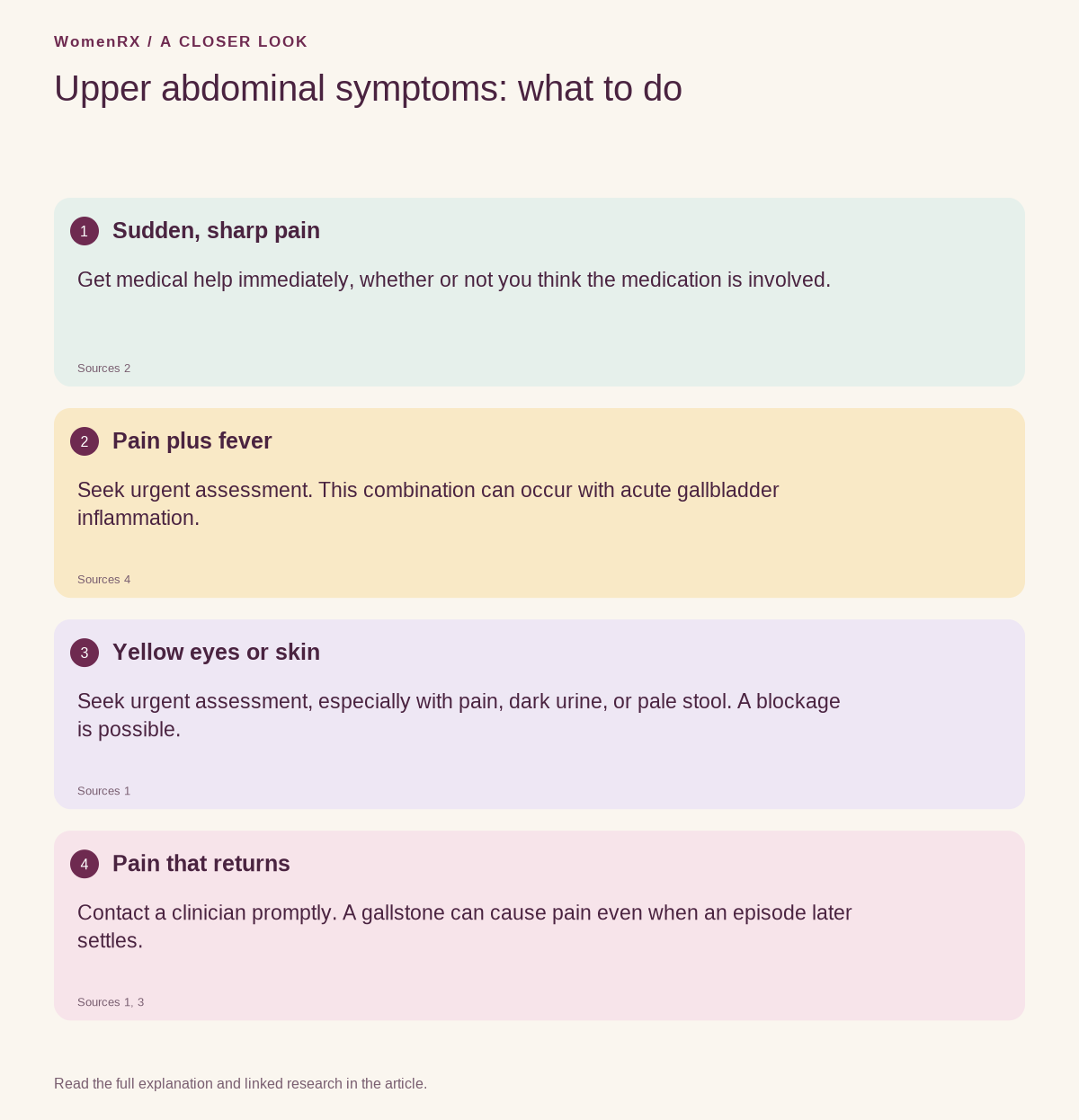
Upper abdominal symptoms: what to do
Sudden, sharp pain: Get medical help immediately, whether or not you think the medication is involved.2
Pain plus fever: Seek urgent assessment. This combination can occur with acute gallbladder inflammation.4
Yellow eyes or skin: Seek urgent assessment, especially with pain, dark urine, or pale stool. A blockage is possible.1
Pain that returns: Contact a clinician promptly. A gallstone can cause pain even when an episode later settles.13
Read the figure as text
Use the symptom pattern to decide how quickly to seek assessment; it cannot identify the cause on its own.- Sudden, sharp pain: Get medical help immediately, whether or not you think the medication is involved.2
- Pain plus fever: Seek urgent assessment. This combination can occur with acute gallbladder inflammation.4
- Yellow eyes or skin: Seek urgent assessment, especially with pain, dark urine, or pale stool. A blockage is possible.1
- Pain that returns: Contact a clinician promptly. A gallstone can cause pain even when an episode later settles.13
More questions, answered
Does finding a gallstone mean I’ll need surgery?
Not necessarily. Gallstones found by chance may need no treatment if they aren’t causing symptoms. Treatment decisions differ when stones cause symptoms, complications, or a blockage in the common bile duct. 1
Sources you can check
- Gallstones - NHSAccessed 2026-09-25Return to first citation
- Abdominal Pain | MedlinePlusAccessed 2026-09-25Return to first citation
- The ketogenic diet is not for everyone: contraindications, side effects, and drug interactions.Dyńka D, Rodzeń Ł, Rodzeń M, Łojko D, Karakuła-Juchnowicz H, Ede G, Grzywacz Ż, Antosik K, Sethi S, Unwin D. · Annals of medicine · 2026Return to first citation
- Clinical Presentation, Imaging, and Management of Acute Cholecystitis.Katabathina VS, Zafar AM, Suri R. · Techniques in vascular and interventional radiology · 2015Return to first citation
- GLP-1 receptor agonists and gallbladder disease risk: insights into molecular mechanisms and clinical implications.Ramírez-Mejía MM, Ponciano-Rodriguez G, Eslam M, Méndez-Sánchez N. · Therapeutic advances in endocrinology and metabolism · 2025Return to first citation
- Association of Glucagon-Like Peptide-1 Receptor Agonist Use With Risk of Gallbladder and Biliary Diseases: A Systematic Review and Meta-analysis of Randomized Clinical Trials.He L, Wang J, Ping F, Yang N, Huang J, Li Y, Xu L, Li W, Zhang H. · JAMA internal medicine · 2022Return to first citation