GLP-1 Medicines and Pancreatitis: What the Evidence Shows
Studies so far haven’t established that GLP-1 medicines cause pancreatitis, but severe, persistent abdominal pain still needs urgent attention.
The evidence doesn’t show a clear increase in pancreatitis with GLP-1 medicines, but it can’t rule out every possible risk. A network meta-analysis of short randomized trials found no statistically significant increase for orforglipron; a separate real-world study also found no increase, but only in a specific group of people with type 2 diabetes. Neither result proves zero risk. Severe, persistent abdominal pain, especially if it spreads to the back, calls for urgent medical assessment. 3 4 1
What the evidence can, and can’t, tell you
The best reading is neither “these medicines cause pancreatitis” nor “there’s no risk.” In a network meta-analysis of randomized trials of orforglipron, an oral GLP-1 receptor agonist, researchers found no statistically significant difference in pancreatitis compared with placebo. The pancreatitis analysis covered 3,305 participants across three studies. The trials lasted 26 weeks, and the analysis did not establish that risk is absent or settle the safety question for every GLP-1 medicine. 3
A large observational study offers a different kind of evidence. Among people with type 2 diabetes already taking an SGLT2 inhibitor, acute pancreatitis was recorded in 32 of 19,727 people who started a GLP-1 medicine (0.2%) and 25 of 13,305 who started a comparator medicine (also 0.2%). The estimated difference was not statistically significant. This study followed people for a median of 1.4 years, but it excluded people with a recorded history of pancreatitis, so it does not answer whether the findings apply to someone with a previous episode. As an observational study, it also can’t prove that a medicine caused or prevented an outcome. 4
Taken together, these findings are reassuring in the groups and time periods studied, but they are not a guarantee for an individual. The studies also don’t provide a clear risk estimate for every medicine, use, or personal medical history. 3 4
A warning is a reason to act, not proof of cause
US prescribing information for liraglutide products Saxenda and Victoza reports that acute pancreatitis has been observed during treatment and tells patients and prescribers to watch for symptoms. That warning matters for safety: it gives a practical response if symptoms arise. By itself, it is not a comparison of how often pancreatitis happens with the medicine versus without it, and it does not prove the medicine caused any particular case. 1 2
The warning describes persistent or severe abdominal pain, sometimes radiating to the back, with or without nausea or vomiting. The Saxenda label says to discontinue the medicine if pancreatitis is suspected and to begin appropriate management. That direction is specific to its prescribing information; don’t assume every product has identical instructions. 1 2
What to do if you have severe abdominal pain
If you develop severe or persistent abdominal pain, especially pain that spreads to your back, seek urgent medical assessment rather than waiting to see if it passes. Nausea and vomiting may occur, but their absence doesn’t rule out the symptom pattern described in the liraglutide labels. Tell the clinician which medicine you take. If you use Saxenda or Victoza, their labels direct stopping treatment when pancreatitis is suspected; get medical guidance promptly about what to do next. 1 2
Abdominal symptoms alone can’t confirm pancreatitis. The useful distinction is not to diagnose yourself from one symptom, but to take severe or persistent pain seriously and get assessed. 1 2
What’s known about risk in women
The UK observational study reports pooled pancreatitis results, not a risk estimate specifically for women. Women made up 40% of treatment initiations, but the reported pancreatitis outcomes were not separated by sex. So the study’s overall result can inform the broader discussion, but it can’t tell you whether the risk differs for women. 4
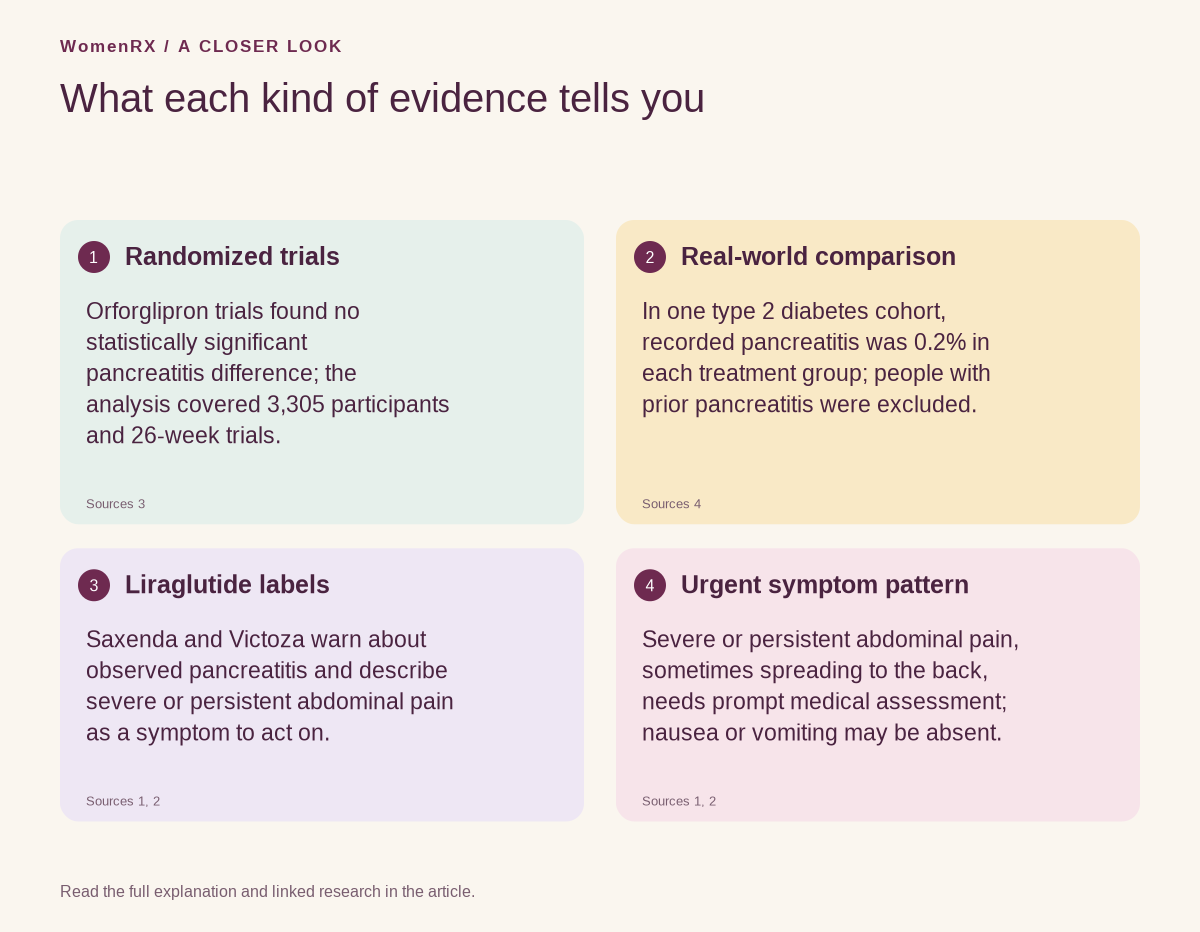
What each kind of evidence tells you
Randomized trials: Orforglipron trials found no statistically significant pancreatitis difference; the analysis covered 3,305 participants and 26-week trials.3
Real-world comparison: In one type 2 diabetes cohort, recorded pancreatitis was 0.2% in each treatment group; people with prior pancreatitis were excluded.4
Liraglutide labels: Saxenda and Victoza warn about observed pancreatitis and describe severe or persistent abdominal pain as a symptom to act on.12
Urgent symptom pattern: Severe or persistent abdominal pain, sometimes spreading to the back, needs prompt medical assessment; nausea or vomiting may be absent.12
Read the figure as text
These findings answer different questions: whether trials detected a difference, what happened in one real-world group, what a product label asks you to do, and which symptoms need prompt assessment.- Randomized trials: Orforglipron trials found no statistically significant pancreatitis difference; the analysis covered 3,305 participants and 26-week trials.3
- Real-world comparison: In one type 2 diabetes cohort, recorded pancreatitis was 0.2% in each treatment group; people with prior pancreatitis were excluded.4
- Liraglutide labels: Saxenda and Victoza warn about observed pancreatitis and describe severe or persistent abdominal pain as a symptom to act on.12
- Urgent symptom pattern: Severe or persistent abdominal pain, sometimes spreading to the back, needs prompt medical assessment; nausea or vomiting may be absent.12
More questions, answered
Does nausea mean I have pancreatitis?
Not by itself. The liraglutide labels describe persistent or severe abdominal pain as the key symptom and say it may occur with or without nausea or vomiting. Severe or persistent pain needs urgent assessment; nausea alone can’t establish the diagnosis. 1 2
Do these studies tell us whether women have a different risk?
No. One observational study included women, but reported pancreatitis outcomes for the combined group rather than women separately. It therefore doesn’t establish a women-specific risk estimate. 4
Sources you can check
- SAXENDA (LIRAGLUTIDE) INJECTION, SOLUTION [NOVO NORDISK PHARMACEUTICAL INDUSTRIES, LP] | US prescribing information and patient instructionsAccessed 2026-09-25Return to first citation
- VICTOZA (LIRAGLUTIDE) INJECTION [NOVO NORDISK] | US prescribing information and patient instructionsAccessed 2026-09-25Return to first citation
- The Gastrointestinal Safety of Orforglipron, a GLP-1 Receptor Agonist, in Adults With or Without Type 2 Diabetes: A Network Meta-Analysis of Randomized Controlled Trials.Hageen AW, Gadelmawla AF, Saleh AO, Abdallfatah A, Mohamed MR, El-Nemr AF, Maihoub O, Elsekhary A, Eladawi S, Ayalew BD, Mansour A, Radi AA, Abuelazm M, Flefel MG. · Endocrinology, diabetes & metabolism · 2026Return to first citation
- Kidney outcomes with GLP-1 receptor agonists in people with type 2 diabetes already receiving SGLT2 inhibitors: a target trial emulation study using UK primary care data.Jansz TT, McGovern AP, Young KG, Dinsdale MM, Cardoso P, Shields BM, Hattersley AT, Jones AG, Pearson ER, Bingham C, Oram RA, Dennis JM. · The Lancet. Primary care · 2026Return to first citation