Heartburn or Reflux on a GLP-1 Medicine: What to Check
GLP-1 medicines are linked with a small increase in reflux risk, but the timing and kind of discomfort matter.
Reflux can happen during treatment with GLP-1 medicines. A review of randomized trials found that GERD was probably more common with these medicines than with placebo, though the extra risk was small. That doesn’t mean every bout of heartburn is caused by treatment. Note when symptoms happen, any recent treatment changes, and what you ate or were doing. Severe, persistent abdominal pain, especially pain that reaches your back, needs urgent medical assessment. 4 2
First, notice what the discomfort feels like
Reflux usually feels like burning in the middle of your chest, sometimes with a sour taste in your mouth. It often gets worse after eating, when you lie down, or when you bend over. A meal-related pattern can be a useful clue, but it doesn’t establish the cause. 1
Upper-abdominal discomfort, nausea, or vomiting can overlap with other digestive problems and with medicine side effects. Don’t assume new pain is “just heartburn,” especially if it is severe or persistent. GLP-1 medicines are also associated with gallbladder events, including gallstones, so tell your prescriber about abdominal symptoms rather than trying to diagnose them yourself. 2 3
How strong is the link with GLP-1 medicines?
A 2025 systematic review and meta-analysis included 55 randomized trials with 106,395 participants overall. In its comparison with placebo, GLP-1 receptor agonists probably increased GERD risk, with an estimated four additional cases per 1,000 people. The abstract doesn’t report the number of participants in the GERD analysis, so the review-wide total shouldn’t be mistaken for that analysis’s sample size. The review included trials involving people with type 2 diabetes, overweight or obesity, and metabolic dysfunction-associated steatotic liver disease. The estimate is a small absolute difference, not a prediction of what will happen to you, and the review did not establish whether risk differs for women. 4
The result is consistent with a US prescribing-information table for oral semaglutide: GERD was reported in 2% of participants taking either listed tablet strength, compared with 0.3% taking placebo. Those figures apply to those particular trial groups and shouldn’t be treated as a rate for every GLP-1 medicine or dose. 3
One possible connection is that semaglutide delays stomach emptying. But the evidence supports an association between treatment and reflux, not proof that delayed emptying explains every person’s symptoms. Reflux also occurs for reasons unrelated to medication. 2 1 4
Make the pattern easier to discuss
For a short stretch, jot down a few details when symptoms happen. This isn’t a diagnostic test; it helps you describe the pattern clearly:
- Treatment: medicine name, when you started, and any recent dose changes.
- Timing: when the burning or discomfort began and how long it lasted.
- Food and position: whether it followed a meal, lying down, or bending over.
- Other symptoms: sour taste, nausea, vomiting, or abdominal pain, including where the pain is and whether it reaches your back.
If pregnancy may be relevant, mention it as context too; it doesn’t by itself establish what’s causing the symptoms.
These details help separate a recurring, meal-related burning sensation from symptoms that deserve a different evaluation. Ask your prescriber whether the pattern could be treatment-related, whether another cause should be considered, and what symptom relief is appropriate for your situation. Don’t stop or change a prescribed medicine on your own; talk with your prescriber first. 1
If symptoms are mild and feel like typical reflux, avoiding lying down soon after eating and noticing which situations bring symptoms on may help you identify a pattern. Raising the head of the bed can help some people; stacking extra pillows may increase pressure on the abdomen and worsen symptoms. If heartburn keeps coming back, ask your care team about next steps rather than relying on repeated self-treatment. 1
Know when abdominal pain is more urgent
Seek urgent medical assessment for persistent or severe abdominal pain, particularly if it radiates to your back. The semaglutide prescribing information identifies this as a possible sign of acute pancreatitis, with or without nausea or vomiting. These symptoms don’t prove pancreatitis, but they shouldn’t be managed as ordinary heartburn without assessment. 2 3
Tell your prescriber about new or worsening reflux, recurring symptoms, or abdominal discomfort even if it doesn’t meet that urgent threshold. The pooled trial estimate is small, and it cannot tell you whether your symptoms are caused by the medicine, another digestive condition, or something else. It can, however, make treatment-related reflux a reasonable question to raise. 4
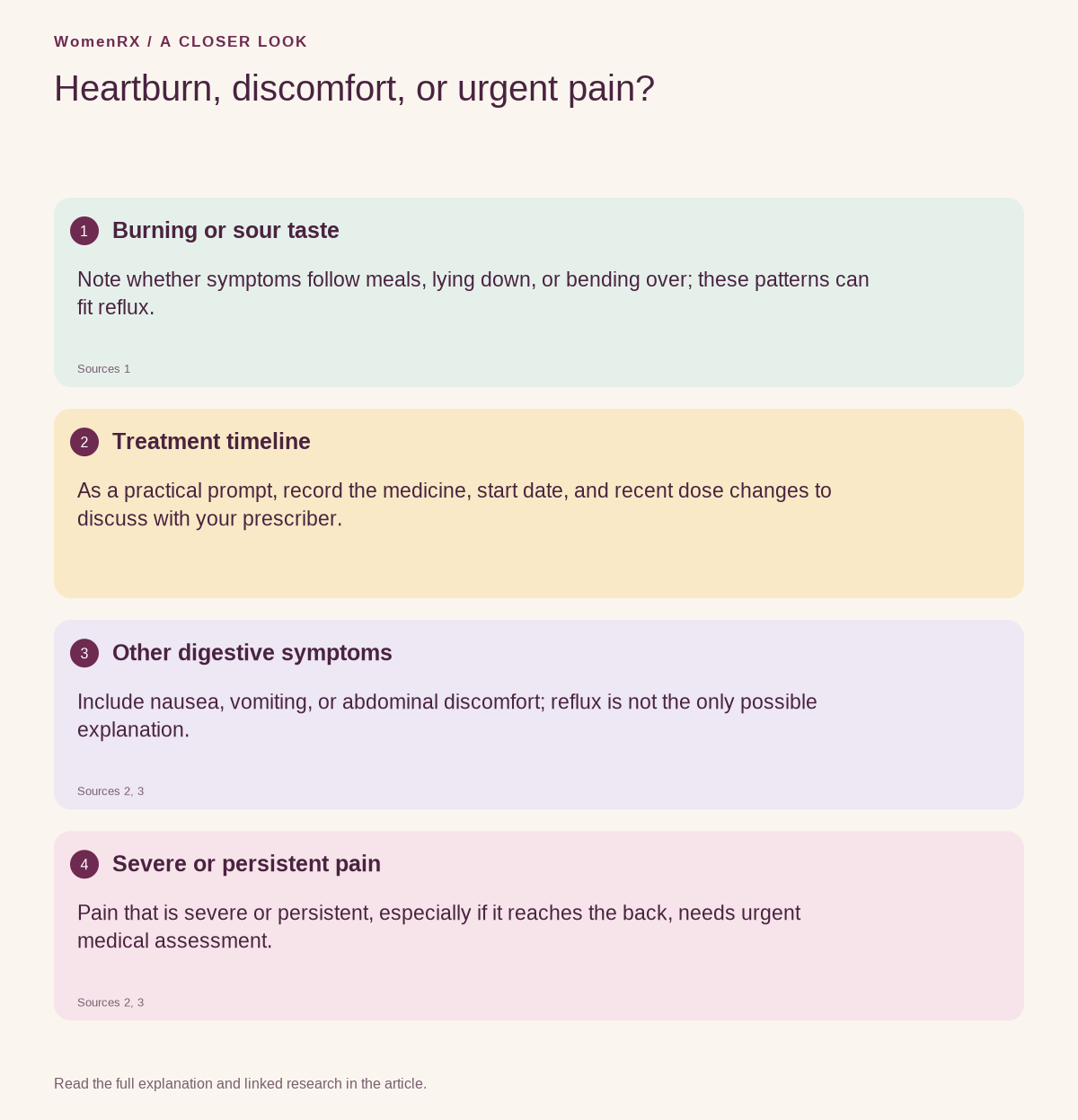
Heartburn, discomfort, or urgent pain?
Burning or sour taste: Note whether symptoms follow meals, lying down, or bending over; these patterns can fit reflux.1
Treatment timeline: As a practical prompt, record the medicine, start date, and recent dose changes to discuss with your prescriber.
Other digestive symptoms: Include nausea, vomiting, or abdominal discomfort; reflux is not the only possible explanation.23
Severe or persistent pain: Pain that is severe or persistent, especially if it reaches the back, needs urgent medical assessment.23
Read the figure as text
Use the symptom pattern to decide what information to record and when abdominal pain needs prompt assessment.- Burning or sour taste: Note whether symptoms follow meals, lying down, or bending over; these patterns can fit reflux.1
- Treatment timeline: As a practical prompt, record the medicine, start date, and recent dose changes to discuss with your prescriber.
- Other digestive symptoms: Include nausea, vomiting, or abdominal discomfort; reflux is not the only possible explanation.23
- Severe or persistent pain: Pain that is severe or persistent, especially if it reaches the back, needs urgent medical assessment.23
More questions, answered
Does reflux mean I need to stop my GLP-1 medicine?
Not by itself. The evidence shows an increased average risk of GERD in trials, not that every case is caused by treatment or that stopping is the right response. Share the symptom pattern with your prescriber before changing a prescribed medicine. 4 1
Do we know whether women are more likely to get reflux on these medicines?
The pooled trial result cited here doesn’t answer whether reflux risk differs by sex. It gives an overall estimate across the included trial populations, not a women-specific estimate. 4
Sources you can check
- Heartburn and acid reflux - NHSAccessed 2026-09-25Return to first citation
- WEGOVY (SEMAGLUTIDE) INJECTION, SOLUTION WEGOVY (SEMAGLUTIDE) TABLET [NOVO NORDISK PHARMACEUTICAL INDUSTRIES, LP] | US prescribing information and patient instructionsAccessed 2026-09-25Return to first citation
- OZEMPIC (ORAL SEMAGLUTIDE) TABLET RYBELSUS (ORAL SEMAGLUTIDE) TABLET [NOVO NORDISK PHARMACEUTICAL INDUSTRIES, LP] | US prescribing information and patient instructionsAccessed 2026-09-25Return to first citation
- Glucagon-Like Peptide-1 Receptor Agonists and Gastrointestinal Adverse Events: A Systematic Review and Meta-Analysis.Chiang CH, Jaroenlapnopparat A, Colak SC, Yu CC, Xanthavanij N, Wang TH, See XY, Lo SW, Ko A, Chang YC, Song J, Hsia YP, Chiang CH. · Gastroenterology · 2025Return to first citation