GLP-1 Medicines, Weight Loss, and Fertility
Stories of unexpected pregnancies don’t prove these medicines directly boost fertility, but weight and cycle changes can matter, especially with PCOS.
The “Ozempic babies” stories aren’t proof that semaglutide directly increases fertility. Weight loss and improved insulin-related health may help ovulation for some people with PCOS, but research on pregnancy outcomes is still limited, particularly for semaglutide. If pregnancy isn’t your goal, consider how changing cycles and your specific medicine affect contraception; if it is, plan when to stop treatment with your prescriber. 2 3 5
Why pregnancy stories can happen
A person may become pregnant while taking a GLP-1 medicine without the medicine itself acting as a fertility drug. One plausible explanation is indirect: weight loss and better metabolic health may ease some of the hormonal disruptions that interfere with ovulation, especially in people with PCOS. If ovulation becomes more regular, conception may become more likely. That pathway is plausible, but it doesn’t show that a GLP-1 medicine directly improves fertility. 3 5
PCOS can involve insulin resistance and higher insulin levels, which are linked with hormonal changes that can disrupt follicle development and ovulation. In people with excess adiposity, related changes in sex hormones may add to that disruption. These connections help explain why changes in weight or insulin sensitivity could affect cycles. They don’t mean that everyone with PCOS will ovulate more often after weight loss, or that a particular medicine will cause a pregnancy. 4 5
What the fertility research actually shows
The evidence is encouraging in places, but it’s not strong enough to call GLP-1 medicines fertility treatments. Reviews report improved menstrual regularity, ovulation, or pregnancy rates in some studies of people with PCOS. Much of that research involves other GLP-1 medicines, small or varied groups, and treatments combined with metformin. Results for those medicines can’t automatically be applied to semaglutide or tirzepatide. 4 5
A small prospective study followed 20 people with PCOS, obesity, and prediabetes who took semaglutide with metformin. The researchers reported that 60% became pregnant during follow-up. Because the study was small and had no comparison group, it can’t show whether the pregnancies resulted from semaglutide, metformin, weight loss, other factors, or a combination. It also can’t establish a typical pregnancy rate for someone taking semaglutide. 2
A 2026 evidence review describes semaglutide findings as sparse and says PCOS-specific evidence for tirzepatide is lacking. That matters: reports about weight loss, changes in cycles, or pregnancies are signals for further study, not proof of a direct fertility effect. 3
If you don’t want to become pregnant
Don’t assume irregular or infrequent periods mean pregnancy is impossible. If cycles change during weight loss, ovulation may also change, and a previously unpredictable cycle may not be a dependable guide to when you can conceive. That possibility is especially relevant if you have PCOS. 4 5
Contraception questions can depend on which medicine you take. One review says semaglutide does not alter absorption of oral contraceptives, while other reviews flag a possible concern about oral contraceptive effectiveness with tirzepatide. If you use tirzepatide, ask your prescriber or pharmacist whether your contraceptive method needs any special consideration. Don’t assume the two medicines have identical effects. 5 6
If you’re thinking about pregnancy
Pregnancy intentions change the medication conversation. Human pregnancy safety data for semaglutide are limited, and animal studies described in prescribing information found potential fetal risks. Reviews recommend stopping semaglutide before trying to conceive, commonly around two months beforehand; they also describe a preconception washout for tirzepatide. Confirm the timing for your specific medicine and health needs with the clinician managing it before you start trying. 1 5 6
If you find out you’re pregnant while taking one of these medicines, contact the prescriber promptly to discuss what to do next. Limited human data and animal findings don’t tell you what will happen in an individual pregnancy, so an exposure alone cannot establish harm. 1 5
The practical takeaway is straightforward: pregnancy stories may reflect changes in weight, metabolism, or ovulation, particularly with PCOS, but they don’t establish that GLP-1 medicines directly increase fertility. Make contraception or conception planning part of the conversation before your goals change.
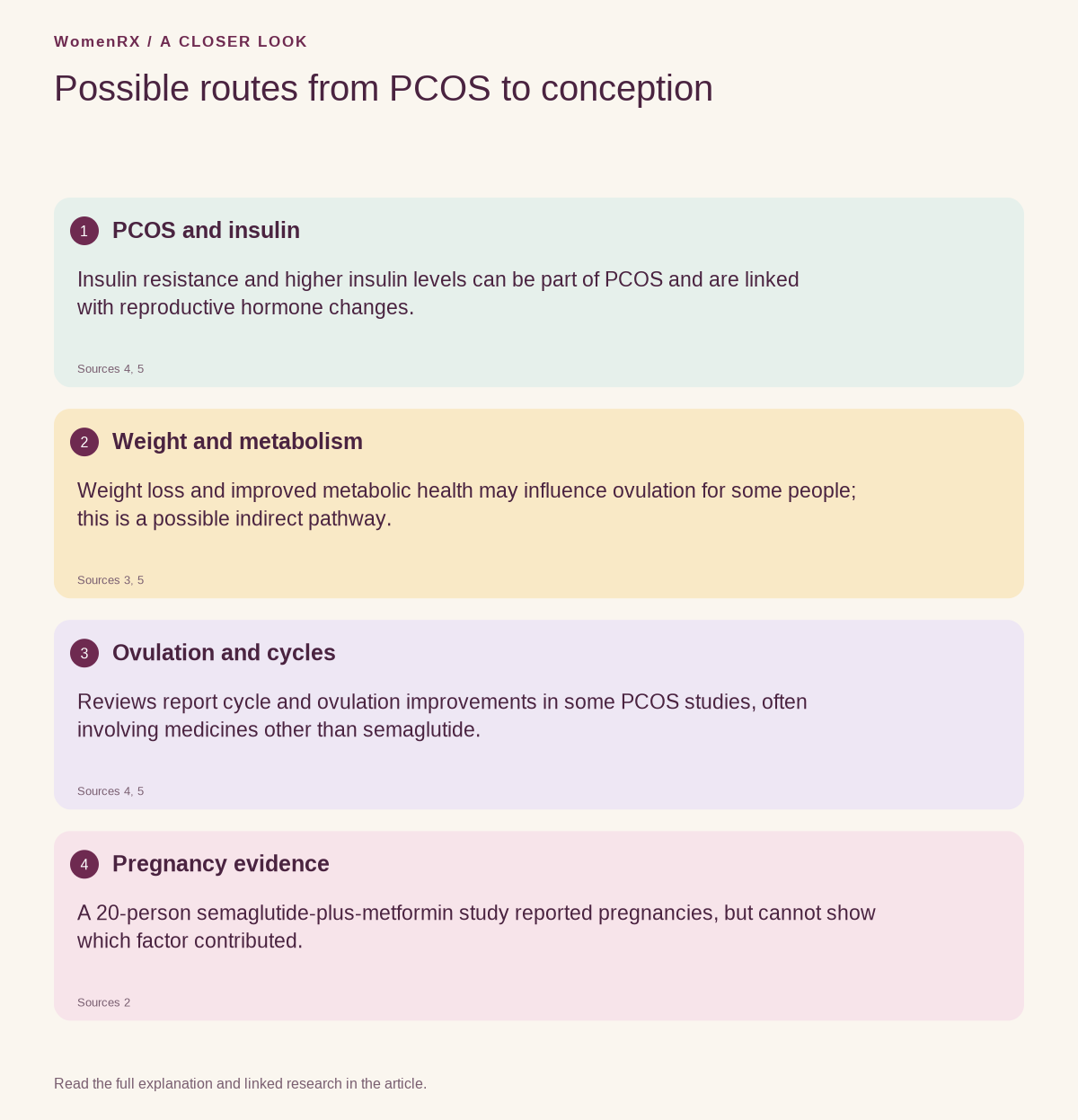
Possible routes from PCOS to conception
PCOS and insulin: Insulin resistance and higher insulin levels can be part of PCOS and are linked with reproductive hormone changes.45
Weight and metabolism: Weight loss and improved metabolic health may influence ovulation for some people; this is a possible indirect pathway.35
Ovulation and cycles: Reviews report cycle and ovulation improvements in some PCOS studies, often involving medicines other than semaglutide.45
Pregnancy evidence: A 20-person semaglutide-plus-metformin study reported pregnancies, but cannot show which factor contributed.2
Read the figure as text
The figure separates established PCOS-related metabolic connections from the still-uncertain claim that a GLP-1 medicine directly increases fertility.- PCOS and insulin: Insulin resistance and higher insulin levels can be part of PCOS and are linked with reproductive hormone changes.45
- Weight and metabolism: Weight loss and improved metabolic health may influence ovulation for some people; this is a possible indirect pathway.35
- Ovulation and cycles: Reviews report cycle and ovulation improvements in some PCOS studies, often involving medicines other than semaglutide.45
- Pregnancy evidence: A 20-person semaglutide-plus-metformin study reported pregnancies, but cannot show which factor contributed.2
More questions, answered
Does semaglutide treat infertility?
Current evidence doesn’t establish semaglutide as an infertility treatment. One small study reported pregnancies among participants with PCOS taking semaglutide and metformin, but without a comparison group it can’t determine what caused them or predict an individual’s chances. 2 3
Are semaglutide and tirzepatide the same for contraception?
Not necessarily. A review says semaglutide does not alter oral contraceptive absorption, while reviews flag a possible concern with tirzepatide. Ask about your specific medicine and contraceptive method rather than assuming the advice is interchangeable. 5 6
Sources you can check
- OZEMPIC (ORAL SEMAGLUTIDE) TABLET RYBELSUS (ORAL SEMAGLUTIDE) TABLET [NOVO NORDISK PHARMACEUTICAL INDUSTRIES, LP] | US prescribing information and patient instructionsAccessed 2026-09-25Return to first citation
- Effect of semaglutide with metformin for weight loss and fertility in polycystic ovary syndrome (PCOS) patients with obesity: A pilot prospective study.Bolek T, Turňová P, Janošova S, Péč MJ, Ságová I, Nagy N, Jurica J, Mokáň M, Samoš M. · Clinical nutrition ESPEN · 2026Return to first citation
- Incretin-Based Anti-obesity Medications in Polycystic Ovary Syndrome: The Evidence Map.Jensterle M, Janez A. · Drugs · 2026Return to first citation
- The potential role of incretin-based therapies for polycystic ovary syndrome: a narrative review of the current evidence.Abdalla MA, Deshmukh H, Atkin S, Sathyapalan T. · Therapeutic advances in endocrinology and metabolism · 2021Return to first citation
- GLP-1 Receptor Agonists and Fertility: What Is Known So Far?Becker AS, Castilhos JP, Shugair SAS, Colombo T, Hentschke M-. · JBRA assisted reproduction · 2026Return to first citation
- The effects of glucagon-like peptide-1 receptor agonists on fertility, contraception, and pregnancy: clinical perspectives.Dilbaz B, Ateş Ç. · The European journal of contraception & reproductive health care : the official journal of the European Society of Contraception · 2026Return to first citation