GLP-1 Weight Loss and Muscle: What the Evidence Shows
Lean mass often falls during medication-related weight loss, but that measurement alone can’t tell you whether your strength or everyday function has changed.
Some studies find a reduction in lean mass during weight loss with GLP-1 medicines, but the amount varies and lean mass isn’t the same as muscle. It includes other nonfat tissues, too. Research measuring strength and physical function is much thinner, so a body-composition result alone can’t show whether you’ve lost meaningful muscle function. 3 6 4
What “lean mass” measures
When a study reports a change in lean mass, it’s not measuring muscle alone. Lean mass includes muscle, bone, organs, and other nonfat tissue. Body-composition methods estimate these components in different ways; the result is a useful measure of body composition, not a direct test of how strong you are. 6
That distinction matters during weight loss. The scale can’t tell you what tissue changed, and a lean-mass reading can’t tell you by itself whether you can still climb stairs, carry groceries, or get up from a chair as well as before. Those are different questions from how much lean mass a scan or other test estimates. 1 6
What the studies find, and why results differ
A 2026 meta-analysis of seven randomized trials in 821 people with obesity found that, compared with placebo, treatment was associated with an average 1.74 kg reduction in lean mass. In the same analysis, lean mass made up a larger share of total body weight after treatment, increasing by 1.81 percentage points. These findings can coexist: the estimated amount of lean mass can decrease while fat mass falls more, making lean mass a larger proportion of what remains. 3
That average isn’t a prediction for an individual. The trials differed in medication and follow-up, and the pooled estimates for absolute and percentage lean-mass change were highly inconsistent across studies. A separate meta-analysis limited to three trials and 171 adults with overweight or obesity, without type 2 diabetes, found a smaller average difference from control: 0.78 kg more lean-mass reduction with treatment. The narrower set of included studies helps explain why its estimate differs; neither result establishes one expected amount for everyone. 3 6
A broader review of randomized and real-world studies also found lower lean or fat-free mass with GLP-1 medicines, but rated the evidence as low certainty. It concluded that whether these changes cause meaningful problems with muscle function or physical performance remains uncertain. 4
So, “some lean mass may be lost” is better supported than “the medication causes a particular amount of muscle loss.” Results depend on which participants and medicines were studied, how long they were followed, and how body composition was measured. 3 4 6
Mass isn’t the same as strength
To find out whether a change matters in daily life, researchers need to measure more than lean mass. Tests such as grip strength or repeated chair stands assess aspects of strength or function. But these outcomes have been measured in far fewer studies than body composition. 2 4
For example, a review of 12 studies in adults with metabolic dysfunction-associated steatotic liver disease found that three studies assessed strength, using grip or sit-to-stand tests. The review found no evidence of worsening on those measures despite weight loss. That’s encouraging, but it doesn’t settle the question for everyone: the review focused on people with this liver condition, and its authors noted small samples and different measurement methods. 2
If you’re concerned about your own progress, pay attention to what you can do as well as the number on a scan or scale. Notice whether everyday activities feel newly difficult, such as rising from a chair or carrying a usual load. If they do, tell your care team; that information addresses function more directly than a lean-mass estimate alone. 2 6
What we know about women and menopause
The available findings don’t establish that GLP-1 medicines affect muscle differently in women and men, or that the effect changes at menopause. Some studies include women, but the reviews here don’t provide reliable menopause-specific results or establish a different medication effect by sex. One review in people with liver disease reported that women made up about half of some study groups, but it did not establish a separate outcome for women. 2 6
That means menopause-related changes in muscle shouldn’t be used to assume that a woman taking one of these medicines will lose more muscle. If you’re postmenopausal, older, or already noticing reduced strength, those details are reasonable to raise with your care team, but current findings don’t give a menopause-specific estimate of medication-related change. 6
Useful questions for your care team
You might ask:
- “Are we tracking only my weight, or also how my strength and daily function are changing?”
- “If a body-composition test shows lower lean mass, what can that test tell us, and what can’t it tell us?”
- “Given how I’m eating, feeling, and moving, would nutrition or physical-activity support make sense for me?”
Nutrition and activity are often included alongside these medicines, but studies haven’t established one best plan to preserve muscle for every person. A review of randomized trials found that the evidence on optimal nutrition strategies remains limited, including on protein needs. That makes individualized discussion more useful than assuming a single plan works for all. 5
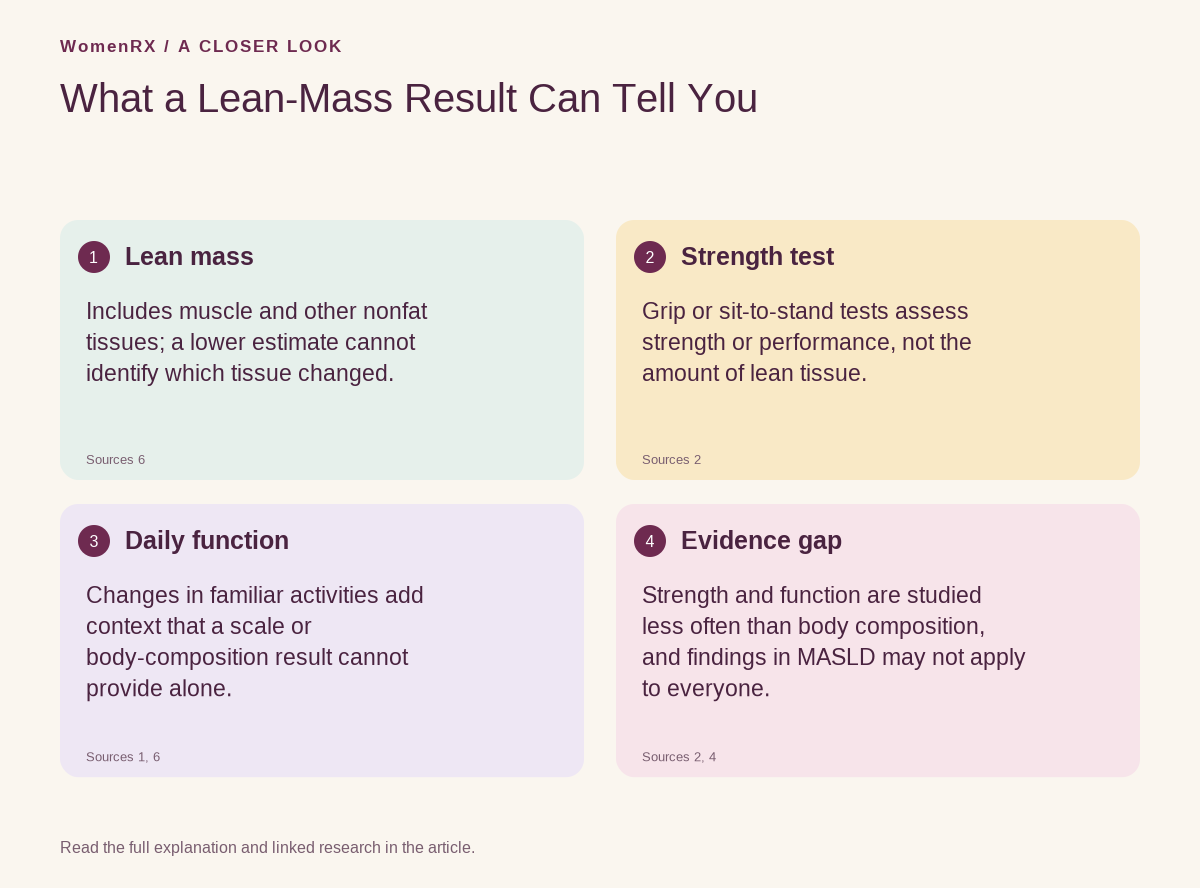
What a Lean-Mass Result Can Tell You
Lean mass: Includes muscle and other nonfat tissues; a lower estimate cannot identify which tissue changed.6
Strength test: Grip or sit-to-stand tests assess strength or performance, not the amount of lean tissue.2
Daily function: Changes in familiar activities add context that a scale or body-composition result cannot provide alone.16
Evidence gap: Strength and function are studied less often than body composition, and findings in MASLD may not apply to everyone.24
Read the figure as text
A body-composition estimate, a strength test, and everyday function answer related but different questions.- Lean mass: Includes muscle and other nonfat tissues; a lower estimate cannot identify which tissue changed.6
- Strength test: Grip or sit-to-stand tests assess strength or performance, not the amount of lean tissue.2
- Daily function: Changes in familiar activities add context that a scale or body-composition result cannot provide alone.16
- Evidence gap: Strength and function are studied less often than body composition, and findings in MASLD may not apply to everyone.24
More questions, answered
Does a lower lean-mass result mean I have sarcopenia?
Not by itself. Lean mass includes more than muscle, and an estimate of lean mass doesn’t directly measure strength or physical performance. Those outcomes need to be considered separately. 6 4
Is there a proven protein target for people taking these medicines?
The reviewed trials don’t establish one optimal protein requirement for everyone taking GLP-1 or dual GIP/GLP-1 medicines. Ask your care team what makes sense for your health, appetite, and usual intake rather than relying on a universal target. 5
Sources you can check
- Body Weight: MedlinePlusAccessed 2026-09-25Return to first citation
- Effects of GLP-1 Receptor Agonists on Muscle Mass, Strength, and Quality in MASLD: A Systematic Review.Iorra F, Jayakar T, Yee M, Thursz MR, Schaan BD, Manousou P. · Liver international : official journal of the International Association for the Study of the Liver · 2026Return to first citation
- Effect of GLP-1 receptor agonists at doses for obesity management on muscle health: systematic review and meta-analysis of randomized controlled trials (RCTs).Laverde LP, Muñoz-Velandia OM, Alfonso D, Gómez Medina AM. · International journal of obesity (2005) · 2026Return to first citation
- GLP-1 Receptor Agonists and Musculoskeletal Outcomes: A Systematic Literature Review and Meta-Analysis.Beaudart C, Malréchauffé Y, van Heden S, Sanchez-Rodriguez D, Scheen A, Bruyère O, Mobasheri A, Duque G, Rizzoli R, Reginster JY, Thiyagarajan JA. · Drugs · 2026Return to first citation
- Dietary Strategies and Nutritional Management in Patients Receiving GLP-1 and Dual GIP/GLP-1 Receptor Agonists as Adjuncts to Lifestyle Interventions: A Systematic Review of Randomised Clinical Trials.de Paulo RS, Bonifácio DB, de Carvalho MHL, Bressan J. · Diabetes, obesity & metabolism · 2026Return to first citation
- The Impact of Glucagon-like Peptide-1 (GLP-1) Receptor Agonists on Body Composition in Individuals with Overweight and Obesity: A Systematic Review and Meta-Analysis.Woźniak M, Tarcz Z, Pyczek G, Bogacka J, Diniejko A, Kuryłowicz A, Mamcarz A, Śliż D. · Journal of clinical medicine · 2026Return to first citation