Loose Skin After GLP-1 Weight Loss: What to Expect
Loose skin can follow substantial weight loss, but current evidence points to changing body volume rather than a proven skin-damaging effect unique to GLP-1 medicines.
Loose skin may become more noticeable after substantial weight loss because fat and some lean tissue beneath the skin decrease, while the skin may not contract at the same pace. This change isn’t unique to semaglutide, liraglutide, or tirzepatide. Age may affect how facial skin responds, but individual results are hard to predict. Procedures are options to discuss, not guaranteed fixes. 3
Why skin can look looser as weight changes
Skin, fat, and muscle all contribute to the shape and support of the body. When weight drops substantially, the tissue beneath the skin can shrink faster than the skin tightens. A 2026 review describes this in the face and body after large weight losses: reduced facial fat can leave hollows or laxity, while changes in the trunk and limbs can leave folds or redundant skin. The review notes that this appearance isn’t specific to semaglutide; weight loss itself can produce similar changes. 3
That makes loose skin different from a demonstrated direct skin injury caused by a GLP-1 medicine. Current discussion links the visible change mainly to weight loss and shifts in body composition, rather than establishing a unique drug effect on skin. The degree and location vary from person to person. In its discussion of facial changes, the review suggests that older skin may have less elastic recoil, but it doesn’t give a reliable way to predict an individual outcome. 3
What to consider before a procedure
The visible changes described after substantial weight loss can involve both loose skin and loss of the volume beneath it. That distinction matters when you’re weighing options: it helps you describe whether a fold of skin, a change in shape, or both are bothering you. 3
Your pregnancy history or menopause may be context you want to mention when describing changes in your body. Neither provides a reliable prediction of your loose-skin outcome here, and sex alone doesn’t determine it.
If you’re still losing weight, the appearance may continue to change along with your body. If you’re concerned, ask the clinician who manages your weight treatment what to expect as your weight changes and whether the skin concern needs a separate assessment. For example, mention whether folds are causing repeated irritation or interfering with movement, clothing, or daily activities. That helps frame the question around function as well as appearance.
Procedures: possible benefit, real tradeoffs
For some people, body-contouring surgery is worth discussing after major weight loss. A systematic review of nine studies in adults after bariatric and body-contouring surgery reported improvements in appearance, wellbeing, physical function, and quality of life. It also found reports of wound-healing problems and dissatisfaction related to scars or contour changes. The studies were too varied to combine in a statistical analysis, so these findings don’t guarantee a particular result for you, especially if your weight loss is medication-associated rather than after bariatric surgery. 2
A small randomized study offers a narrower example: among 76 adults with abdominal skin laxity after losing at least 20 kg, those who had a helium-plasma device added to abdominal contouring surgery reported higher satisfaction and excess-skin appraisal scores at six months, one year, and two years than those who had surgery alone. Independent surgeons also gave the add-on group higher appearance ratings; the reported summary doesn’t specify when those ratings were made. The authors described it as a pilot study. It tested an add-on during surgery, not a stand-alone treatment, and doesn’t establish that the device is right for everyone or for other body areas. 1
A useful discussion is what bothers you most, whether the concern is functional or cosmetic, what improvement is realistic, and what recovery, scarring, and possible complications mean for your situation. A consultation can clarify options; it doesn’t commit you to a procedure.
A practical way to think about your next step
If the change is mainly about appearance and isn’t affecting daily life, you may prefer to give your body time to change before deciding whether to pursue a procedure. If skin folds are uncomfortable or interfere with everyday activities, describe the specific problem to your care team and ask whether a skin or surgical assessment makes sense. Either way, loose skin after weight loss isn’t evidence that you’ve done something wrong, and it doesn’t by itself show that your medication is harming your skin.
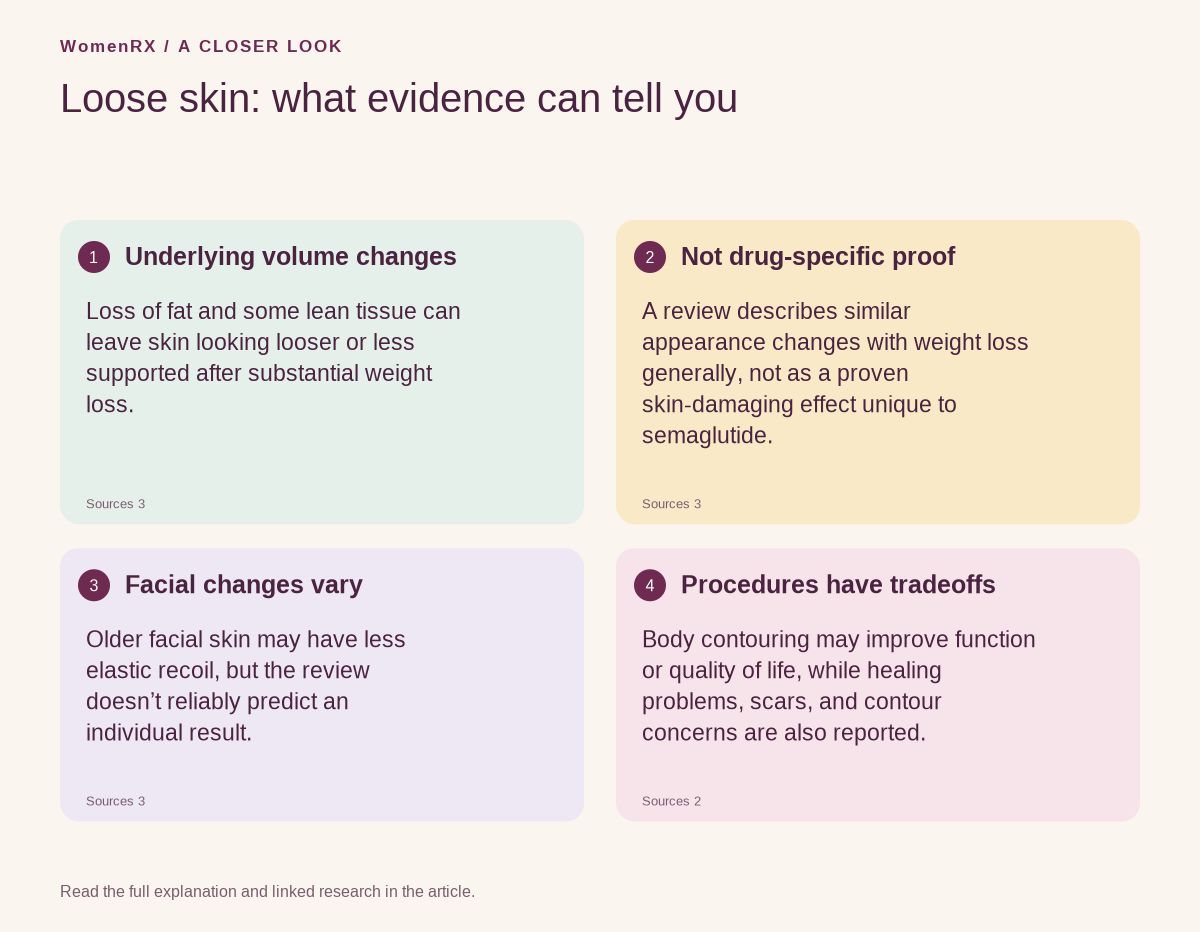
Loose skin: what evidence can tell you
Underlying volume changes: Loss of fat and some lean tissue can leave skin looking looser or less supported after substantial weight loss.3
Not drug-specific proof: A review describes similar appearance changes with weight loss generally, not as a proven skin-damaging effect unique to semaglutide.3
Facial changes vary: Older facial skin may have less elastic recoil, but the review doesn’t reliably predict an individual result.3
Procedures have tradeoffs: Body contouring may improve function or quality of life, while healing problems, scars, and contour concerns are also reported.2
Read the figure as text
Separate the weight-loss changes described in research from what remains uncertain and what procedural studies actually tested.- Underlying volume changes: Loss of fat and some lean tissue can leave skin looking looser or less supported after substantial weight loss.3
- Not drug-specific proof: A review describes similar appearance changes with weight loss generally, not as a proven skin-damaging effect unique to semaglutide.3
- Facial changes vary: Older facial skin may have less elastic recoil, but the review doesn’t reliably predict an individual result.3
- Procedures have tradeoffs: Body contouring may improve function or quality of life, while healing problems, scars, and contour concerns are also reported.2
More questions, answered
Does loose skin mean my GLP-1 medicine is damaging my skin?
Loose skin alone can’t tell you that. A review describes loose or hollowed appearance after substantial weight loss and doesn’t establish a direct skin-damaging effect unique to semaglutide or other GLP-1 medicines. 3
Can surgery improve loose skin after weight loss?
Body-contouring surgery may improve appearance, function, and quality of life for some adults after major weight loss, but evidence is varied and results aren’t guaranteed. Studies also report wound-healing problems and concerns about scars or contour changes. 2
Sources you can check
- Efficacy of Renuvion Helium Plasma to Improve the Appearance of Loose Skin in Patients Undergoing Abdominoplasty After Massive Weight Loss: A Prospective Controlled Randomized Study.Barone M, Salzillo R, De Bernardis R, Brunetti B, Tenna S, Persichetti P. · Aesthetic plastic surgery · 2025Return to first citation
- Quality of life among adults following bariatric and body contouring surgery: a systematic review.Gilmartin J, Bath-Hextall F, Maclean J, Stanton W, Soldin M. · JBI database of systematic reviews and implementation reports · 2016Return to first citation
- Anti-Obesity Medications in Longevity and Aesthetic Medicine.Bijoch J. · Journal of clinical medicine · 2026Return to first citation