Can You Reduce Loose Skin During GLP-1 Weight Loss?
You can support your strength and nutrition during weight loss, but those habits aren’t proven ways to prevent loose skin.
Loose skin can become more noticeable as weight loss reduces the fat that once supported the skin, including in the face. There’s no reliable way to predict your individual skin changes from these studies. Eating enough and doing resistance exercise can help protect nutrition and muscle during GLP-1 treatment, but that’s a different goal from preventing skin laxity. 36
Why skin can look different as weight changes
As fat is lost beneath the skin, the shape and fullness of an area can change. In the face, that may show up as hollowing around the cheeks or temples, more visible folds, or skin that looks less firm. Clinicians have described these changes in people losing weight with GLP-1-based medicines, but their experience-based guidance is focused on the face and neck, not a prediction of what will happen to your skin elsewhere. 3
This distinction matters: less fullness isn’t always the same thing as more loose skin. A cheek can look different because it has lost volume beneath the skin, because the skin itself looks less firm, or both. Weight loss also isn’t confined to one chosen area, so you can’t direct it away from your face with a particular exercise or meal plan. 3
What you can work on, and what those habits can’t promise
A practical plan separates two goals that are often bundled together: taking care of your body during weight loss and trying to control exactly how your skin will look. The first has useful guidance. For the second, the available GLP-1 aesthetic literature doesn’t establish that a particular eating pattern, strength routine, or rate of weight loss prevents loose skin. That’s a limit on what you can promise yourself, not a reason to skip habits that support your health. 36
Make room for nutritious food. GLP-1 treatment can change how much you feel like eating. A joint advisory from four professional societies recommends regular meals, adequate fluids, and varied foods that supply protein and other nutrients. For example, if a large meal feels unappealing, a smaller meal with eggs or yogurt and fruit may be more manageable than routinely missing meals. The advisory addresses nutrient adequacy and other health needs during treatment; it doesn’t show that any menu keeps skin tight. 6
Train for strength, not a skin guarantee. Some weight lost during GLP-1 treatment can include lean mass. The same advisory says structured resistance or mixed resistance-and-aerobic training helps preserve lean mass during weight reduction, while protein alone is unlikely to do the same job without strength training. That gives exercise a clear purpose even if your skin changes: supporting the muscle and strength beneath it. It doesn’t establish that training prevents skin laxity. 36
Don’t choose a pace solely on a skin claim. Rapid, large weight loss is discussed alongside visible soft-tissue changes in aesthetic reviews. But an association isn’t a tested rule that slowing weight loss by a certain amount will prevent loose skin. If your appetite has fallen so much that regular meals are difficult, that’s worth raising with your prescribing team as a nutrition and treatment issue, rather than trying to calculate a supposedly skin-safe rate. 56
What about creams, supplements, or procedures?
Be wary of a product that promises to stop loose skin as you lose weight. A review of topical skincare discusses potential improvements in skin quality and laxity, but its abstract doesn’t establish that a cream prevents loose skin in people starting GLP-1 treatment. Nor does an ingredient marketed for weight loss become a skin treatment: the NIH notes that evidence for many weight-loss supplement ingredients is limited or inconsistent, and that results for individual ingredients may not apply to products combining them. 41
If changes in your face or neck bother you, an aesthetic specialist can help distinguish loss of underlying volume from skin laxity before you consider a procedure. Published GLP-1-specific guidance on nonsurgical facial and neck treatments is based largely on clinician experience; the authors say these treatments haven’t been widely studied in this population. That’s a reason to ask what a proposed treatment is meant to change and what evidence supports it, rather than assuming every change calls for ‘skin tightening.’ 3
If pregnancy or contraception is part of your plan
Your exact medicine matters here. Tirzepatide, sold for weight management as Zepbound, can reduce the effectiveness of oral hormonal contraceptives because it delays stomach emptying. Its US prescribing information advises switching to a non-oral contraceptive method or adding a barrier method for four weeks after starting Zepbound and for four weeks after each dose increase; it says non-oral hormonal contraceptives should not be affected. If you use an oral contraceptive or are planning a pregnancy, bring that up when you discuss your weight-management medicine. Don’t assume instructions for tirzepatide apply unchanged to semaglutide or liraglutide. 7
The useful target is a plan you can live with: enough food to meet your needs, movement that helps you keep strength, and realistic expectations about appearance. Your weight alone won’t tell you how much of a change is fat, muscle, or water, and it can’t tell you how your skin will respond. 26
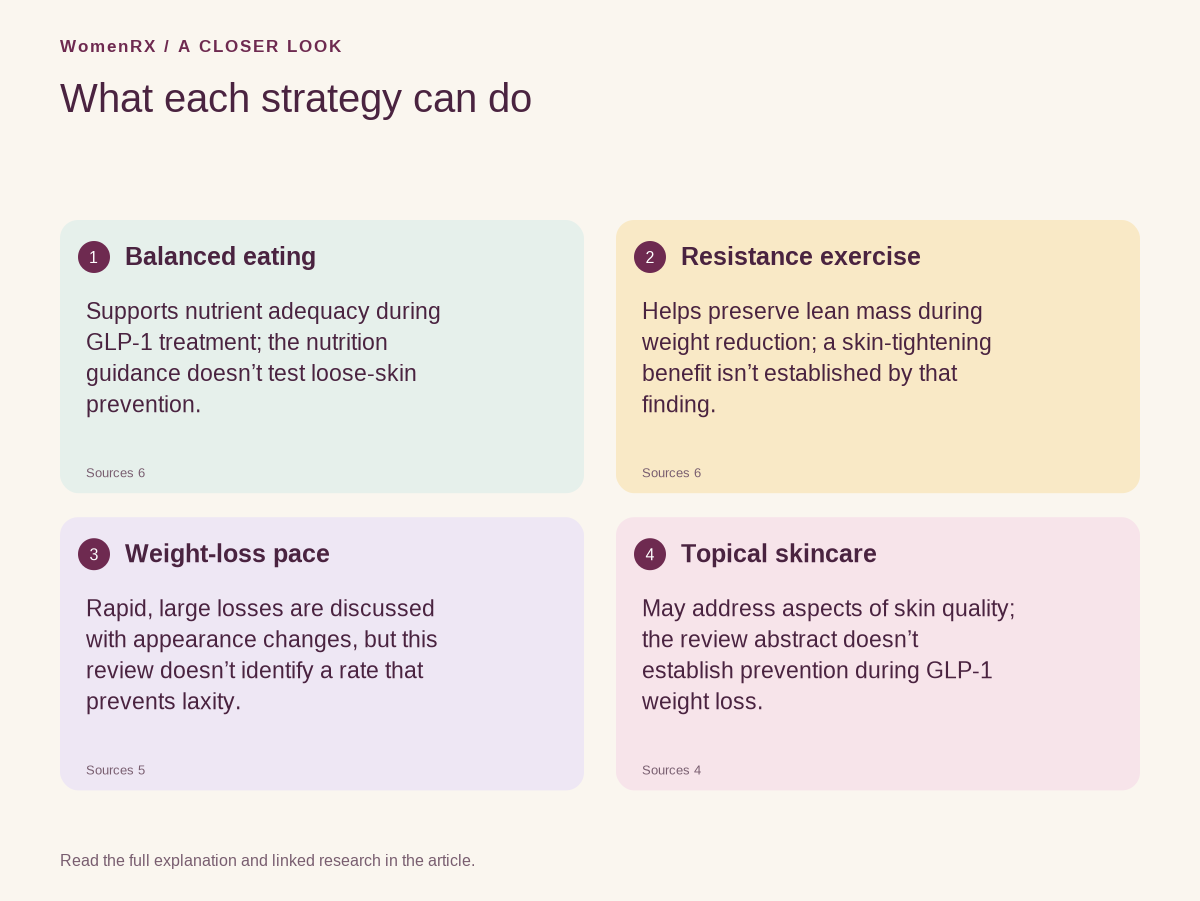
What each strategy can do
Balanced eating: Supports nutrient adequacy during GLP-1 treatment; the nutrition guidance doesn’t test loose-skin prevention.6
Resistance exercise: Helps preserve lean mass during weight reduction; a skin-tightening benefit isn’t established by that finding.6
Weight-loss pace: Rapid, large losses are discussed with appearance changes, but this review doesn’t identify a rate that prevents laxity.5
Topical skincare: May address aspects of skin quality; the review abstract doesn’t establish prevention during GLP-1 weight loss.4
Read the figure as text
A guide to the difference between supporting health during weight loss and preventing loose skin.- Balanced eating: Supports nutrient adequacy during GLP-1 treatment; the nutrition guidance doesn’t test loose-skin prevention.6
- Resistance exercise: Helps preserve lean mass during weight reduction; a skin-tightening benefit isn’t established by that finding.6
- Weight-loss pace: Rapid, large losses are discussed with appearance changes, but this review doesn’t identify a rate that prevents laxity.5
- Topical skincare: May address aspects of skin quality; the review abstract doesn’t establish prevention during GLP-1 weight loss.4
More questions, answered
Is loose skin a side effect unique to GLP-1 medicines?
The visible changes described during GLP-1 treatment include loss of fat beneath the skin as weight comes off. The experience-based facial guidance doesn’t establish that the medicine itself causes a unique form of loose skin apart from weight-loss-related changes. 3
Sources you can check
- Dietary Supplements for Weight Loss - Health Professional Fact SheetAccessed 2026-09-25Return to first citation
- Body Weight: MedlinePlusAccessed 2026-09-25Return to first citation
- Nonsurgical Aesthetic Treatment of the Face and Neck in GLP-1 Receptor Agonist Weight Loss Patients: Experience-Based Considerations.Moradi A, Denkova R, Holcomb K, Rossi A, Ashourian N. · Aesthetic surgery journal. Open forum · 2026Return to first citation
- The Potential Role of Topical Skincare Approaches After Glucagon-like Peptide-1 Receptor Agonist Use and Rapid Weight Loss.Shridharani SM, Kourosh AS, Saltzman E, Carver L, Makino ET, Cheng T, Maitra P. · Dermatologic surgery : official publication for American Society for Dermatologic Surgery [et al.] · 2026Return to first citation
- Anti-Obesity Medications in Longevity and Aesthetic Medicine.Bijoch J. · Journal of clinical medicine · 2026Return to first citation
- Nutritional priorities to support GLP-1 therapy for obesity: four-society joint advisory2025Return to first citation
- ZEPBOUND (TIRZEPATIDE) INJECTION, SOLUTION ZEPBOUND (TIRZEPATIDE) INJECTION, SOLUTION ZEPBOUND KWIKPEN (TIRZEPATIDE) INJECTION, SOLUTION [ELI LILLY AND COMPANY] | US prescribing information and patient instructionsAccessed 2026-09-25Return to first citation