Loose Skin After Weight Loss: What Can Change?
Weight loss can change both the skin and what lies beneath it, so the most useful option depends on which change is bothering you.
Loose-looking skin during GLP-1 treatment isn’t always excess skin. Loss of fat volume can change the shape of the face or breasts, while larger folds of skin may cause a different problem. The amount of weight lost and age-related skin properties can influence how these changes look. The cited studies do not establish a way to predict or prevent excess skin for an individual GLP-1 user. 567 Exercise, skin products, and surgery address different things; none is a guaranteed fix. 567
First, identify what looks or feels different
A change in contour isn’t necessarily a change in the skin alone. After substantial weight loss, studies of facial appearance describe both reduced fat volume, particularly in the mid-cheek, and increased laxity around the neck. A face that looks less full may therefore call for a different conversation than skin that gathers in a fold. Most of the research in that review involved people after bariatric interventions, so it cannot tell you how likely either change is during treatment with semaglutide, liraglutide, or tirzepatide. 7
The distinction matters elsewhere on the body, too. Research on breasts after major weight loss describes a combination of reduced volume and excess skin. An abdominal fold may instead be bothersome because it affects movement or causes skin problems. Those are examples of different concerns, not stages everyone goes through. 68
What influences how much loose skin you see?
The amount of weight lost matters to the change in underlying volume. Skin also varies: a clinician consensus notes that age-related differences in elasticity and skin thickness can affect how facial skin contracts as volume changes. These findings do not yield an individual prediction for someone taking a GLP-1 medication. 567
Can you prevent loose skin by losing weight more slowly?
The cited consensus does not test whether losing weight more slowly helps skin contract, so it cannot identify a pace that guarantees prevention. A clinician consensus on appearance changes during medication-driven weight loss calls for assessing each body region individually and says that the best timing for some proposed cosmetic treatments remains uncertain. It is expert opinion, not a trial showing that a particular pace or early treatment prevents loose skin. 5
Studies of weight-loss supplements involving postmenopausal women report weight or body-fat outcomes, not loose-skin outcomes. They cannot tell you whether menopause changes skin outcomes after weight loss. 1
What each option can realistically address
Exercise is about strength and body composition, not removing a skin fold. Your weight includes muscle as well as fat, bone, and water, so the number on the scale doesn’t describe every physical change. A consensus on medication-driven weight loss recommends attention to resistance training and nutrition, particularly because muscle loss is a concern. It does not demonstrate that training prevents or tightens excess skin. That makes strength a worthwhile goal to consider on its own terms, rather than a test of whether you’ve done enough to protect your skin. 35
Creams need a more specific claim than “firms skin.” A 2026 review of an AP31-containing skin-care regimen describes studies in middle-aged women that measured visible signs of facial aging. The authors also say randomized trials are needed to establish whether it helps skin changes associated with GLP-1 treatment. A result for facial firmness in an aging study is not proof that a product can prevent or remove skin left after weight loss. 4
Supplements marketed for weight loss answer a different question. The NIH Office of Dietary Supplements evaluates their effects on outcomes such as weight and body fat, with evidence that varies by ingredient and product. Those outcomes do not establish that a supplement prevents excess skin. Be wary of a product that uses weight-loss research as proof of a skin-tightening benefit. 1
Procedures depend on what you want changed. A cosmetic consensus discusses assessing facial volume and skin quality by region; it also notes that delaying facial volumization until weight is stable may avoid overtreatment in some cases. That is not a promise that waiting will make loose skin disappear. 5 Surgery can remove excess abdominal skin, but it brings recovery and risks, including infection and bleeding. Evidence about those risks should be read in context: one study of 505 body-contouring procedures found more perioperative anemia among patients with prior bariatric surgery than among those without it. That finding should not be treated as a risk estimate for everyone taking a GLP-1 medication. 28
If a fold is affecting movement or causing recurring skin trouble, say that plainly when seeking an assessment. If your concern is instead a less-full face or breast shape, say that too. The useful next question isn’t simply “How do I tighten my skin?” It’s “Is the change I want to address a loss of volume, excess skin, or both?” 678
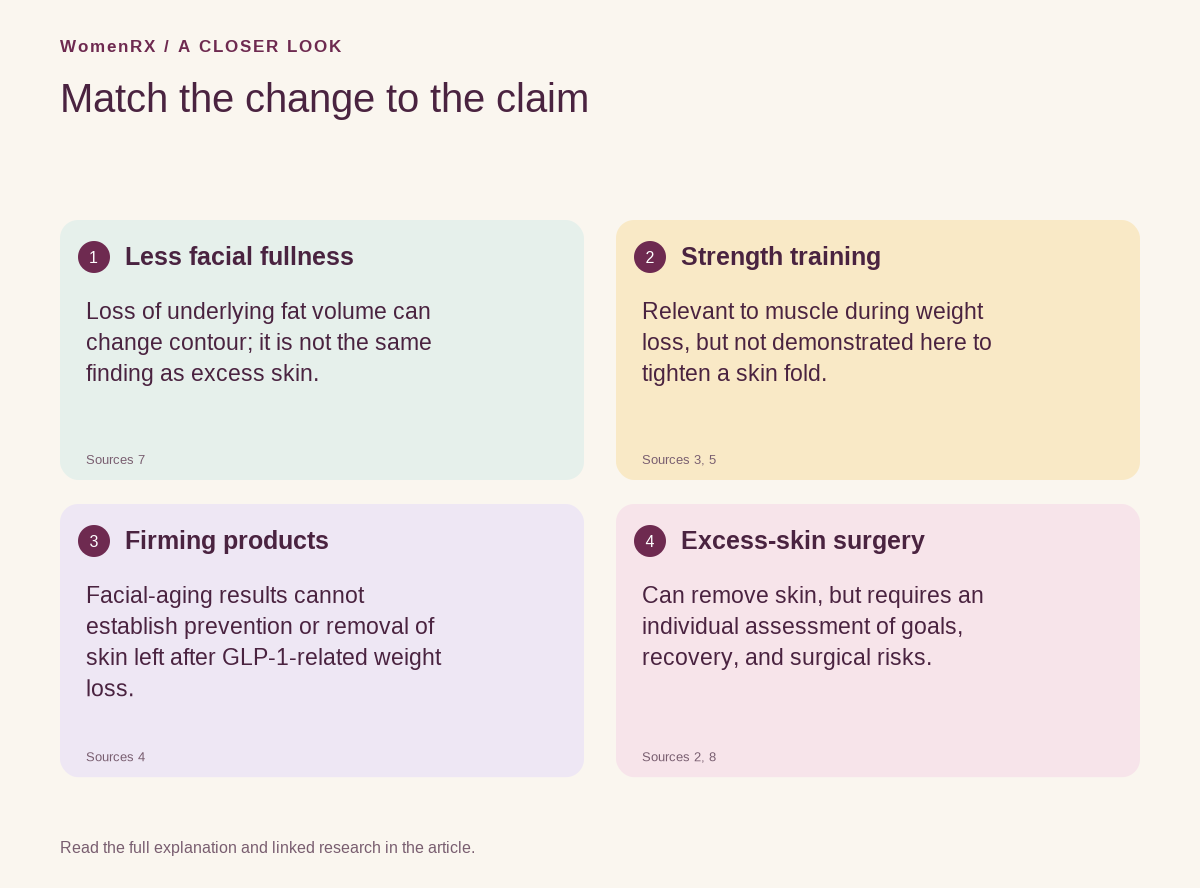
Match the change to the claim
Less facial fullness: Loss of underlying fat volume can change contour; it is not the same finding as excess skin.7
Strength training: Relevant to muscle during weight loss, but not demonstrated here to tighten a skin fold.35
Firming products: Facial-aging results cannot establish prevention or removal of skin left after GLP-1-related weight loss.4
Excess-skin surgery: Can remove skin, but requires an individual assessment of goals, recovery, and surgical risks.28
Read the figure as text
Similar-looking changes may involve different tissues, and evidence for one option does not prove it works for another.- Less facial fullness: Loss of underlying fat volume can change contour; it is not the same finding as excess skin.7
- Strength training: Relevant to muscle during weight loss, but not demonstrated here to tighten a skin fold.35
- Firming products: Facial-aging results cannot establish prevention or removal of skin left after GLP-1-related weight loss.4
- Excess-skin surgery: Can remove skin, but requires an individual assessment of goals, recovery, and surgical risks.28
More questions, answered
Does everyone who loses substantial weight develop excess skin?
No individual prediction follows from these studies. The amount of weight lost and age-related skin properties can influence appearance. Research describing laxity after substantial weight loss, often in bariatric populations, does not establish who will develop excess skin during GLP-1 treatment. 567
Sources you can check
- Dietary Supplements for Weight Loss - Health Professional Fact SheetAccessed 2026-09-25Return to first citation
- Surgery: MedlinePlusAccessed 2026-09-25Return to first citation
- Body Weight: MedlinePlusAccessed 2026-09-25Return to first citation
- A Novel Cosmetic Anti-inflammatory Peptide With Firming and Lifting Benefits: The Potential for Adjunctive Care for Skin Laxity Associated With Weight Loss.Lisante TA, Green B, Hubert K, Parsa R, Patel Shah A, Shuja Z, Sylianteg G. · Dermatologic surgery : official publication for American Society for Dermatologic Surgery [et al.] · 2026Return to first citation
- Managing Aesthetic Needs in Prescription Medication-Driven Rapid Weight Loss Patients: Results of an International Consensus. The Clinician Perspective.Nikolis A, Somenek MT, Dayan S, Cartier H, Fabi SG, Avelar L, Franco J, Frank K, Haddad A, Alsufyani MA, Huang J, Prygova I, Safran T. · Journal of cosmetic dermatology · 2026Return to first citation
- Reshaping the Postbariatric Breast: A Single-center Experience With the Dermal Suspension Parenchymal Reshaping Mastopexy Technique.Massarwa S, Rittblat M, Tzur T, Margulis A, Amar D. · Plastic and reconstructive surgery. Global open · 2026Return to first citation
- Soft Tissue Facial Changes Following Massive Weight Loss Secondary to Medical and Surgical Bariatric Interventions: A Systematic Review.Jafar AB, Jacob J, Kao WK, Ho T. · Aesthetic surgery journal. Open forum · 2024Return to first citation
- Bariatric Surgery Before Abdominoplasty Is Associated with Increased Perioperative Anemia, Hemoglobin Loss and Drainage Fluid Volume: Analysis of 505 Body Contouring Procedures.Flores T, Schön J, Glisic C, Pfoser K, Kerschbaumer C, Mayrl MS, Schrögendorfer KF, Bergmeister KD. · Journal of clinical medicine · 2025Return to first citation