Loose Skin After Weight Loss on Ozempic: What Affects It?
After substantial weight loss, changes in body volume and skin can leave loose tissue, but reports of this change don’t isolate an effect of semaglutide itself.
Loose skin can appear after substantial weight loss, including weight loss while taking Ozempic. Reports of sagging after GLP-1-associated weight loss don’t show whether semaglutide has an independent effect on skin. What helps depends on the change you’re seeing: skin care may improve skin quality, facial treatments address volume or contour, and surgery can remove substantial excess body skin. 1 2 3 4
Why skin can remain after weight loss
Skin and the tissue beneath it form an envelope around your body. When body volume decreases substantially, that envelope may not fully conform to the new shape. After major weight loss, excess tissue can involve several areas, not just the abdomen. 3
That can happen during weight loss on Ozempic, but the timing doesn’t tell you that semaglutide itself caused the loose skin. A survey of clinicians describes concerns they see after GLP-1-associated weight loss, while reviews discuss changes in body fat and skin. Those reports don’t separate a direct medicine effect from the effects of weight loss. 1 2 4
What affects the picture, and what’s harder to predict
The extent and location of change matter. A loose fold on the abdomen is different from reduced fullness in the face. Body-contouring research describes excess skin across the abdomen, flanks, back, and other regions after major weight loss. Where the tissue sits affects which options could address it. 2 3
Skin characteristics matter to the concern you’re trying to address. A change in texture or firmness isn’t the same as a substantial amount of extra skin. Research on people seeking body contouring after major weight loss describes differences in skin tissue, but it doesn’t offer a way to predict your result from a single skin characteristic. 1 3
Pace and age aren’t simple forecasts. Rapid weight loss features in discussions of skin and facial changes, and facial aging can affect how a loss of volume looks. That doesn’t establish that slowing weight loss now will prevent loose skin, or tell you how much skin will tighten based on your age. 1 2
Pregnancy can add another question about abdominal shape. Loose outer skin and rectus diastasis, a widening of connective tissue between the abdominal muscles, are distinct changes. If your concern is a bulge as well as loose skin, it’s worth distinguishing the two because an approach to excess skin alone may not address the abdominal wall. 3
Choose an option for the change you want to address
For skin quality: Some topical formulations have been studied for improvements in skin appearance and laxity. That’s different from removing a substantial fold of excess skin. There isn’t a basis here for recommending a particular cream or promising how much it will change your skin. 1 3
For facial hollowing: Loss of facial volume can make contours look different even when excess skin isn’t the main concern. Fillers and collagen-stimulating treatments are discussed as approaches to facial volume and tissue quality; they aren’t substitutes for removing excess skin elsewhere on the body. 2 3
For a substantial fold of body skin: Body-contouring surgery can remove excess tissue. The operation depends on where that tissue is and, for abdominal concerns, whether the abdominal wall also needs evaluation. It involves scars and surgical risks, so there isn’t one best procedure for every pattern of loose skin. 3
Before comparing treatments, put the change into words: Is it texture, a loss of facial fullness, an overhanging fold, or a bulge beneath loose abdominal skin? You may notice more than one. Separating them makes it easier to judge what an option could realistically change. 2 3
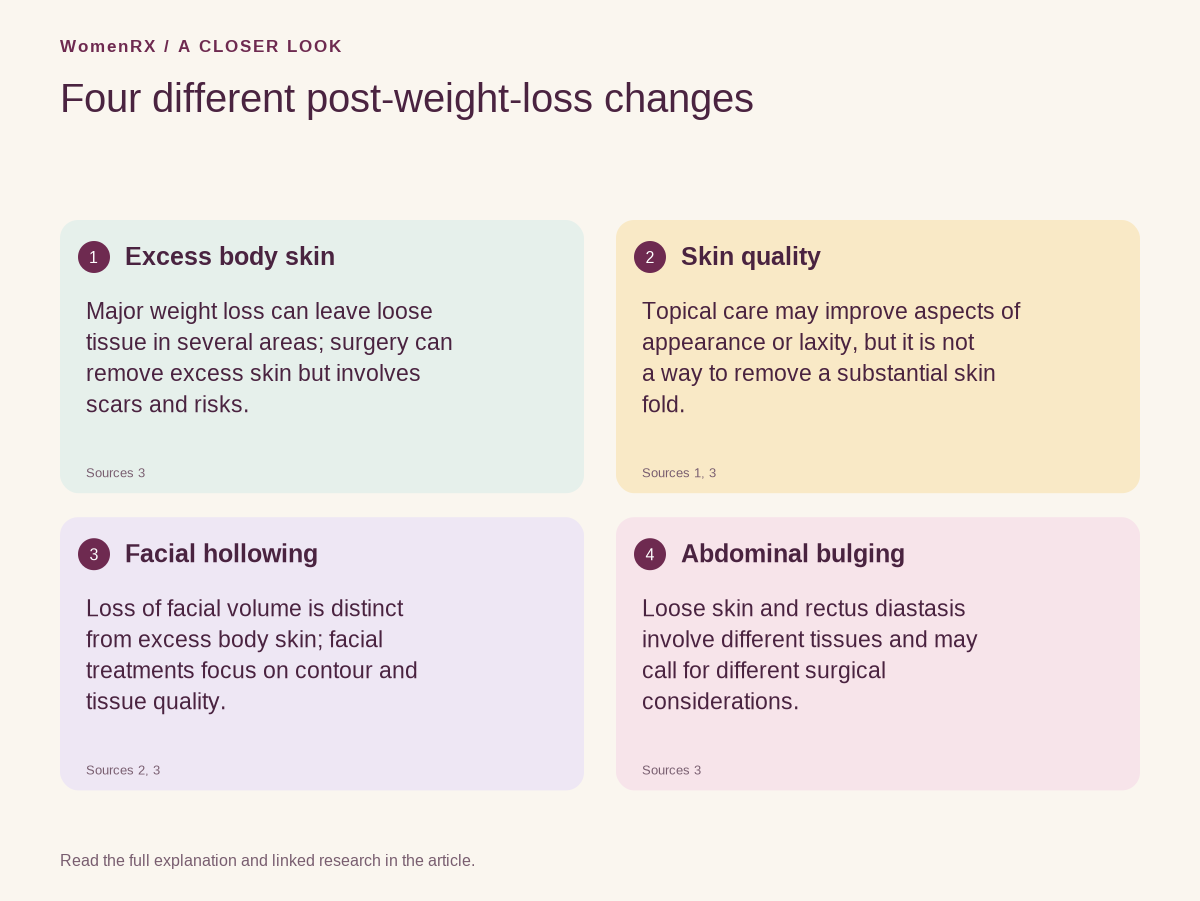
Four different post-weight-loss changes
Excess body skin: Major weight loss can leave loose tissue in several areas; surgery can remove excess skin but involves scars and risks.3
Skin quality: Topical care may improve aspects of appearance or laxity, but it is not a way to remove a substantial skin fold.13
Facial hollowing: Loss of facial volume is distinct from excess body skin; facial treatments focus on contour and tissue quality.23
Abdominal bulging: Loose skin and rectus diastasis involve different tissues and may call for different surgical considerations.3
Read the figure as text
The visible change is a better starting point for comparing options than the medicine name alone.- Excess body skin: Major weight loss can leave loose tissue in several areas; surgery can remove excess skin but involves scars and risks.3
- Skin quality: Topical care may improve aspects of appearance or laxity, but it is not a way to remove a substantial skin fold.13
- Facial hollowing: Loss of facial volume is distinct from excess body skin; facial treatments focus on contour and tissue quality.23
- Abdominal bulging: Loose skin and rectus diastasis involve different tissues and may call for different surgical considerations.3
More questions, answered
Does loose skin after pregnancy mean I have diastasis recti?
No. Loose skin involves the outer tissue; diastasis recti involves widening of connective tissue between the abdominal muscles. They can occur together, but loose skin alone doesn’t establish that you have diastasis recti. 3
Sources you can check
- The Potential Role of Topical Skincare Approaches After Glucagon-like Peptide-1 Receptor Agonist Use and Rapid Weight Loss.Shridharani SM, Kourosh AS, Saltzman E, Carver L, Makino ET, Cheng T, Maitra P. · Dermatologic surgery : official publication for American Society for Dermatologic Surgery [et al.] · 2026Return to first citation
- GLP-1-Induced Weight Loss and the Face: Anatomical Mechanisms and Rationale for Collagen-Stimulating and Volumizing Aesthetic Treatments.Frank K, Guertler A, Hoffmeister V, Kohler L, Nikolis A, Prantl L, Pupo D, Moellhoff N, Hopf M, Heiland M, Alfertshofer M. · Dermatologic surgery : official publication for American Society for Dermatologic Surgery [et al.] · 2026Return to first citation
- Superficial Abdominal Skin Laxity Versus Rectus Diastasis: Distinct Pathophysiological Entities With Different Functional and Reconstructive Implications in Modern Abdominoplasty.Victor Baldin A, Bautista Perez IJ, Padilla Sierra MG, Briceño-Suárez M. · Cureus · 2026Return to first citation
- Aesthetic Concerns and Nonsurgical Treatment Trends in Patients With GLP-1 Agonist-Associated Weight Loss.Fabi S, Yoo J, Kaufman-Janette J, Dayan S, Boyd C, Sangha S, Ashourian N. · Dermatologic surgery : official publication for American Society for Dermatologic Surgery [et al.] · 2026Return to first citation