Loose Skin After Weight Loss on Zepbound
Loose skin can follow substantial weight loss, but current research can’t separate the effect of tirzepatide from the weight loss that happens while taking it.
Zepbound (tirzepatide) is associated with weight loss, and loose skin has been reported by people losing weight on GLP-1 medicines. But available research doesn’t show that tirzepatide itself directly causes skin laxity: people who lost more weight reported sagging more often, and the studies can’t cleanly separate medication effects from weight-loss effects. Skin elasticity and lost tissue volume also matter. 2 3 4
Why skin may look looser after weight loss
As body fat decreases, the volume supporting the skin decreases too. Skin may not adapt fully to that change, leaving folds or sagging. Changes in collagen, elastin, and the layer of fat beneath the skin can also affect how it looks. These changes may show up in different places, including the face, arms, abdomen, or thighs. 4
That doesn’t mean loose skin is inevitable, or that it reflects a personal failure. The appearance varies, and a number on the scale can’t tell you how your skin will respond.
What research says about Zepbound and skin
Zepbound contains tirzepatide, a medicine used for weight management. 2 A 2026 voluntary survey of 1,226 people receiving medication-based weight management found that reported skin sagging was more common in groups reporting greater weight loss: 57 of 380 people who lost less than 10% of their body weight (15%), 172 of 395 who lost 10-20% (44%), and 233 of 325 who lost more than 20% (72%). These are survey responses, not estimates of what will happen to everyone taking Zepbound. 3
The survey included people using different medication regimens, and its authors noted that greater weight loss often occurred among GLP-1 medicine users. It can show an association, but it can’t establish whether the medicine itself, the amount of weight lost, or other differences between people explain skin changes. A separate survey analysis also found that concerns about appearance were more common with greater weight loss, but did not capture the rate of weight loss. 3 4
So, if you notice sagging while taking tirzepatide, the most accurate answer is not “the drug caused it” or “the drug had nothing to do with it.” The change may be related to weight and volume loss during treatment, but research hasn’t isolated a direct effect of tirzepatide on skin laxity.
Your history matters, but don’t assume a prediction
The research summarized here doesn’t establish whether pregnancy history, menopause, or being a woman independently predicts loose skin after weight loss. One study included mostly women, but did not report findings that answer those questions. Your past weight changes and personal circumstances can still be useful context when discussing what you’re noticing, without treating them as a reliable forecast. 4
What you can discuss before choosing an option
If loose skin bothers you, first separate the concerns: Is it mainly a change in facial volume, skin folds, or both? Are you looking for help with appearance, comfort, or a practical issue such as skin that gets in the way? Those distinctions can help make a conversation about options more specific.
For changes in your weight-management plan: Talk with the clinician managing your treatment about your goals and how you’re feeling. A study of patient-reported effects proposed a broader approach that includes nutrition and preserving strength, but it did not prove that these steps prevent loose skin. 4
For facial changes: A small 12-week study of 25 people taking GLP-1 medicines tested one particular topical regimen alongside an ultrasound procedure. Its results are preliminary and don’t show that creams or procedures generally tighten skin after weight loss. 6
For procedures: A systematic review of facial changes after major weight loss found a limited body of research on facial rejuvenation options. Results from small groups or specific procedures shouldn’t be treated as a guaranteed outcome for you, or as evidence about every body area. If you’re considering surgery, ask about likely benefits, recovery, and possible complications for the procedure being discussed. 5 1
Be wary of promises that a supplement, cream, workout, or procedure will reliably remove excess skin or restore your previous appearance. Ask what evidence applies to your specific concern, what a treatment can and cannot change, and what tradeoffs it carries. The best next step depends on what you want help with, not simply on which medicine you take.
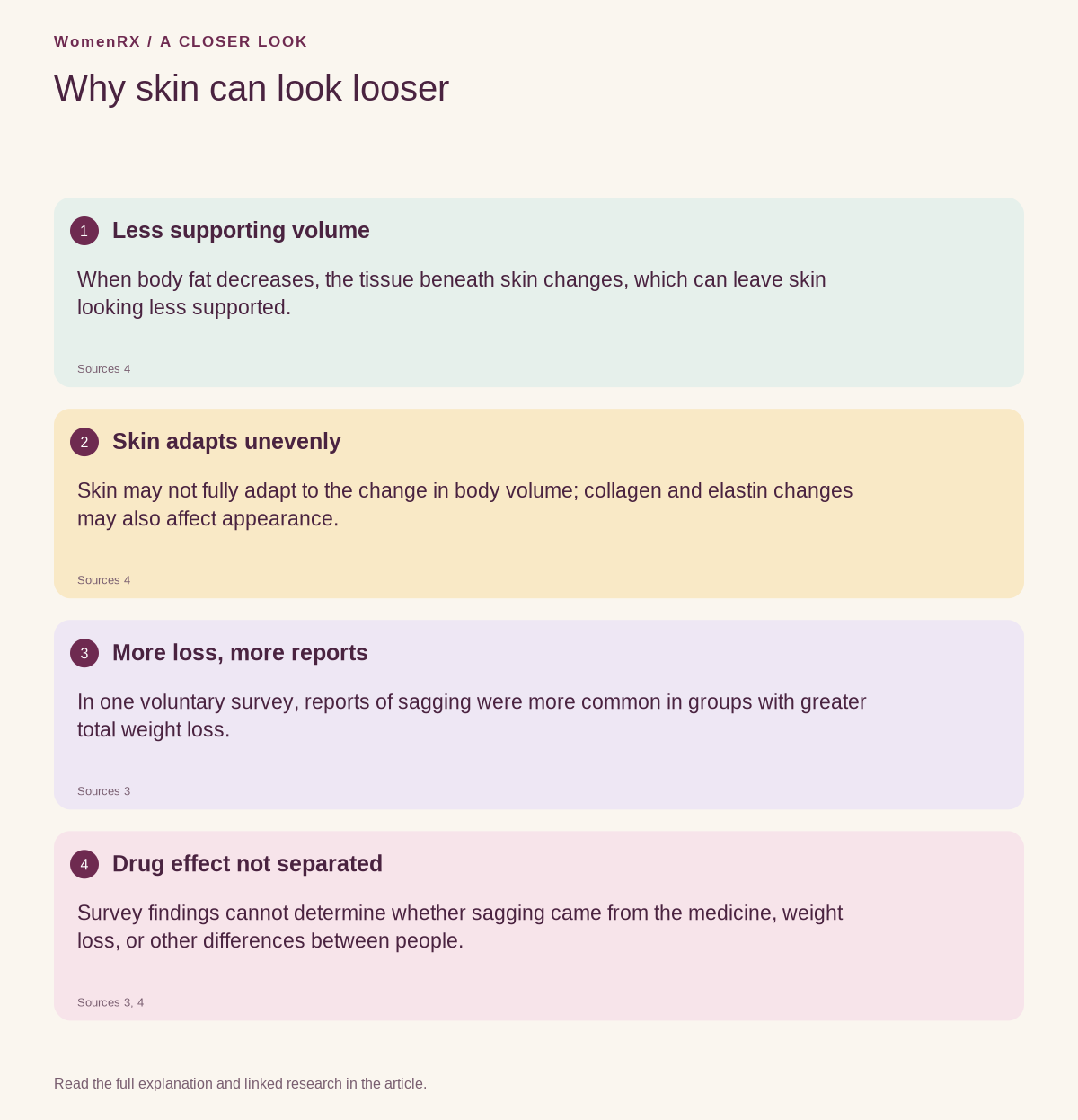
Why skin can look looser
Less supporting volume: When body fat decreases, the tissue beneath skin changes, which can leave skin looking less supported.4
Skin adapts unevenly: Skin may not fully adapt to the change in body volume; collagen and elastin changes may also affect appearance.4
More loss, more reports: In one voluntary survey, reports of sagging were more common in groups with greater total weight loss.3
Drug effect not separated: Survey findings cannot determine whether sagging came from the medicine, weight loss, or other differences between people.34
Read the figure as text
Weight loss changes body volume; the appearance of skin laxity can reflect several connected changes, not simply the medicine used.- Less supporting volume: When body fat decreases, the tissue beneath skin changes, which can leave skin looking less supported.4
- Skin adapts unevenly: Skin may not fully adapt to the change in body volume; collagen and elastin changes may also affect appearance.4
- More loss, more reports: In one voluntary survey, reports of sagging were more common in groups with greater total weight loss.3
- Drug effect not separated: Survey findings cannot determine whether sagging came from the medicine, weight loss, or other differences between people.34
More questions, answered
Does losing weight faster cause more loose skin?
The studies summarized here don’t establish that faster weight loss causes more skin laxity. One survey found more reported sagging in groups with greater total weight loss, but it did not measure the rate of weight loss. 3 4
Does exercise tighten loose skin?
The survey-based research does not establish that exercise tightens excess skin. One study proposed preserving strength as part of broader weight management, but it did not test exercise as a way to prevent or reverse skin laxity. 4
Sources you can check
- After Surgery: MedlinePlusAccessed 2026-09-25Return to first citation
- ZEPBOUND (TIRZEPATIDE) INJECTION, SOLUTION ZEPBOUND (TIRZEPATIDE) INJECTION, SOLUTION ZEPBOUND KWIKPEN (TIRZEPATIDE) INJECTION, SOLUTION [ELI LILLY AND COMPANY] | US prescribing information and patient instructionsAccessed 2026-09-25Return to first citation
- Skin Impacts and Tradeoffs of GLP-1 Therapy: Improved Patient-Reported Outcomes of Inflammatory Skin Disease in the Era of "Ozempic Face".Rao S, Midura I, Mangual KPS, Igel LI, Saunders KH, Carter J, Murase JE, Kourosh AS. · Dermatology and therapy · 2026Return to first citation
- Aesthetic, muscle, and dermatologic effects of medical weight management: patient-reported outcomes shape a holistic preventive procedural approach.Santiago Mangual KP, Midura I, Patin E, Rao S, Igel LI, Saunders KH, Carter J, Kourosh AS. · International journal of women's dermatology · 2026Return to first citation
- Soft Tissue Facial Changes Following Massive Weight Loss Secondary to Medical and Surgical Bariatric Interventions: A Systematic Review.Jafar AB, Jacob J, Kao WK, Ho T. · Aesthetic surgery journal. Open forum · 2024Return to first citation
- Clinical Efficacy of a Flavo-Proxylane Topical Regimen Pre- and Post-ultrasound Procedure for Subjects Undergoing Glucagon-Like Peptide 1 (GLP-1) Receptor Agonist Therapy.Moradi A, Kim JH, Kim JM, Choudhary HN, Brieva PM. · Dermatology and therapy · 2026Return to first citation